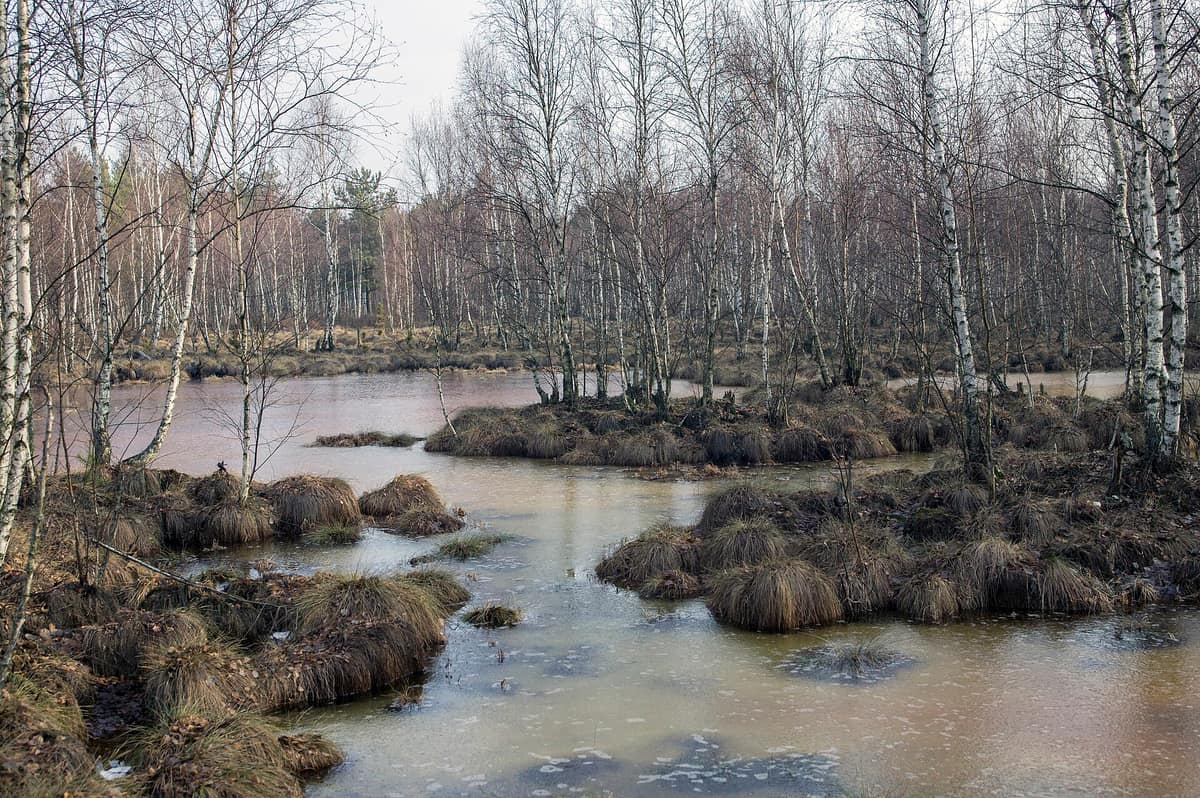
Biebrza National Park
Biebrzański Park Narodowy
Podlaskie Voivodeship (Osowiec-Twierdza) · Poland
Photo: Jerzy Strzelecki · CC BY-SA 3.0 · Wikimedia Commons
Poland’s largest national park and Central Europe’s greatest valley mire and wetland wilderness complex.
In spring the Biebrza overflows its banks, transforming a valley roughly one hundred kilometres long into a shallow inland sea of water, reed beds, and peat. This is the defining image of Biebrza National Park: the vastest valley mires in Poland, unfurling along an unhurried, meandering lowland river that forms one of the largest pristine wetland wildernesses in the European Union. It is also the largest of Poland's national parks.
The idea of protecting this water world has deep roots. Between the two world wars, two early nature reserves were established at Czerwone Bagno and Grzędy, and in 1995 the entire wetland expanse was designated as a Ramsar Wetland of International Importance.
What makes it unique
Poland’s premier stronghold for moose and breeding ground for an emblematic wader that graces the park emblem: the ruff.
The place
Nature
The landscape
The Biebrza is an archetypal lowland river with lazy loops, meandering bends, and an unhurried current, with almost its entire course, some 155 km, flowing inside the national park. That gentle gradient explains everything: water spreads widely, stands in shallow pools, and sustains an uninterrupted mosaic of wetland communities. There are open channels, sluggish backwaters, fens, expansive reed swamps, and wet riparian woodlands of black alder and downy birch where the ground stays waterlogged.
The most precious habitats are the moss-rich low bogs, which harbour rare boreal relics like the dwarf birch that have vanished from the rest of the country. Notable orchids include early marsh-orchid (storczyk krwisty) and lady's-slipper (obuwik pospolity); sundews feature the great sundew (rosiczka długolistna). In the heart of it all lies the strictly protected sanctuary of Czerwone Bagno, the Red Bog.
Wildlife and seasons
Here ecological statistics reflect sheer abundance. Observers have recorded 291 bird species, with 195 breeding within the park boundaries. Boreal rarities, taiga specialists, and tundra birds nest in isolated outposts, making this one of Central Europe's critical breeding havens for waders that depend on uninterrupted swathes of wet ground. Iconic breeders include the ruff, the globally threatened aquatic warbler, common crane, Eurasian eagle-owl, and the greater spotted eagle, for which the valley represents a sanctuary of European significance.
Among mammals, the moose reigns: the park serves as its foremost refuge in Poland, hosting roughly four hundred individuals. Sharing this vast wilderness are the Eurasian lynx, wolf, and Eurasian otter. Beneath these large species thrives an immense hidden world: more than 700 species of butterflies and moths and 448 species of spiders.
The natural calendar governs all activity. In spring, especially near Brzostowo and Chyliny, spectacular mass bird migrations unfold alongside the May floods. Autumn offers the park's other great season. Two periods also enforce seasonal trail closures: during bird breeding and during the rut of moose and red deer, certain walking, paddling, or equestrian routes may be closed temporarily.
Species
With a page in the atlas
Being mentioned in a source doesn't guarantee sightings: check with the people who manage the area.
Memory and protection
History and conservation
In April 2020, an illegal grass fire sparked a massive wildfire that consumed at least 6.000 hectares of peat grassland and forest; drought and low river levels prevented the usual spring floods from extinguishing the flames. The park also operates a wildlife rehabilitation centre, which takes in around 200 injured or orphaned wild animals annually across dozens of species to nurse them back to health and release them into the wild.
Before you set off
Visiting
How to visit
The natural gateway is Osowiec-Twierdza, where park headquarters are located within the nineteenth-century Osowiec Fortress complex. Here you will find visitor services, an exhibition centre, and a field education trail with a viewing tower and network of wooden boardwalks leading into the marsh.
To begin, walk the Kładka educational trail: about two kilometres with nine interpretive stops, and one of the few trails where leashed dogs are permitted. For a longer hike, the red trail at Grzędy covers 7 km across a historic dyke, sand dunes, and wetlands; it is easy walking, though often damp. Near the Grzędy forest lodge, a short spur leads to a raised boardwalk with informative panels in a bog pine forest. Between Gugny and Barwik, an adventurous trail crosses a viewing platform where you can witness the mating dance of the great snipe, continuing to a tower at Występ.
Altogether, the park lists 50 designated trails: for walking, cycling, canoeing, horseback riding, cross-country skiing, and nature education. For cycling, options include the gentle Wizna to Goniądz route spanning 64,3 km or the 20,5 km trail from Laskowiec to Tykocin along the Narew past traditional villages.
Before you go
Visits are permitted from one hour before sunrise until one hour after sunset. Camping, lighting fires, and smoking are allowed only at designated facilities. Dogs are restricted strictly to authorized trails, held on a short leash no longer than 1,5 m.
Trails often cross waterlogged stretches, and boardwalks, steps, and viewing towers become slippery when wet. Some routes, such as Osowiec-Twierdza to Kuligi or the path to Biały Grąd, can be very challenging or impassable during spring high water. Check park management notices before leaving: individual trails, towers, and river sections close temporarily.
Check access, rules and visiting conditions in the official information from the managing body before you set off.
Location
Where it is and how far it reaches
Boundary of Biebrzański Park Narodowy · © EEA, CDDA (CC-BY) The coordinate is estimated; it isn't a verified access point.
Transparency
Sources
The research data with its sources, and the official links for this place, are in the Spanish version of this page. See the Spanish version
Around it
The Augustów Primeval Forest lies only 5 km away; Narew National Park is 19 km distant, and the Knyszyn Forest Landscape Park is twenty-five kilometres away. Further afield, Soomaa National Park shares moose, lynx, and wolf with Biebrza, alongside expansive riverine wetlands.
Entry #167 of the original atlas.