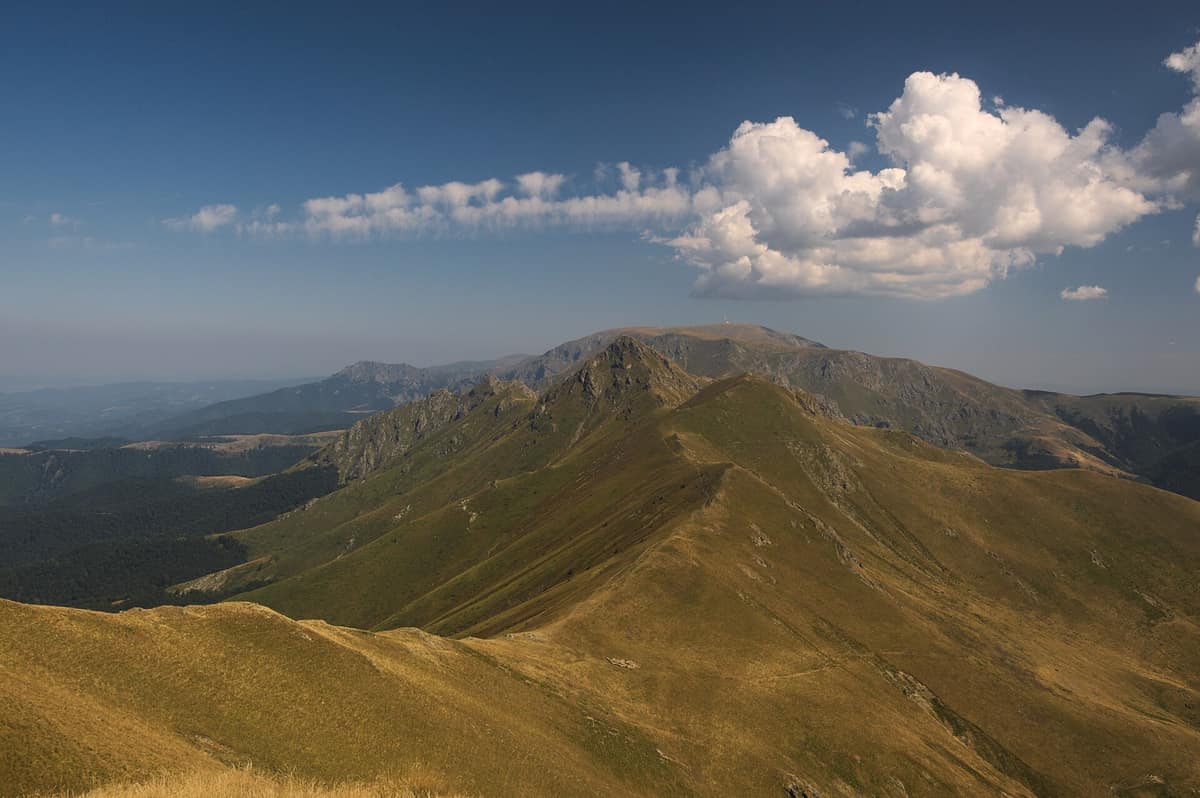
Central Balkan Primeval Beech Forests
Lovech, Plovdiv, Stara Zagora and Gabrovo Provinces · Bulgaria
Photo: Derbeth · CC BY 4.0 · Wikimedia Commons
Nine strict nature reserves protecting the largest contiguous tract of unmanaged ancient beech forest in the Balkans.
What you see here was planted by no human hand. Fully 97% of the forests of Central Balkan National Park are of natural origin, and 99% regenerated spontaneously from seed rather than plantation. The park drapes across the high central spine of Bulgaria's Balkan Mountains: 716.69 km² along an 85 km west-east ridge, with an average width of barely 10 km. Within its heart, nine strict nature reserves safeguard ancient beech forests inscribed on the UNESCO World Heritage list since 2017.
What makes it unique
Nine strict nature reserves harbour the largest unbroken mass of primeval beech forest in the Balkan Peninsula.
The place
Nature
The landscape
Altitude dictates almost everything: from 550 m near Karlovo up to 2,376 m at Botev Peak, the highest summit in the Balkan range. Between these extremes lie alpine meadows, sheer precipices, vertiginous cliffs, deep gorges, and leaping torrents, with some 20 peaks exceeding 2,000 m. Among the waterfalls are some of Bulgaria's tallest: Raiskoto Praskalo plunges 124.5 m, Vidimskoto 80 m, and Kademliyskoto 72 m.
Underground, the limestone dissolves into subterranean realms. Within the Steneto reserve lies Raichova Dupka, Bulgaria's second-deepest vertical pothole at 377 m, while prominent registered rock landmarks include Skalen Most, Markova Dupka, and Kalchovi Kamani.
The mountain climate is severe. On high ridges snowpack lingers for over six months, accumulating beyond 2 m in depth, and fog is notoriously thick. From that mantle of snow and mist springs vital water: the park feeds the Vit, Osam, and Rositsa rivers, flowing north toward the Danube.
The forest organizes into ecological belts. European beech reigns supreme between 900 and 1,600 m, with an average stand age of 135 years, representing over 7% of all beech woods in Bulgaria. Blending with Norway spruce, silver fir, hornbeam, and sessile oak, it blankets the park. In the Boatin reserve, spanning 800 to 1,750 m across 1,590.3 hectares, beech trees reaching 200 years of age and over 50 m in height are widespread. The average age of all forests across the park is 111 years, rising to 121 years for deciduous stands.
Wildlife and seasons
The park shelters 59 mammal species, 224 birds, 14 reptiles, 8 amphibians, and 6 fish. Among carnivores, 12 species occur: grey wolf, golden jackal, red fox, brown bear, Eurasian otter, European badger, and wildcat. The wildcat population here is considered the genetically purest not just in Bulgaria, but across the entire Balkan Peninsula. The brown bear population is the largest within any single protected area in Europe. Red deer, roe deer, and Balkan chamois listed in the Bulgarian Red Data Book inhabit all sectors in stable numbers.
For birds, scan the crags and skies. High alpine meadows support alpine accentor and wallcreeper; the golden eagle maintains a breeding population accounting for roughly 5% of Bulgaria's total, accompanied by eastern imperial eagles. In all, 224 bird species have been recorded, 123 of them breeding on site.
In the streams, the Balkan stream trout, vulnerable across Europe, thrives in nationally vital populations. On the high slopes, common European adders and viviparous lizards are frequent. Botanically, over half of Bulgaria's native flora is represented in the park, including 10 endemic species, alongside protected treasures like edelweiss.
Species
With a page in the atlas
Being mentioned in a source doesn't guarantee sightings: check with the people who manage the area.
Memory and protection
History and conservation
Central Balkan National Park was designated on 31 October 1991. Four of its nature reserves form part of the UNESCO World Network of Biosphere Reserves, and since 2017 the ancient beech stands of all nine reserves have been inscribed on the UNESCO World Heritage Primeval Beech Forests register. Park administration actively engages local communities, volunteers, and mountaineering clubs.
The park territory is zoned into five management tiers. The reserve zone, encompassing the nine strict reserves (Boatin, Tsarichina, Kozya Stena, Steneto, Stara Reka, Dzhendema, Severen Dzhendem, Peeshti Skali, and Sokolna), enjoys the strictest legal protection.
Before you set off
Visiting
How to visit
Hiking is the primary way to explore: more than 470 km of trails crisscross the park. The international E3 long-distance trail (Kom–Emine) follows the main Stara Planina ridge through the park, while another classic marked trail connects the Cordella hut with Danchova Polyana through the ancient Boatin reserve. Horseback riding and mountain biking routes are also designated, alongside specialist circuits for botanists and historic monuments.
To interpret what you encounter, the park maintains eco-trails, educational circuits, The Forest visitor complex, and the Vezhen information centre. Even within the strict nature reserves, designated trails permit transit for educational and hiking purposes.
Before you go
The most reliable weather occurs from June to October. Respect wildlife: park regulations emphasise that animals are entitled to peaceful habitat and outdoor leisure must not compromise their wellbeing. Mushroom foraging requires a prior permit issued by the park directorate.
Check access, rules and visiting conditions in the official information from the managing body before you set off.
Location
Where it is and how far it reaches
Boundary of Tsentralen Balkan · IUCN II · © EEA, CDDA (CC-BY) The coordinate is estimated; it isn't a verified access point.
Transparency
Sources
The research data with its sources, and the official links for this place, are in the Spanish version of this page. See the Spanish version
Entry #72 of the original atlas.