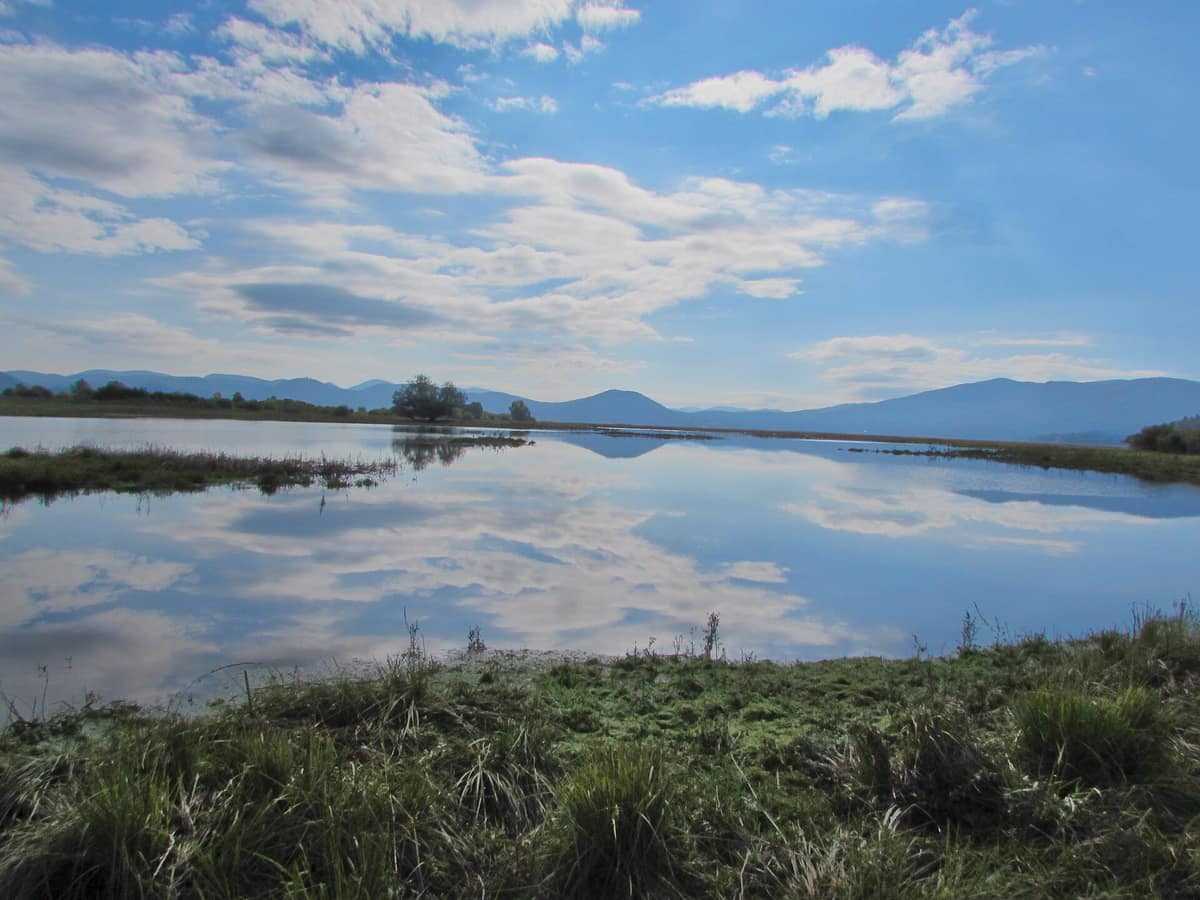
Lake Cerknica
Cerkniško Jezero
Inner Carniola (Cerknica) · Slovenia
Photo: Ajznponar · CC0 · Wikimedia Commons
Europe's largest intermittent lake, which fills and empties completely through underground karst sinkholes.
A lake that disappears. In Cerknica, in Inner Carniola, the plain fills with water after the rains and, when drought sets in, the lake empties completely, slips underground, and leaves behind meadows, sinkholes, and pools with trapped fish. It is one of Europe's largest intermittent lakes, and when full it is the largest in Slovenia. That is why, in the same year and in the very same spot, you can row, walk, or scythe grass.
What makes it unique
It is a lake that fills and empties like breathing, and each visit reveals a different landscape.
The place
Nature
The landscape
The lake appears each year in a polje, a karst plain tucked between the Javorniki hills and the Bloke plateau on one side, and Mount Slivnica on the other. Everything works by a single rule: the lake expands when more water comes in than goes out. A heavy autumn rain fills it in two or three days; in spring, snowmelt helps. Water arrives from below, from the Bloke and Vid plateaus, the Lož Valley, and the foot of the Javorniki hills, while the only surface tributary is the Cerkniščica stream.
The outflow is slower and entirely karstic. Without rain, the lake dries up in three or four weeks as water sinks through ponors, swallow holes, and estavelles. Part flows out through Jamski zaliv and re-emerges in the Rakov Škocjan valley as the Rak River; the rest runs straight to the springs of the Ljubljanica at the edge of the Ljubljana Marshes. Thus the lake drains into two separate catchments. It usually dries up in May or June, sometimes also in winter, and fills primarily after autumn rains and spring melt.
The calendar does not always dictate things. At times the lake does not vanish for several years, and once it stayed dry for over a year, in 1834–35.
The plain holds an archive of scientific history. Valvasor was the first to investigate its hydrology, which earned him fellowship in the Royal Society; from here karstology emerged, with terms like polje and intermittent lake. And European maps have recorded the lake since the fifteenth century.
Wildlife and seasons
The lake shifts its wildlife as its waters shift. Here 303 species of birds have been recorded, half of all European species, along with 45 mammals, half of Slovenia's total, and 125 butterflies. Among the birds, the white-tailed eagle and the black stork nest alongside the Eurasian bittern and the corncrake, among others.
Each season has its spectacle. In spring, wood sandpipers, ruffs, and snipes forage along the shore, and harriers hunt low over the plain. In summer, red-necked grebes dive at dawn, black storks arrive at the marsh by dusk, and on clear nights corncrakes call relentlessly. In autumn, the lake provides feeding grounds and refuge to migrating flocks of common cranes and thousands of waterfowl, while white-tailed eagles patrol above. To see them, the best time is shortly before sunrise and for two or three hours after, and shortly before sunset.
When the lake empties, the forest steps down into the plain. Bears, wildcats, and polecats forage on trapped fish in shallow pools, and Eurasian otters patrol the meanders. The fish themselves know how to wait: the burbot emerges from shade at dusk and, when the lake dries up, waits underground until the next flood. In winter, up to 20,000 common frogs can gather in a single cave—the largest such gathering in Europe—and in spring thousands of amphibians head to the lake to spawn.
Among plants, the damp meadows overflow with wild gladioli and orchids. Amphibious plants, such as flowering rush, have adapted to the drying cycles and thrive both in water and on land. There are 56 plant species on the Slovenian Red List and 2 species found nowhere else in Slovenia. There are also three carnivorous plants: intermediate bladderwort, common bladderwort, and oblong-leaved sundew.
Species
With a page in the atlas
Being mentioned in a source doesn't guarantee sightings: check with the people who manage the area.
Memory and protection
History and conservation
People have been drawn to the lake since the Stone Age for its wealth of fish and game. Those who scythe its floodplain meadows sustain, to this day, vital habitats for threatened flora and fauna.
The lake is a Natura 2000 site and a BirdLife Important Bird Area, and together with Rakov Škocjan valley and Križna Cave forms a Ramsar wetland. Notranjska Regional Park was established by the municipality of Cerknica in 2002.
Before you set off
Visiting
How to visit
The Lake Cerknica Visitor Centre is the best first stop: a 15-minute film and an interactive quiz explain how the lake formed, its geology, and its hydrology. In Dolenje Jezero, the Lake Museum features a working relief model of the plain and the subterranean water network, the drevak (the traditional lake boat), and an ethnographic park with over 100 exhibits, from historic fishing gear to antique skates and ice saws.
To explore on foot, the Drvošec trail covers 3.7 km one way, winding through the woods from the Rešeto ponors. It is marked by a bittern icon, and viewing platforms at Kuharca and Klejni vrh plus the 10-metre Otočec tower offer views of the entire karst phenomenon. The first, flat section is wheelchair accessible. Mount Slivnica is more demanding, with its bare summit accessible from the surrounding villages; below the peak lies Coprniška cave, where warm, humid air vents in winter and condenses into mist—sparking the local legend that witches dwelt within.
When water levels allow, canoeing is possible from April to September. For birdwatching, guided outings with an ornithologist depart from the museum's ornithology classroom.
Before you go
Water levels dictate everything: check the lake's condition at the Visitor Centre before visiting, as it determines what you can see and whether boating is permitted. Park regulations prohibit lighting fires, picking plants, and leaving marked trails. If you want to see a full lake, go in spring or autumn; if you prefer meadows and sinkholes, visit in the dry season.
Check access, rules and visiting conditions in the official information from the managing body before you set off.
Location
Where it is and how far it reaches
Boundary of Cerkniško jezero · © EEA, CDDA (CC-BY) The coordinate is estimated; it isn't a verified access point.
Transparency
Sources
The research data with its sources, and the official links for this place, are in the Spanish version of this page. See the Spanish version
Around it
Just 1 km away, the Javorniki Forest and Karst Plateau border the plain, and the Snežnik Forest Massif adjoins the lake directly at 0 km. About 10 km away lies the Nanos Karst Plateau; at 15 km, the Kočevsko Forest Complex; sixteen kilometres away, the Ljubljana Marsh Landscape Park, where the springs of the Ljubljanica emerge, fed in part by water from the lake; and twenty-seven kilometres away, the Škocjan Caves. The Classical Karst and Postojna-Planina Cave System overlaps directly.
Further away, Fertő-Hanság National Park shares with Cerknica the corncrake and lake and wetland habitats.
What else to explore nearby
Approximate straight-line distance between the edges of each area. It doesn't indicate access, routes or driving times.
- Javorniki Forests and Karst Plateau
Inner Carniola (Postojna / Cerknica)
About 1 km away
Forested karst plateau without continuous human settlements adjoining the intermittent lake of Cerknica.
JFMAMJJASONDMay – October · Crowding very low
If you like this place, elsewhere in Europe
Distant places with uncommon wildlife and habitats in common. The most widespread species don't count. Sharing species doesn't imply a corridor or guaranteed presence.
- Körös-Maros National Park
Southeastern Great Hungarian Plain (Békés / Csongrád-Csanád)
In common: Corn crake · White-tailed eagle
Mosaic of saline puszta grasslands, loess steppes, and riparian gallery forests harbouring Central Europe's premier great bustard stronghold.
JFMAMJJASONDApril – June · Crowding very low
Entry #157 of the original atlas.