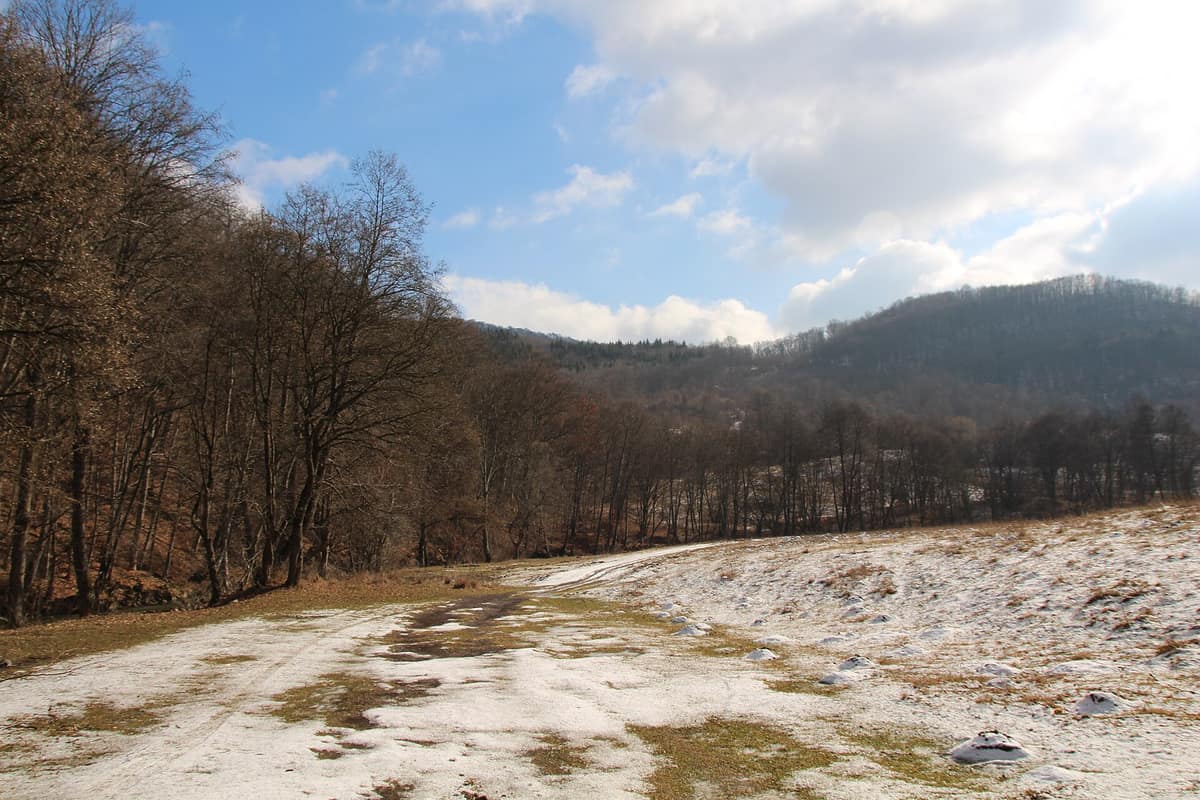
Vârghiș Gorge
Cheile Vârghișului
Harghita and Covasna Counties (Baraolt / Vârghiș) · Romania
Photo: MARIUS PASCU · CC BY 3.0 · Wikimedia Commons
Limestone gorge reserve with over 120 caves of major chiropterological importance (Peștera Merești).
A stream, four kilometres of rock, and more than a hundred caves. That is Cheile Vârghișului: a gorge carved by water into Jurassic limestones in the southern group of the Eastern Carpathians, within the Perșani Mountains. It stretches between Vârghiș in Covasna County and Merești in Harghita County, and you explore it on foot, tracing the stream bed amidst the cliffs and caverns.
What makes it unique
A four-kilometre karst canyon with nearly 130 caves and the largest, Peștera Balázs Orbán, home to bats and bears protected at European level.
The place
Nature
The landscape
The gorge formed within Jurassic limestones and spans four kilometres. The walking trail follows the stream course among the caves—a pure nature adventure. There are close to 130 caves, four of them open to the public; another tourism site counts 124, citing Peștera Balázs Orbán as the largest in the complex.
The protected area belongs to the alpine ecoregion of the northern Perșani Mountains and encompasses seven natural habitat types. These include calcareous rocky slopes with chasmophytic vegetation, caves not exploited for tourism, and Luzulo-Fagetum beech forests.
Wildlife and seasons
The site was designated for 17 fauna species protected at European scale or listed on the IUCN Red List. Mammals include the brown bear, the Eurasian otter, and several bats: the barbastelle, the greater mouse-eared bat, and the greater horseshoe bat, along with the lesser horseshoe bat. Invertebrates include the water beetle Carabus variolosus, the flat bark beetle Cucujus cinnaberinus, the Transylvanian bush-cricket, and the rosalia longicorn.
Species
With a page in the atlas
Being mentioned in a source doesn't guarantee sightings: check with the people who manage the area.
Memory and protection
History and conservation
The gorge and its caves form an IUCN Category IV national protected area covering 800 hectares, overlapping with Natura 2000. The Site of Community Importance (ROSCI0036) was designated in December 2007 and became a Special Area of Conservation in June 2022. It spans 866.5 hectares, entirely terrestrial, encompassing the nature reserve and the gorge caves. It was established to protect biodiversity and preserve wild flora, fauna, and habitats of Community interest in favourable conservation status.
Before you set off
Visiting
How to visit
The trail along the stream is best from May to October with light hiking gear and a torch. The four open caves cannot be visited without appropriate equipment: helmet, headlamp, and sturdy hiking shoes or rubber boots.
Access is from Miercurea Ciuc via the DN13A to Vlăhița and then along the DJ132 towards Lueta and Merești; or from Baraolt via Tălișoara to the village of Vârghiș.
Before you go
The caves require appropriate gear; check access conditions with the site administrator or the county tourism portal before heading out.
Check access, rules and visiting conditions in the official information from the managing body before you set off.
Location
Where it is and how far it reaches
Boundary of Cheile Vârghișului și peșterile din chei · IUCN IV · © EEA, CDDA (CC-BY) The coordinate is estimated; it isn't a verified access point.
Transparency
Sources
The research data with its sources, and the official links for this place, are in the Spanish version of this page. See the Spanish version
Around it
In the atlas it has no immediate neighbours, but it shares the greater mouse-eared bat and brown bear with other gorges: Buila-Vânturarița National Park - Bistrița Gorge, Kvačianska and Prosiecka Valleys NNR, and Jiu Gorge National Park - Ancient Forests. With Škocjan Caves it shares the greater mouse-eared bat and a striking karst landscape.
Entry #392 of the original atlas.