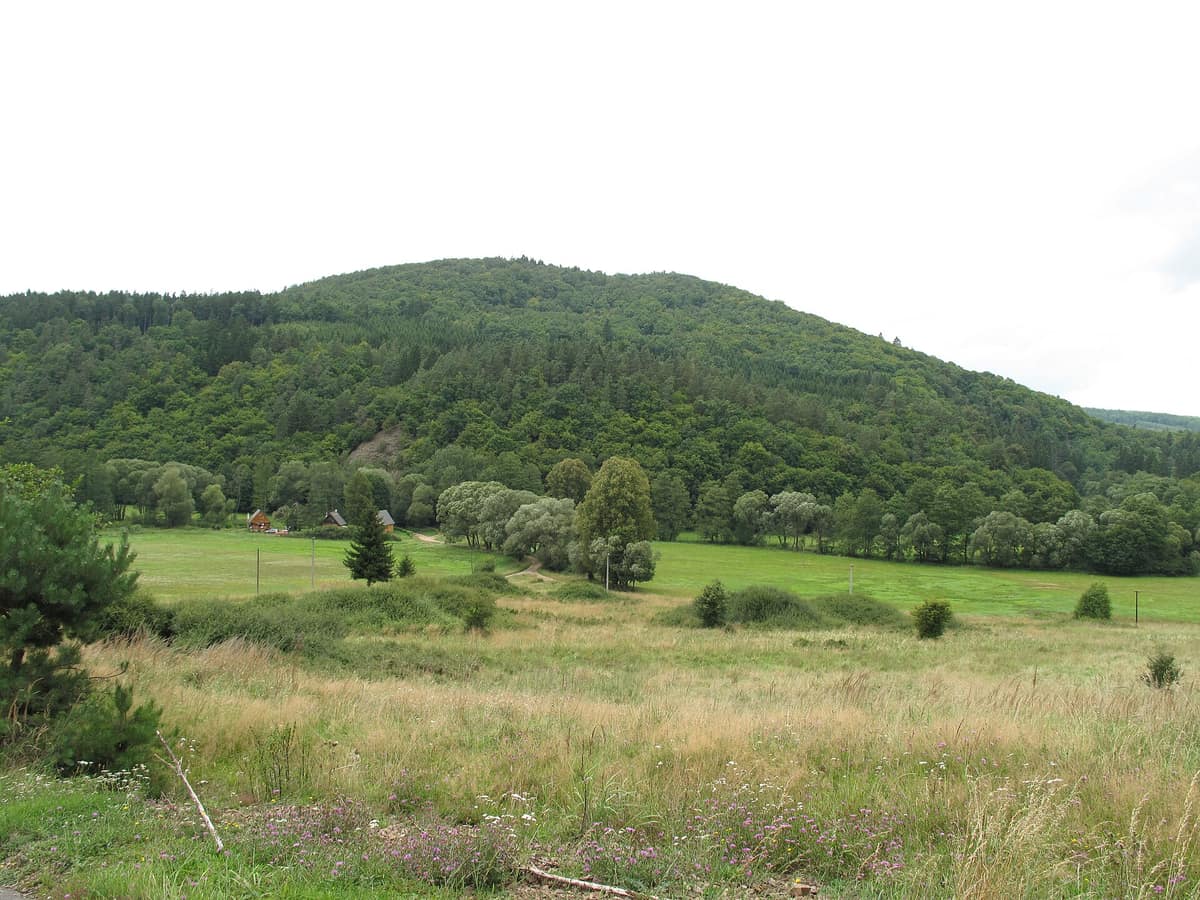
Křivoklátsko Protected Landscape Area
Chráněná krajinná oblast Křivoklátsko
Central Bohemia (Beroun / Rakovník) · Czechia
Photo: Juandev · CC BY-SA 3.0 · Wikimedia Commons
Exceptional mosaic of oak and beech forests draping the winding canyon gorges of the Berounka River.
Before it became a protected landscape, this was royal hunting domain. From the early Middle Ages Křivoklátsko was preserved deliberately as a sovereign hunting forest, shielding vast contiguous canopies while much of Bohemia was cleared and turned by the plough. Today the legacy is a magnificent deciduous heartland in Central Bohemia, carved deeply by the meandering Berounka canyon with precipitous screes and open hilltop clearings hosting steppe flora. The statistics reveal its ecological caliber: woodlands cover 62 % of the territory, far exceeding national averages, and over 1800 vascular plant taxa have been documented.
What makes it unique
A former royal hunting preserve that still shelters yew woodlands, Cambrian trilobites, and miniature steppe enclaves along rocky crests.
The place
Nature
The landscape
Two geological dynamics govern the landscape. The first is fluvial incision: the Berounka River has gouged a deep winding canyon flanked by rocky talus and terraced meanders. The second is the presence of unwooded summit bald spots called pleše, where dry grasses and xerothermic steppe shrubs thrive. Between these extremes flourishes diverse deciduous woodland: thermophilous oakwoods, oak-hornbeam, mountain beechwoods, and native yews.
Bedrock explains this richness. During the Cambrian period ancient seas reached modern Skryje, laying down fossiliferous shales packed with trilobites, brachiopods, and echinoderms. Precipitation is slightly lower than national means, shadowed by the Ore Mountains.
Vegetation faithfully maps geology. On scree slopes before trees leaf out, spring snowflakes and wood anemones spread dense flower carpets. Up on exposed rocky bluffs thrive stunted oaks and steppe plants like Dictamnus albus and Pulsatilla pratensis. The agency even maintains a live «Co tu kvete?» seasonal flowering bulletin to help visitors choose excursion dates.
Wildlife and seasons
Habitat diversity generates extraordinary faunal abundance. Records document 120 breeding bird species and 35 migratory passage species, 60 mammals, 8 reptiles, 12 amphibians, 750 butterflies, and 1500 beetles.
For birds, scan crags and then forest canopies. Bare rocky bastions accommodate the Eurasian eagle-owl and common kestrel. Mature mixed oak-beech stands shelter the red kite, European honey buzzard, northern goshawk, and black woodpecker. The reserve forms a vital breeding area for the black stork, while small nocturnal owls include the Eurasian pygmy owlet (kulíšek nejmenší) and rare boreal owls. River corridors attract passing ospreys, the common kingfisher, and white-throated dipper; the white-tailed eagle is an occasional breeder.
Mammals are dominated by red deer, the primary forest ungulate, alongside plentiful roe deer and wild boar. Fire salamanders frequent headwater springs, while deadwood stands support the stag beetle, Central Europe's largest coleopteran. River shoals harbor thick-shelled river mussels and stone crayfish.
Each reserve retains individual character: Týřov National Nature Reserve preserves ancient yews and rich insect faunas; Nezabudické skály crags shelter abundant reptiles; Kabečnice protects the critically endangered green-winged orchid (Anacamptis morio).
Species
With a page in the atlas
Being mentioned in a source doesn't guarantee sightings: check with the people who manage the area.
Memory and protection
History and conservation
Royal hunting tenure deliberately protected these vast woodlands from feudal forest clearing. Much earlier, Stradonice was the site of a celebrated late Iron Age Celtic oppidum of European prominence.
UNESCO designated Křivoklátsko a biosphere reserve in 1977 under the Man and the Biosphere programme, and the Natura 2000 network encompasses 16 Sites of Community Importance and a Special Protection Area. Invasive American mink and overabundant ungulate herds currently pose management challenges requiring controlled population culls.
Before you set off
Visiting
How to visit
The best approach is via educational nature trails. The Brdatka trail spans seven kilometres with 17 interpretive panels on forest ecology, geology, and wildlife, offering panoramic river views. A gentle 7.5 km walk links Zbečno to Křivoklát, partly tracing this path.
To explore the canyon, the Kaňonem Berounky za eremitem loop covers nearly 10 km through U Eremita and Nezabudické skály reserves from a central parking area; through U Eremita the footpath narrows along steep rock ledges and requires sure footwork. An arboretum path in U Eremita identifies thirty-five native tree and shrub species.
Paleontology enthusiasts should visit Skryje. The Po stopě trilobita trail starts at the museum, ending at the church with comic-strip panels, viewpoints, and a bridge fossil locality. The 10 km Okolí Skryj circuit links Jezírka pools, the Joachim Barrande Memorial, and Týřov castle ruins.
For paddlers, the 58 km Berounka water trail features 14 riverside information stops on local ecology and history from Zvíkovec downstream.
Before you go
The reserve regulations are unambiguous. Collecting fossils is strictly prohibited; to discover the palaeontological heritage, follow the Po stopě trilobita educational trail in Skryje. In the national nature reserves you must keep strictly to marked trails. Dogs must be kept on a leash to avoid disturbing wildlife, and bicycles are permitted only on marked paths and designated cycle routes. Consult the administration website before setting out for any current notices or seasonal restrictions.
Check access, rules and visiting conditions in the official information from the managing body before you set off.
Location
Where it is and how far it reaches
Boundary of Křivoklátsko · IUCN V · © EEA, CDDA (CC-BY) The coordinate is estimated; it isn't a verified access point.
Transparency
Sources
The research data with its sources, and the official links for this place, are in the Spanish version of this page. See the Spanish version
Entry #112 of the original atlas.