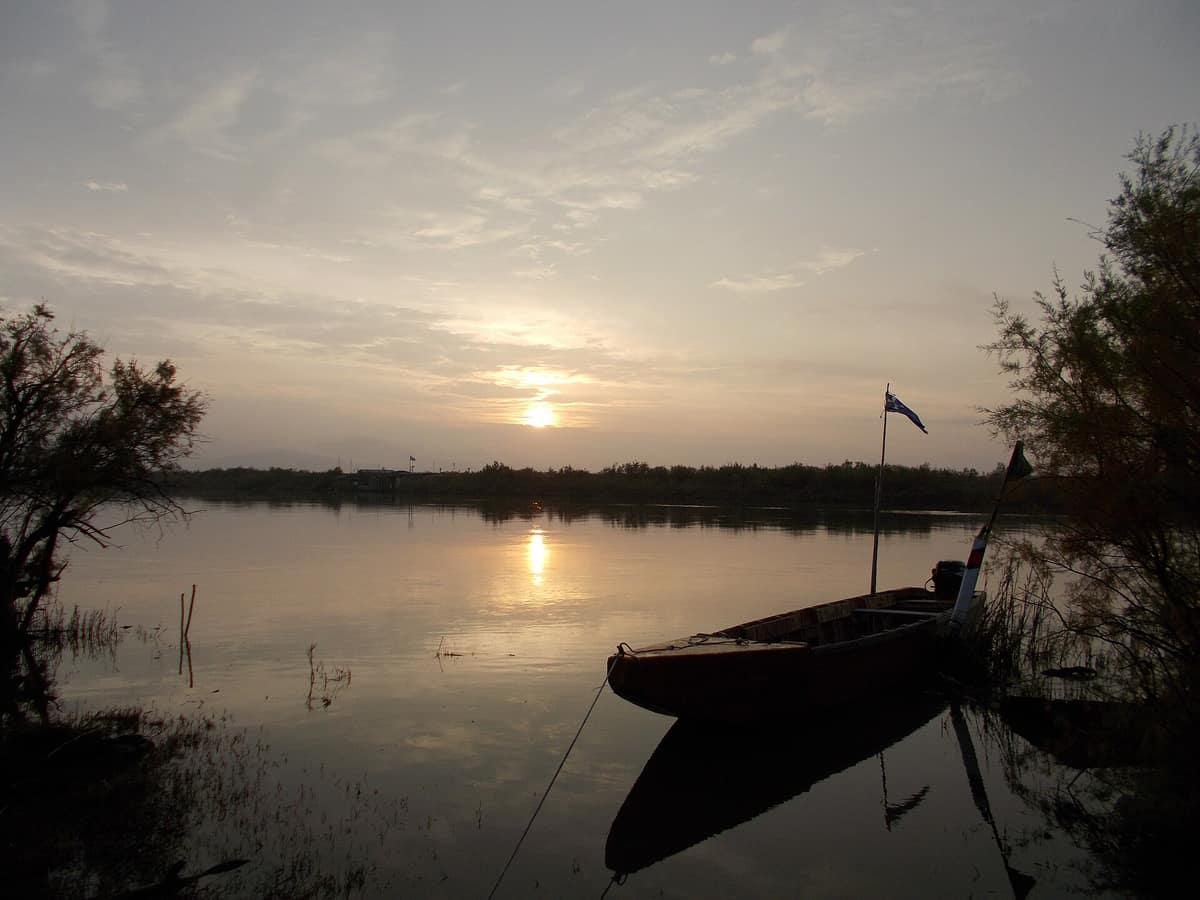
Evros Delta National Park
Εθνικό Πάρκο Δέλτα Έβρου
Thrace (Alexandroupoli / Feres) · Greece
Photo: Evrodelta · CC BY-SA 4.0 · Wikimedia Commons
The great delta on the Greek-Turkish border, one of Greece's foremost wetlands for wintering and migratory birds.
A river coursing through the interior of the Balkan Peninsula to trace the border between Greece and Turkey reaches the climax of its journey, unravelling into islets, lagoons, and vast reedbeds. This is the delta of the Evros, known in Bulgarian as the Maritsa. It discharges into the Aegean near Enez, where fresh river discharge and marine wave action have sculpted and continue to reshape its contours. The Evros Delta National Park protects this intricate landscape in Greek Thrace. What has made it renowned worldwide is its avifauna: over 320 species have been recorded.
What makes it unique
In a delta that is simultaneously a geopolitical border, a migration corridor, and a winter haven, waterfowl, raptors, and storks arrive in their tens of thousands, each season with its own ensemble.
The place
Nature
The landscape
The Maritsa is the longest river flowing entirely within the Balkan Peninsula, stretching 480 kilometres, with its lower reach marking the international frontier between Greece and Turkey. This dual character explains two fundamental realities: portions of the delta remain a sensitive military frontier with strictly controlled access, and the low-lying floodplain stays inundated for roughly four months each year.
With so much dynamic water constantly reshaping the terrain, the delta is not a single landscape but a mosaic of several: specialists identify 7 major biotope units, each defined by distinct vegetation shaped by soil conditions, microclimate, and salinity gradients. Journeying from north to south toward the open Aegean, one traverses riparian woodland, tamarisk scrub, wet rush meadows, and submerged brackish meadows, seamlessly interwoven with freshwater lagoons, saline soils, and coastal dune sands.
The vascular flora numbers over 300 species. Along the riverbanks and secondary distributaries thrive oriental planes, willows, black poplars, and alders; water lilies and water chestnuts drift across the canals, while damp pastures bloom with wild irises and orchids. Yet the most striking visual event arrives in autumn, when halophytic glassworts (armyríthres) turn a rich, blazing crimson, fringing the saline lagoons in deep red.
Wildlife and seasons
The delta follows an annual ecological calendar, with each season bringing its own avian multitude.
In winter, tens of thousands of waterfowl settle across the waters, including thousands of dabbling and diving ducks. Wild geese arrive in force, led by the greater white-fronted goose, joined by rarer visitors such as the red-breasted goose and the greylag goose. The delta stands as Greece's premier wintering stronghold for all three native European swans: the mute swan, the whooper swan, and the tundra swan. Among wintering birds of prey, the eastern imperial eagle, the white-tailed eagle, and the western marsh harrier patrol the marshland.
Spring witnesses the arrival of long-distance migrants winging northward from Africa to northern Europe, pausing to feed and rest: thousands of waders, terns, and swallows, accompanied by the white stork, the black stork, and pelicans—both the great white pelican and the rare Dalmatian pelican. Autumn passage brings renewed waves of raptors and passerines, with white storks and white pelicans congregating once again in significant flocks.
Breeding populations, however, are now limited. Habitats were curtailed over the twentieth century, and since the 70s many key species ceased nesting here, appearing only on migration or as non-breeding summer wanderers. Species that continue to breed include the great cormorant, grey heron, purple heron, white-tailed eagle, marsh harrier, common kingfisher, European bee-eater, and little tern.
Land and water shelter much more: 40 mammal species, with red fox, badger, weasel, European wildcat, wild boar, and Eurasian otter among the most widespread; 28 species of amphibians and reptiles, dominated by terrapins, dice snakes, frogs, and wall lizards; and 46 fish species, including the European eel in saline lagoons.
Species
With a page in the atlas
Being mentioned in a source doesn't guarantee sightings: check with the people who manage the area.
Memory and protection
History and conservation
The park's dedicated management body has operated since 2003, based at the visitor centre. Its responsibilities encompass visitor hospitality, surveillance, and long-term scientific monitoring of the wetland ecosystems, alongside running single-day and multi-day environmental education workshops for school groups from Thrace and across Greece.
The Evros Delta management unit, headquartered in Alexandroupoli, administers two Natura network sites in the delta: GR1110006 and GR1110007.
Before you set off
Visiting
How to visit
Visits begin at the Traianoupoli Information Centre, operational since September 1997. Established to safeguard regional nature, promote sustainable ecotourism, and raise awareness among authorities and the public, the centre houses an exhibition hall and screens a film on wetland functions. Visitors then board park-operated minibuses to enter the wetland itself. Excursions combine birdwatching using provided binoculars and spotting scopes with a guided boat trip along the water channels.
The centre answers technical enquiries, organizes guided educational tours, and provides informative print material. The management authority also operates an auxiliary information centre in Feres.
Volunteers participate in litter clean-ups, avian censuses, public outreach, and tree planting. Annually, the authority celebrates EuroBirdwatch, World Wetlands Day, and environmental events at the centre, neighbouring villages, and Alexandroupoli.
Before you go
Foreign visitors wishing to explore the delta for ecotourism and birdwatching must obtain a military entry permit issued jointly by Greek police and armed forces authorities. Clearance requires advance processing, so contact park management as early as possible. Confirm operating hours and tour departures before planning your arrival.
Check access, rules and visiting conditions in the official information from the managing body before you set off.
Location
Where it is and how far it reaches
Boundary of Εθνικό Υγροτοπικό Πάρκο Δέλτα Έβρου · © OpenStreetMap contributors (ODbL) The coordinate is estimated; it isn't a verified access point.
Transparency
Sources
The research data with its sources, and the official links for this place, are in the Spanish version of this page. See the Spanish version
Around it
Thirteen kilometres away lies Dadia-Lefkimi-Soufli Forest National Park, with which the delta constitutes the greater Evros ecological complex under unified management oversight.
Further away, other major wetlands share ecological parallels: Srebarna Biosphere Reserve shares Dalmatian pelicans, greylag geese, and white-tailed eagles; Prespa National Park shares both pelican species; and Doñana National Park shares greylag geese, spoonbills, and greater flamingos.
Entry #1039 of the original atlas.