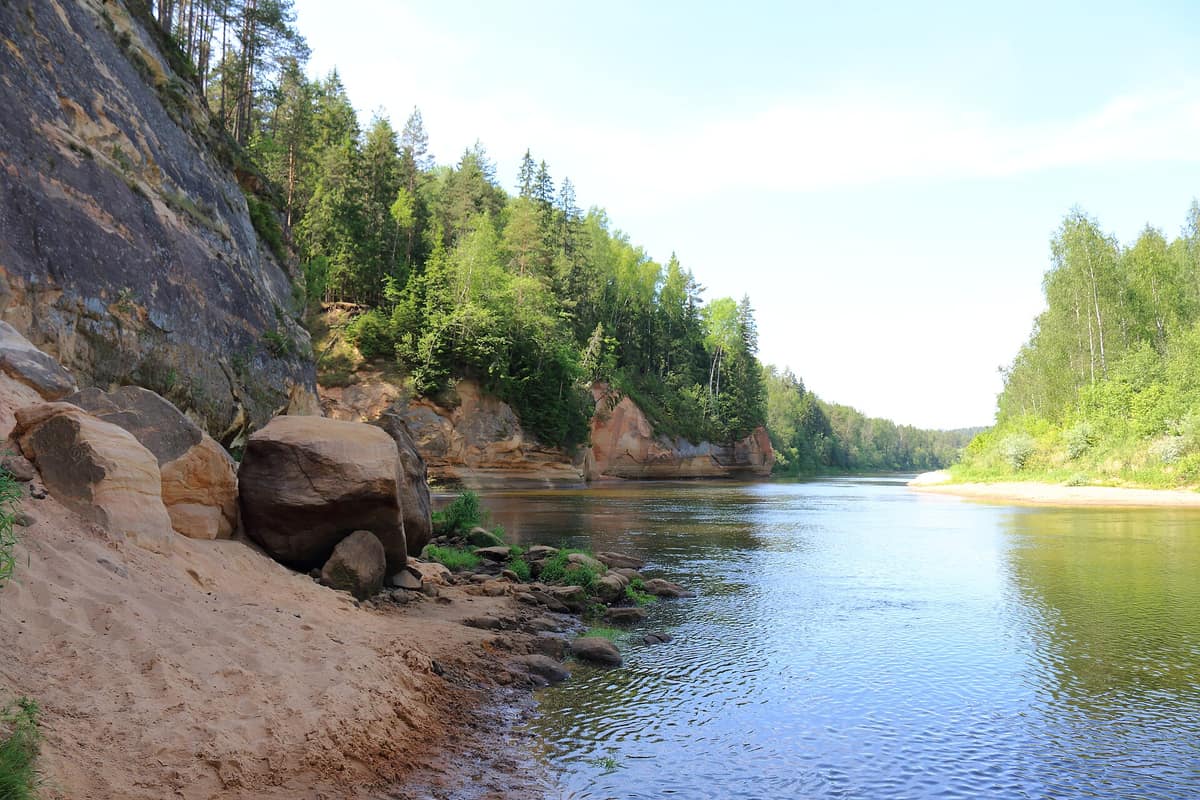
Gauja National Park - Ancient Valley of the Gauja
Gaujas Nacionālais Parks - Senleja
Vidzeme (Sigulda / Cēsis / Līgatne) · Latvia
Photo: FrDr · CC BY-SA 4.0 · Wikimedia Commons
Latvia's oldest and largest National Park, famous for its red Devonian sandstone cliffs rising above forested valleys.
There are valleys hollowed out over centuries, and others carrying more than three hundred and fifty million years of geological memory. The Gauja belongs firmly to the latter: a primeval ancient valley whose dramatic ravines were sculpted by meltwater at the close of the Ice Age, traversed by Latvia's longest river at 452 km. Gauja National Park has safeguarded it since 14 September 1973, standing as the nation's first and oldest national park.
What makes it unique
Devonian sandstone cliffs, occasionally rising up to ninety metres, exposed by the river along its winding valley.
The place
Nature
The landscape
The park spans 91786 ha and is organized into five functional zones. Forests mantle 47 % of its surface, and what you behold along the banks of the Gauja and its tributaries are towering Devonian sandstones, designated as protected geomorphological monuments. Upstream from Cēsis, the most famous outcrops include Kazu iezis and the Ērgļi cliffs along the left bank, alongside Raiskums rock on the right. Around Sigulda, at the base of the bluffs, caves hollow out the sandstone: Gūtmaņa, Velna, Kraukļu, and Pētera.
The valley shifts character along the waterway. Near Sigulda the Gauja flows through a dolomite gateway where the chasm narrows to about one kilometre and plummets over eighty-five metres deep. Near Vildoga and Nurmiži the maze of gullies and wooded ravines is the densest in all Latvia. The river itself has a reputation for unpredictability, shifting course swiftly and churning over boulder rapids at Kazu, Raiskuma, Rakšu, and Ķūķu. Oxbow lakes cut off from the main channel form peaceful crescent lagoons, while willow thickets thrive across the floodplain. The park's largest bodies of water are lakes Ungura, Vaidava, and Raiskums.
Wildlife and seasons
The managing agency has recorded more than 800 species of vascular plants in the park, 149 of birds, and 48 of mammals. To observe native wildlife within an easy walking excursion, the nature trails of Līgatne allow visitors to watch animals from elevated viewpoints in spacious, semi-wild enclosures replicating their native habitat. Here live brown bears, wild boar, foxes, Eurasian lynx, roe deer, red deer, moose, and birds such as eagle owls and Ural owls. Most arrived injured or were reared by hand as orphaned cubs, unable to survive in the wild: the very first inhabitants were six red deer, joined the following year by two wild boar.
The Līgatne trails were established in 1975 to showcase Latvia's indigenous wildlife and cover roughly 4–5 km, typically requiring between two and three hours to explore. Managed by the Nature Conservation Agency, they wind through the steep gullies and sand knolls of the ancient valley.
Species
With a page in the atlas
Being mentioned in a source doesn't guarantee sightings: check with the people who manage the area.
Memory and protection
History and conservation
The river served as a vital trade artery, and ancient Livonian clans established fortified villages along its bluffs. The national park was created to safeguard pristine landscapes, cultivate nature tourism, and ensure sustainable development, joining the Natura 2000 network in 2004. Together with its surrounding recreation areas, it welcomes over one million visitors annually.
Before you set off
Visiting
How to visit
The park features a foot trail network extending over more than one hundred kilometres. Walking sticks have accompanied ramblers along the Sigulda paths since the nineteenth century. The park's visitor network encourages exploring at an unhurried pace: on foot, by touring bicycle, on horseback, or paddling canoes along the gentle current of the Gauja.
There are also more than five hundred historical and cultural monuments, including fortified hillforts, medieval stone castles, churches, manor estates, and water- and windmills. In the thirteenth century, formidable stone fortresses were raised on sheer cliff spurs guarded by deep ravines, forming the kernels around which vibrant towns eventually grew.
Before you go
Strict nature reserves encompass a small percentage of the park and remain entirely closed to casual visitors. If you plan to visit Līgatne, check opening hours with the park authority beforehand.
Check access, rules and visiting conditions in the official information from the managing body before you set off.
Location
Where it is and how far it reaches
Boundary of Gaujas Nacionālais parks · IUCN II · © EEA, CDDA (CC-BY) The coordinate is estimated; it isn't a verified access point.
Transparency
Sources
The research data with its sources, and the official links for this place, are in the Spanish version of this page. See the Spanish version
Entry #228 of the original atlas.