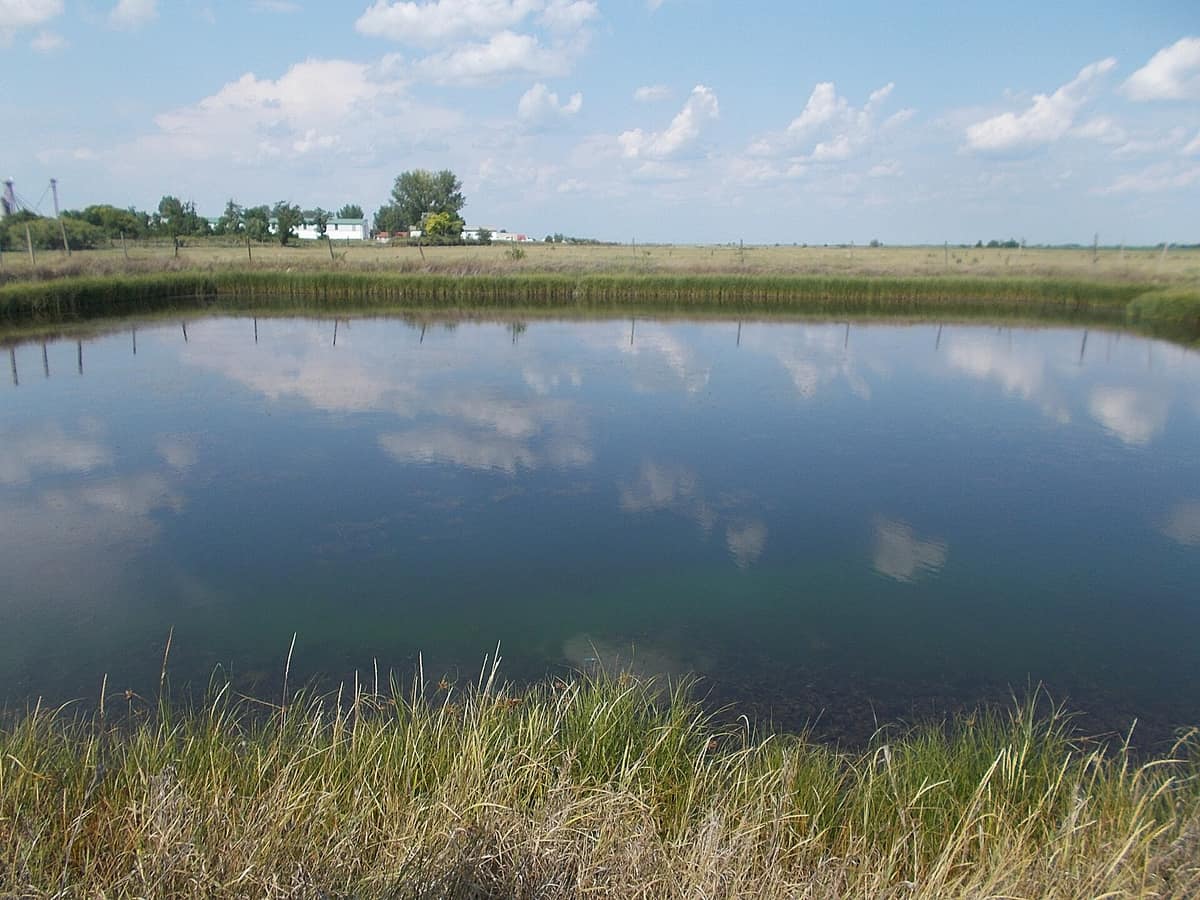
Kiskunság National Park - Saline Steppes
Kiskunsági Nemzeti Park - Szikes puszták
Bács-Kiskun (Kecskemét) · Hungary
Photo: Globetrotter19 · CC BY-SA 3.0 · Wikimedia Commons
Saline steppe mosaic between the Danube and Tisza rivers with continental shifting sand dunes and alkaline lakes.
A river once dictated where the waters pooled, and human hands later intervened to banish them. The Upper Kiskunság steppe occupies the historic floodplain of the Danube, an origin that remains clearly legible in the topography: former braided river channels are revealed by botanical patterns and periodic winter flooding. Today it constitutes the second most extensive saline steppe on the Great Hungarian Plain after Hortobágy, encompassing 11,061 hectares of salt pastures, alkaline meadows, and temporary sodic pools protected within Kiskunság National Park. Its most renowned enclave is Apaj.
What makes it unique
A steppe born from the drainage of a great river: the salts left behind by retreating waters sustain great bustards, avocets, and Grey cattle herds.
The place
Nature
The landscape
The key lies in drainage hydrology. When the vast Danube floodplain was cut off by dykes, ground salts concentrated and soil salinisation intensified. Wetland drainage began in the 1910s and subsequent river regulation finished the transformation: early spring floodwaters are swiftly evacuated through canals while residual waters evaporate under the early summer sun. The sole permanent open waterbodies are the Apaj fishponds, covering 450 hectares, maintained artificially through management.
What meets the eye is an intricate mosaic: carbonate-rich alkaline steppes, salt pastures, seasonal marsh depressions, and low wind-deposited sand and loess ridges. Growing conditions are harsh, governed by fine-textured solonetz soils, poor drainage, and heavy salt loads; only a specialist halophytic flora survives: a local fescue grass, Hungarian sea lavender, scented chamomile, and sea wormwood.
Beside the steppe, the Upper Kiskunság Lakes tell a parallel story. On the First Military Survey of 1783-1784, they were depicted as vast freshwater marshes rejuvenated by seasonal inundations. Embankments constructed in the 1840s isolated the plain; deprived of cleansing river floods, the deepest depressions evolved into white or black sodic pans. Hundreds once existed, yet most have vanished or hold water only in early spring. The largest—Kis-rét, Zab-szék, Büdös-szék, Kelemen-szék, and Fehér-szék—rank among Hungary's most precious soda lakes.
Wildlife and seasons
The greatest spectacle across this vast horizon is its birdlife, moving through the seasons with clockwork regularity.
In spring, waves of migrating waders (Tringa and Calidris sandpipers) stage across the shallow muds to refuel. This coincides with the courtship displays of the great bustard: the regional breeding population is the largest in Hungary. Once migration wanes, stillness settles over the steppe, broken only by resident breeders like the red-footed falcon, an elegant colonial raptor hunting large insects.
Late summer and autumn bring another surge of southbound passage migrants. Wild geese roost on the soda pans in immense numbers from autumn to spring, accompanied by tens of thousands of dabbling ducks: teals, wigeons, pintails, and shovelers. Saline breeding specialists include the pied avocet and black-winged stilt, while an island in Kelemen-szék shelters a noisy colony of black-headed gulls. The western marsh harrier nests in the reedbeds of Kis-rét and Fehér-szék.
Winter welcomes arctic passerines and raptors: between two and six white-tailed eagles and eastern imperial eagles winter around the lakes, joined by merlins and hen harriers.
Looking closer reveals other treasures: green-winged orchids, bug orchids, and dwarf irises flower on loess mounds in early spring. European fire-bellied toads inhabit vegetated lake margins, and Danube crested newts breed in roadside pools. Notable invertebrates include the flightless longhorn beetle Dorcadion fulvum cervae and the South Russian tarantula, Hungary's largest spider.
Species
With a page in the atlas
Being mentioned in a source doesn't guarantee sightings: check with the people who manage the area.
Memory and protection
History and conservation
The Kiskunság is a cultural landscape deeply shaped by millennia of pastoralism. Archaeological finds trace livestock herding back to the late Copper Age (the third and fourth millennia BC), a lifestyle later perpetuated by Hungarians and Cumans. Extensive grazing has centuries of history across the salt steppes, and local sheep and cattle breeds remain essential to maintaining open grasslands. Around the lakes, the park grazes cattle and water buffalo to prevent scrub invasion.
Established in 1975 as Hungary's second national park, Kiskunság comprises nine non-contiguous units. The Upper Kiskunság Steppe, the Upper Kiskunság Lakes, and Lake Kolon are internationally protected under the Ramsar Convention, with the sodic pans being among Hungary's earliest designated Ramsar sites.
Before you set off
Visiting
How to visit
The Apaj educational nature trail provides the natural gateway. It extends over a kilometre through a restored wetland constructed upon former fishponds, featuring high observation platforms at both ends overlooking the open puszta. Along the way you learn about reedbed ecology and saline birds, with regular sightings of Hungarian Grey cattle—one of the largest herds in the country. The best times to visit are spring, early summer, and autumn, when birdlife peaks.
For waterbirds, another essential stop is the Avocet Trail in Fülöpszállás: 1300 metres with six interpretive stops ending at an observation hide suitable for wildlife photography in all seasons. Spring and autumn offer the greatest abundance; in summer, visit early in the morning or late in the afternoon with binoculars. The park's water buffalo graze along Lake Kelemen, requiring the trail to pass safely between electric fences to the hide.
To grasp the wider landscape before heading into the field, the House of Nature in Kecskemét features permanent interactive exhibitions on Hungarian conservation history and the Danube-Tisza habitats.
Before you go
Strictly protected core areas are marked with warning signs and may only be entered with written park permission or accompanied by an expert ranger. Stay strictly on marked trails: straying damages fragile solonetz crusts and threatens ground-nesting birds. Photographing birds near active nests is prohibited, and portable photography hides require prior park authorization. Motor vehicles must remain on public roads, and the park strongly encourages travel by bicycle or train.
Check access, rules and visiting conditions in the official information from the managing body before you set off.
Location
Where it is and how far it reaches
Boundary of Kiskunsági Nemzeti Park · IUCN II · © EEA, CDDA (CC-BY) The coordinate is estimated; it isn't a verified access point.
Transparency
Sources
The research data with its sources, and the official links for this place, are in the Spanish version of this page. See the Spanish version
How it fits into the territory
Calculated from the Atlas boundaries. «Part of» is only stated with an official boundary; an estimated area only means that they overlap.
Within this area · 1
- Kiskunság National Park - Bugac Puszta
Bács-Kiskun (Bugac / Kecskemét)
Inside its official boundary
The most renowned expanse of the Kiskunság puszta, preserving herds of Hungarian Grey cattle and traditional steppe horses.
JFMAMJJASONDMay – October · Crowding low
Around it
Just 2 km away lies Kiskunság National Park - Apaji-szikesek, while the Bugac Puszta unit forms part of the same park. Twenty-eight kilometres away lies the flooded forest floodplain of Gemenc on the Danube.
Further across the Pannonian Plain, Dévaványa Plain and the Serbian reserve Pašnjaci velike rit share great bustards and red-footed falcons, while Rusanda Nature Park shares identical sodic lakes and saline steppes.
Entry #252 of the original atlas.