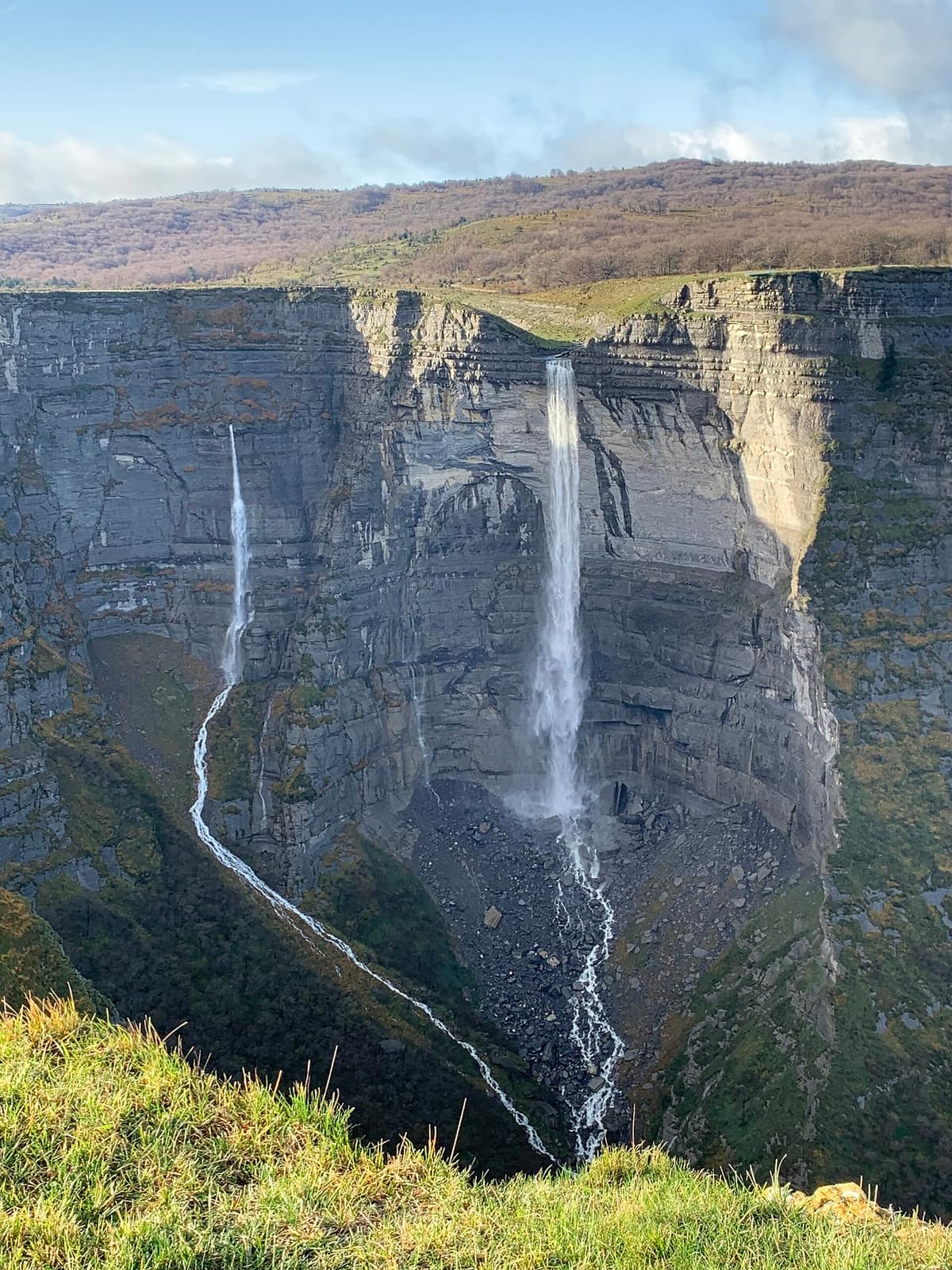
Monte Santiago Natural Monument and Nervión Waterfall
Monumento Natural Monte Santiago & Salto del Nervión
Castile and León / Basque Country (Burgos / Álava / Berberana) · Spain
Photo: Centenoyespelta · CC BY-SA 4.0 · Wikimedia Commons
The dramatic karst precipice of the Salto del Nervión (Spain's highest waterfall with a 222 m freefall) and the dense beech forest of Monte Santiago.
First the dense shade of the forest, then absolute void. Monte Santiago is a lush, shadowed beech forest whose northeastern boundary suddenly meets the lip of a colossal limestone amphitheatre: the heavily karstified crests of the Sierra Salvada, dropping vertically into the Délika canyon. Cantilevered over the abyss stands the panoramic viewpoint overlooking the Salto del Nervión. This natural monument occupies the northeastern tip of Burgos province on the border with the Basque Country, designated by regional decree on 14 March 1996.
What makes it unique
An Atlantic beechwood terminating abruptly at a sheer karst amphitheatre, where a river plunges only when saturated limestone fissures release their waters.
The place
Nature
The landscape
Karst geology and Atlantic precipitation explain this dramatic topography. A thick layer of massive Cretaceous limestone rests upon softer underlying marls: where the rock resists, vertical battlements form; where it erodes, gentle slopes develop. The Salto del Nervión owes its origins to this differential erosion and intense tectonic fracturing associated with the Orduña diapir. Because the plateau is porous karst, the watercourse is ephemeral: water plunges over the cliff face only a few months each year following heavy rain or spring snowmelt; otherwise, drainage flows entirely through underground caves, resurging downstream near Orduña. Below the waterfall, the Délica river takes the name Nervión.
Timing is everything. The waterfall is best witnessed following consecutive rainy days, violent storms, or thaw, when subterranean aquifers overflow through hanging cliff face springs.
Vegetation mirrors altitude and aspect. The monument belongs to the Atlantic biogeographic domain, dominated by European beech, but borders Mediterranean Iberia: holm oaks and gall oaks occupy lower sunny slopes, while beeches crown high elevations. The understorey intermingles heathers, rockroses, gorse, junipers, box, and bearberry. Atop the limestone table, the beechwood floor is pitted with sinkholes and clint-and-grike lapiés.
Wildlife and seasons
Surveys record 20 mammal species, including the wildcat, badger, pine marten, stone marten, and thriving wild boars. Among some 60 bird species, griffon vultures dominate the skies, joined by scarcer breeders like the red-billed chough and booted eagle. The Salto del Nervión viewing platform grants eye-level vistas of soaring vultures circling the canyon.
The beech forest bears intriguing historical hallmarks. Pollard beeches exhibit candelabra branch shapes from historical charcoal coppicing, while the park visitor centre showcases a monumental veteran beech of 21 metres, catalogued among Castile and León's singular trees. Semi-feral horses and cattle graze the open pastures near the park entrance.
Species
With a page in the atlas
Being mentioned in a source doesn't guarantee sightings: check with the people who manage the area.
Memory and protection
History and conservation
The park visitor centre occupies the grounds of the medieval monastery of Santiago de Langrériz, founded beside the plateau's solitary perennial freshwater spring. The waterfall can also be approached on foot from Álava via a cliff-edge path starting past the village of Untza.
Before you set off
Visiting
How to visit
Access begins from Berberana: 3 km along, a forest road leads into Monte Santiago. The walking trail to the Salto del Nervión viewpoint departs from the Hoyalante car park at the entrance, following a wide, level gravel track closed to unauthorized motor vehicles. Along the way lie the Calzadas de Gigante—fluted limestone pavements resembling hand-chiselled stone—and the Lobera de Santiago, an ancient funnel-walled wolf trap ending in a pitfall, today brought to life by life-sized sculptures.
For longer hikes, two circular routes branch out. The Senda del Bosque covers 6,67 km in about two hours and a half of moderate walking, threading a dense canopy so enclosed it forms a living tunnel. The Senda de los Miradores connects the Salto del Nervión with the Esquina Rubén lookout over 6,28 km, revealing sweeping panoramas of the Sierra Salvada cliffs, the Orduña valley, and Mount Gorbea.
The visitor centre beside the Fuente Santiago spring features displays on local ecology and an inner courtyard dedicated to native amphibians. The spring emerges at the base of a collapse sinkhole, its stream flowing barely some 50 metres before vanishing into a subterranean swallow hole.
Before you go
The waterfall is strictly seasonal: without recent rainfall or active thaw, the precipice remains dry. Check weather forecasts and visitor centre opening hours before travelling. Visitors with reduced mobility may drive to the viewpoint upon prior authorization at the visitor centre.
Check access, rules and visiting conditions in the official information from the managing body before you set off.
Location
Where it is and how far it reaches
Boundary of Monte Santiago · IUCN III · © EEA, CDDA (CC-BY) The coordinate is estimated; it isn't a verified access point.
Transparency
Sources
The research data with its sources, and the official links for this place, are in the Spanish version of this page. See the Spanish version
Entry #499 of the original atlas.