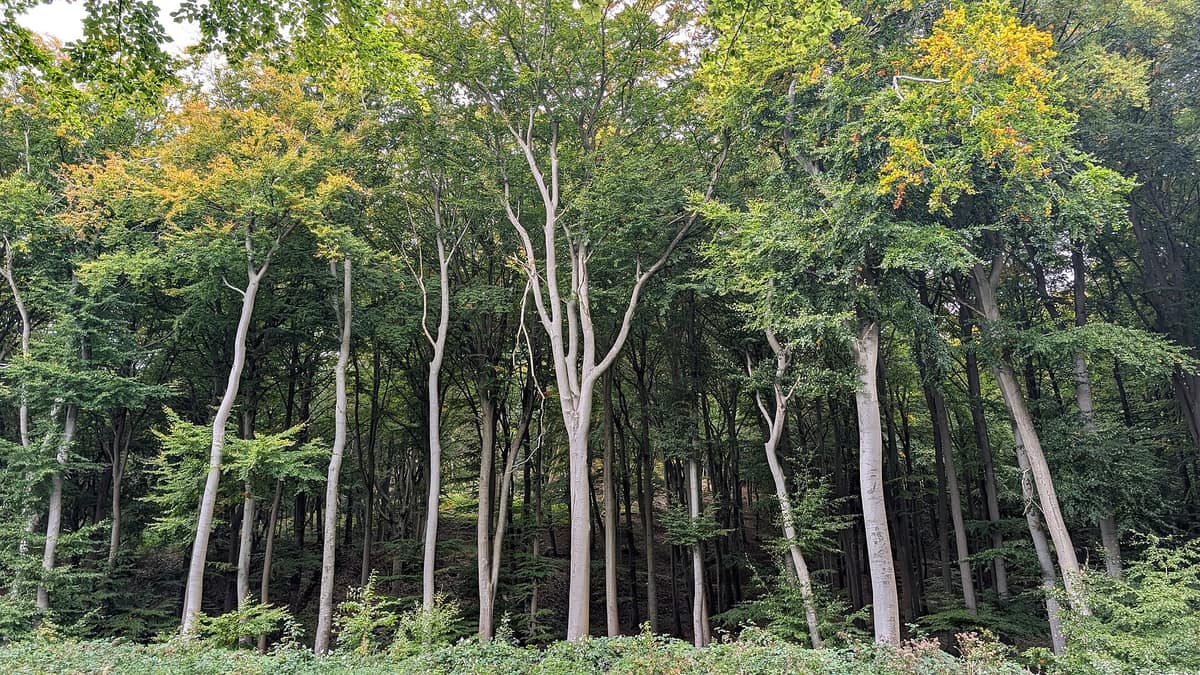
Jasmund National Park - Chalk Cliffs and Ancient Beech Forest
Nationalpark Jasmund - Buchenurwald auf Kreidefelsen
Mecklenburg-Western Pomerania (Rügen Island) · Germany
Photo: Siarhei Besarab · CC BY-SA 4.0 · Wikimedia Commons
Germany's smallest National Park, famed for gleaming white chalk cliffs plunging into the Baltic beneath ancient beechwoods.
Imagine a warm, shallow sea seventy million years ago whose seabed slowly accumulated grain by grain from the microscopic skeletons of plankton. That is chalk. Today it rears up in dazzling white sea cliffs sheer above the Baltic Sea, capped by primeval beech forest spreading over hills and stream gullies. Jasmund National Park, situated on the Jasmund peninsula in northeastern Rügen, unites both marvels across some 3.070 hectares: it is Germany's smallest national park, with 493 hectares of pristine beechwoods inscribed as UNESCO World Heritage.
What makes it unique
Emerald forest, turquoise sea, and white chalk cliffs in a single panorama, where World Heritage beechwoods crown eroding sea cliffs.
The place
Nature
The landscape
The saga began in the late Cretaceous period, roughly 70 million years ago. At that time the region lay beneath a shallow sea teeming with microscopic unicellular coccolithophore algae. As they died, their calcareous skeletons rained down onto the seafloor, compacting over epochs alongside shells into the chalk seen today. The sea cliffs of Jasmund represent the most dramatic geological exposure in northern Germany: an open window cut through 70 million years of Earth history.
Then came the Ice Age. Glacial ice sheets buckled and fractured the semi-consolidated chalk into tilted slabs, and since then waves and rains have done the rest. Landmark stacks like the 118-metre Königsstuhl and the Wissower Klinken were not built: they were sculpted out by ceaseless coastal erosion. The process never stops. Over the past 7.000 years the shoreline has receded nearly two kilometres, currently eroding by some thirty centimetres annually. The world-famous Wissower Klinken collapsed dramatically on 24 February 2005. Erosion accelerated further when giant shoreline erratic boulders that acted as natural breakwaters were historically removed for harbour building.
Crowning the chalk grows the woodland. Jasmund preserves the largest contiguous ancient beech forest along the German Baltic coast, where diverse habitats interlock: old-growth woods, sheer cliffs, kettle-hole bogs, and dry calcareous grasslands. Across the Stubnitz plateau, undrained depressions created by melting stagnant ice harbour alder carrs; dry crests support wild pear, crab apple, wild service tree, and English yew. Native lady’s-slipper orchids thrive, while the northern shoreline supports salt-tolerant cliff vegetation. Small brooks rise in woodland mires and tumble over coastal precipices directly into the Baltic Sea, forming some of the few natural waterfalls in the North German Plain.
Wildlife and seasons
The forest shelters classic woodland ungulates: red deer, fallow deer, roe deer, and wild boar, alongside marine seals occasionally resting offshore.
Birdlife follows the rhythm of the seasons. The white-tailed eagle, the park's grandest avian predator, nests securely within the old-growth Stubnitz, while sand martins excavate colonies in soft cliff sediments. Red-breasted flycatchers nest among ancient beech hollows. On sunny spring mornings, migrating cranes circle high over the forest, riding warming thermal updrafts to gain altitude before crossing the open Baltic. Along clear woodland brooks you can watch the brilliant flash of the common kingfisher.
Down on sunny woodland tracks, viviparous lizards are common, while damp kettle bogs provide habitat for grass snakes, adders, and the elusive smooth snake. Crystal-clear streams shelter alpine planarians—relict mountain flatworms surviving from glacial times—and the Stubnitz supports a thousand species of wood-dwelling beetles. Jasmund is also the sole known locality in Germany for the chalk-carpet Kreideeule, a rare cream-coloured nocturnal moth. In winter, sea trout and Atlantic salmon forage in coastal shallows.
Species
With a page in the atlas
Being mentioned in a source doesn't guarantee sightings: check with the people who manage the area.
Memory and protection
History and conservation
Chalk was quarried along the coast for centuries. In 1926, when a disused quarry north of Sassnitz was slated for reopening, widespread public protests led to the coastline being declared a nature reserve to prevent industrial destruction. On 12 September 1990, under the historic GDR National Park Programme, the area was formally designated a national park. A substantial sector of its ancient beech forest was inscribed as a UNESCO World Heritage site on 25 June 2011.
Before you set off
Visiting
How to visit
The classic hiking route is the Hochuferweg, setting out from Lohme and tracing the cliff-edge trail for almost 12 km to Sassnitz, following the white-blue-white trail markings throughout. After around 4 km you reach the Königsstuhl centre, and 5 km farther awaits the World Heritage Forum at Waldhalle, dedicated to ancient beech forest ecology. Upon concluding the hike in Sassnitz, regular buses return to Lohme. For a circular tour, the Weißes Rügen route departs from Sassnitz railway station, requiring about seven hours while taking in both Königsstuhl and the Wissower Klinken ruins. Two themed walking paths also branch through the park: the Chalk Trail follows the Hochuferweg and the Forest Trail begins at Hagen; both converge on the Königsstuhl centre. Cyclists have dedicated tracks, but cycling on the clifftop Hochuferweg is strictly prohibited.
The Nationalpark-Zentrum Königsstuhl offers an engaging portal into the landscape: four floors of interactive exhibits spanning eighteen themed rooms, audio guides, cinema, and a barrier-free skywalk floating out over the Königsstuhl with breathtaking vistas of chalk cliffs and sea. It opened in March 2004; check pet regulations before planning your visit.
Along the pebble beach below the cliffs you can discover Cretaceous fossils, including belemnites—popularly known as Donnerkeile or thunderbolts, the internal guards of ancient cephalopods—alongside fossil sea urchins, bivalves, and sponges. Take photos and leave every find on the beach.
Before you go
The pebble beach below the chalk cliffs poses a life-threatening danger of rockfalls and cliff collapses, which occur particularly after prolonged rains or during the spring thaw. Always keep a safe distance from cliff edges and overhanging overhangs. Staying on marked paths is strictly mandatory: stepping off trails disrupts fragile habitats, and near nesting birds even fleeting disturbances cause nest abandonment. Dogs must be kept on a leash. Several bus routes connect regional railway hubs to Sassnitz and surrounding gateway car parks.
Check access, rules and visiting conditions in the official information from the managing body before you set off.
Location
Where it is and how far it reaches
Boundary of Jasmund · IUCN II · © EEA, CDDA (CC-BY) The coordinate is estimated; it isn't a verified access point.
Transparency
Sources
The research data with its sources, and the official links for this place, are in the Spanish version of this page. See the Spanish version
Entry #125 of the original atlas.