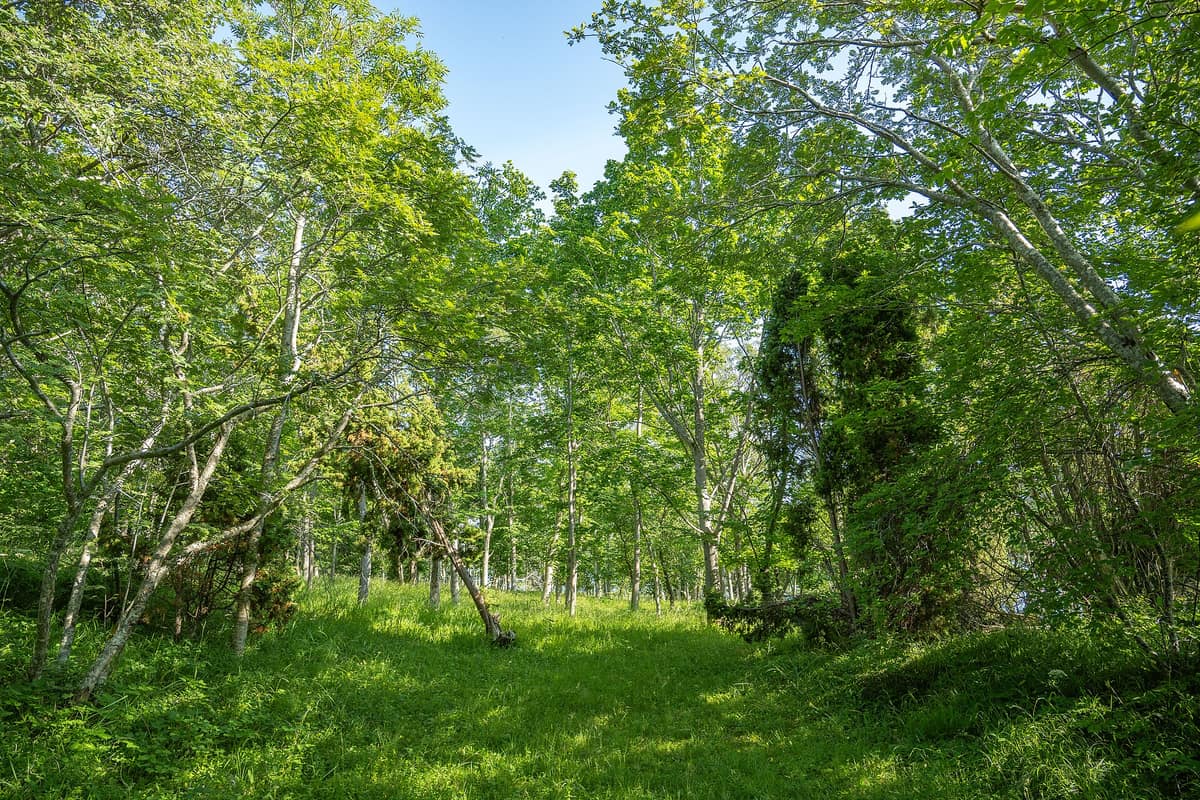
Nåtö–Jungfruskär Nature Reserve
Nåtö–Jungfruskär naturreservat
Åland — Nåtö and protected islets of Lemland and Mariehamn · Finland
Photo: Håkan Skogsjö · CC BY-SA 4.0 · Wikimedia Commons
Wooded meadows maintained through traditional management, ancient woodlands of Korsö and an old-growth yew forest on Jungfruskär.
Picture a centuries-old meadow where careful human stewardship has never lapsed. Every single year the brushwood is raked away, the hay is mown, and livestock is turned out to graze, precisely as has been done for centuries; in spring that groomed topsoil bursts into a vibrant carpet of liverleaf, wood anemones, cowslips and wild orchids. This is Nåtö, the pastoral heart of the Nåtö–Jungfruskär Nature Reserve in Lemland municipality, Åland. Surrounding the main island, an archipelago of satellite islets completes the picture with near-virgin old-growth forests and the northern Baltic’s densest yew sanctuary.
What makes it unique
Jungfruskär shelters the largest contiguous stand of common yew in the northern Baltic, and a few kilometres from Mariehamn Nåtö preserves what is regarded as the most quintessential wooded meadow in all of Finland.
The place
Nature
The landscape
The nature reserve is a mosaic: hayfields, wooded meadows, dense woodland and maritime archipelago. The marine domain encompasses eight solitary islets and four islet groups endowed with rich and varied ecosystems, while the main island of Nåtö concentrates the prized wooded meadows.
These wooded meadows form the soul of the landscape. They consist of park-like parklands of broadleaved trees, dotted with hazel groves and sunlit grassy glades, perpetually sustained by spring clearing, pollarding, brush removal and late-summer grazing. Eskskär, Idholm, Senskär and Slåtholm share this identical pastoral character and receive traditional maintenance. In contrast stands the ancient forest: on Yttre Korsö the woodland is ancient and laden with decaying coarse woody debris, while Inre Korsö features venerable conifers and dense understorey thickets of yew in moist hollows. On Jungfruskär, the yew grove is largely impenetrable and gathers at least 1200 individual trees.
Wildlife and seasons
Spring is the undisputed season of wild flora. Ground layer blooms include liverleaf, wood anemone, yellow wood anemone, cowslip, and the wild orchids Adam and Eve and early purple orchid. On Sesleria calcicolous swards blooms the bird’s-eye primrose. Idholm ranks as the botanically richest locality among all studied sites in Åland, hosting a significant portion of Finland’s entire population of early purple orchids. On Nåtö, municipal botanists highlight the profuse blooming of the provincial floral emblem of Åland. Rare saxicolous lichens and wood-decay fungi also thrive.
The surrounding sea and woodlands attract distinctive birdlife. On Yttre Korsö nests the white-tailed eagle; during the 2015 breeding survey, two fully feathered fledglings were observed exercising their wings. Senskär revealed thirteen active nests of common eider during spring inventories. The waters around Nåtö shelter abundant horned grebes, with pairs breeding at Västerberget and eastern Nåtö. Numerous hole-nesting passerines breed throughout the reserve, alongside the spotted nutcracker.
Memory and protection
History and conservation
The nature reserve was assembled incrementally over decades. The offshore islet of Jungfruskär received legal protection in 1943, Idholm followed in 1949, and the core Nåtö reserve was established in 1964, subsequently expanded in multiple phases. Today Idholm, Jungfruskär and Nåtö form a cohesive conservation unit.
The historical vernacular buildings of the former Norrgård farmstead are maintained by the Government of Åland; several are utilized by the Nåtö Biological Station, which hosts academic fieldwork and botanical courses. The primary ecological threat is insidious: declining pastoral grazing allows common reed and encroaching scrub to swallow open coastal swards. A potential maritime hazard would be an accidental oil spill along the busy shipping lane traversing the adjacent waters.
Before you set off
Visiting
How to visit
You begin your visit at Nåtö. An official waymarked nature trail winds through the wooded meadows, reached via a scenic ten-kilometre causeway road threading across a chain of islands south from Mariehamn into the Järsö and Nåtö archipelago. The western sector of the nature reserve lies on the island itself, some three and a half kilometres south of Mariehamn.
The local municipality conducts a guided cultural landscape walk through Nåtö, covering about three kilometres when the traditional wooded meadow reaches peak flowering. The terrain is gentle, featuring occasional short rocky outcrops and boardwalks across damp spots; participants gather at the parking area on the right side of the Järsö road, roughly two hundred metres past the bridge.
Jungfruskär features its own dedicated nature trail to explore the yew grove. The meadow trail on Nåtö and the yew trail on Jungfruskär are entirely separate outings, so plan them as two distinct excursions.
Before you go
Check access regulations and landing permissions with the reserve authority before arranging boat trips to the outlying islets. Also verify the exact scheduled dates for the municipal guided walk, which takes place only on selected days.
Check access, rules and visiting conditions in the official information from the managing body before you set off.
Location
Where it is and how far it reaches
Boundary of NÅTÖ OCH JUNGFRUSKÄR NATURRESERVAT · IUCN IV · © EEA, CDDA (CC-BY) The coordinate is estimated; it isn't a verified access point.
Transparency
Sources
The research data with its sources, and the official links for this place, are in the Spanish version of this page. See the Spanish version
Entry #1071 of the original atlas.