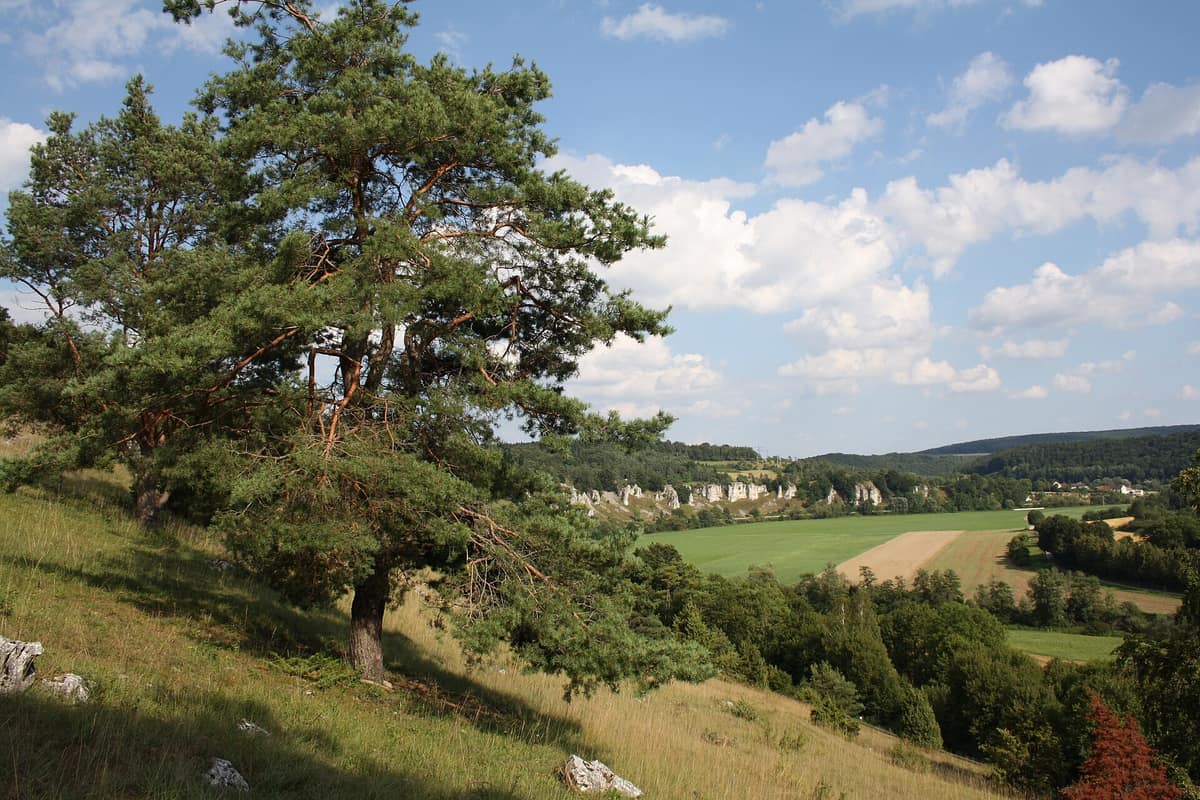
Altmühltal Nature Park
Naturpark Altmühltal
Bavaria (Eichstätt / Kelheim / Solnhofen) · Germany
Photo: Cku · CC BY-SA 3.0 · Wikimedia Commons
Meandering limestone valley of the Franconian Jura with the "Zwölf Apostel" (Twelve Apostles) pinnacles and Archaeopteryx fossil quarries.
Before it became a nature park, this realm was an ancient tropical sea. The platy limestones that form the geological foundation of the Altmühltal Nature Park originated in shallow lagoons of the Jurassic ocean, which is why exceptional fossils turn up across the region. Atop this stone substrate lie 2962 km² of Bavaria, nearly coincident with the southern Franconian Alb natural region. It is the fourth largest nature park in Germany, and ever since an association established it at Pappenheim on 25 July 1969, it preserves a magnificent mosaic of crags, dry grasslands and forest.
What makes it unique
In a single valley you can wander across a Jurassic seabed, juniper heathland fashioned by medieval sheep farming, and the Archaeopteryx fossil sites of Solnhofen-Eichstätt, designated among the top 100 geological heritage sites on Earth.
The place
Nature
The landscape
The trademark landscape features recurring across the park are nutrient-poor dry grasslands, juniper heaths, wet valley meadows, exposed limestone dolomite cliffs, karst caves and historic quarries. Half the park’s territory is forested. And rock governs the scenery: at the Twelve Apostles between Solnhofen and Eßlingen, the rock pillars are layered limestone of the Treuchtlingen marble, dating from the Upper Jurassic. Within the Jurassic sea, resilient sponge reefs developed, displaying higher resistance to weathering; thus differential erosion left them standing as bold towers.
The juniper bushes and sheep pastures, by contrast, are semi-natural: the product of human history. Today’s grasslands and heaths were once cloaked in dense beech and mixed oak woodland. From the High Middle Ages onwards, shepherds grazed large flocks of sheep and goats through these forests. Over time, light-loving and thermophilic flora and fauna spread. At Gungolding the story repeats itself: the expansive juniper heath originated in the Middle Ages when woodlands were felled and livestock took over, and flocks still graze there today to keep regenerating forest from reclaiming the open hillsides.
The river course has also endured human intervention. The Main-Danube Canal, completed in 1992 through the valley, sparked fierce political controversy. The natural course of the Altmühl was transformed into isolated oxbows, and extensive ecological restoration along the canal sought to re-create natural riverbanks and wetlands.
Wildlife and seasons
The biological highlight of the calendar year is the flora, which awakens exceptionally early. Walking across the Kreutberg in early spring, through March and April, the purple blossoms of pasqueflowers greet you, alongside blooming spring cinquefoil across the calcareous turf. On open rock ledges appears the rare mountain alyssum (Bergsteinkraut), scarcely found beyond these crags. During the searing heat of summer these delicate ephemerals wither away, persisting safely as seeds that germinate in late autumn.
The Twelve Apostles follow a different botanical rhythm. Across their sparse dry meadows grow Carthusian pink (Karthäuser-Nelke), dark-red helleborine (Violette Stendelwurz) and two species of germander, accompanied by specialized dung beetles, cicadas, blue lycaenid butterflies and drought-adapted grasshoppers. Targeted conservation measures have even enabled the Apollo butterfly (Apollofalter) to recolonize the crags. On the Gungolding juniper heath bloom the rock pink, fine-leaved sandwort, an extraordinarily rare rock-rose and three distinct gentian species: spring, fringed and German gentian.
Down by the water, the habitat transforms completely. In the Heutal valley, the Eurasian beaver has reshaped the stream bed and landscape in recent years through its dams and lodges. And at the northern tip of the Altmühlsee reservoir, the Vogelinsel bird island serves as one of Bavaria’s premier staging reserves for migratory waterbirds.
Species
With a page in the atlas
Being mentioned in a source doesn't guarantee sightings: check with the people who manage the area.
Memory and protection
History and conservation
Juniper was woven into daily rural life: fragrant branches smoked sausages and hams, while sturdy wood fashioned whip handles. Folklore held that juniper smoke repelled contagious disease and evil spirits, while whip handles crafted from juniper wood shielded horses from witchcraft.
These cultural landscapes endure because they receive active stewardship. The Twelve Apostles site has enjoyed nature reserve protection since 1984, spanning some 15,2 hectares. The Gungolding juniper reserve encompasses around seventy hectares on the northern valley slope, while the Kreutberg reserve covers about 30 hectares. The dry calcareous grasslands support 187 threatened plant species included on the Red List that depend on these dry, nutrient-poor conditions. At Gungolding, sheep flocks prevent encroaching woodland from reclaiming the open heath.
Before you set off
Visiting
How to visit
Begin your exploration at the Eichstätt information centre: it offers an informative modern exhibition exploring culture, nature and regional history, alongside a biotope display garden and an environmental education centre.
For hiking, the crown jewel is the Altmühltal-Panoramaweg, covering two hundred kilometres following the winding river from Gunzenhausen to Kelheim. It represents the park’s most acclaimed long-distance trail, certified since 2006 with the Wanderbares Deutschland seal of quality. High above, it skirts the Twelve Apostles, granting commanding vistas over the Solnhofen valley. To reach the iconic crags, park in Eßlingen and follow waymarks, or hike up from Solnhofen along roughly 2 km of the Panoramaweg.
Shorter day loops abound. The circular pathway encircling the Altmühlsee spans thirteen kilometres, takes about three hours and provides wheelchair accessibility; the nature trail on the Vogelinsel bird sanctuary features interpretive panels. The Heutal educational trail forms a loop of roughly four kilometres along the Wissinger Laber brook, illustrating the cultural and aquatic ecology of watercourses. On the Kreutberg, a marked 3,5 km circular walk winds through the Felsengarten rock garden and past a lion-shaped dolomite formation.
For alternate travel, the Altmühltal-Radweg cycleway runs for 166 km along flat river valley paths. The boating stretch along the Altmühl within park boundaries extends across nearly 120 kilometres between Gunzenhausen and Dietfurt; its gentle current makes it an ideal family-friendly paddling river, whether for an afternoon or an extended multi-day tour. If fossils fascinate you, several public visitor quarries allow amateur fossil hunting.
Before you go
Within the Gungolding nature reserve it is strictly forbidden to harvest juniper berries. The delicate floral blooms on the Kreutberg are visible exclusively in March and April: by summer nothing remains on view except dormant seeds. The Altmühl holds the QMW water tourism seal of quality, certifying its well-maintained infrastructure, environmental safeguards and visitor management.
Check access, rules and visiting conditions in the official information from the managing body before you set off.
Location
Where it is and how far it reaches
Boundary of Schutzzone im Naturpark "Altmühltal" · IUCN V · © EEA, CDDA (CC-BY) The coordinate is estimated; it isn't a verified access point.
Transparency
Sources
The research data with its sources, and the official links for this place, are in the Spanish version of this page. See the Spanish version
Entry #418 of the original atlas.