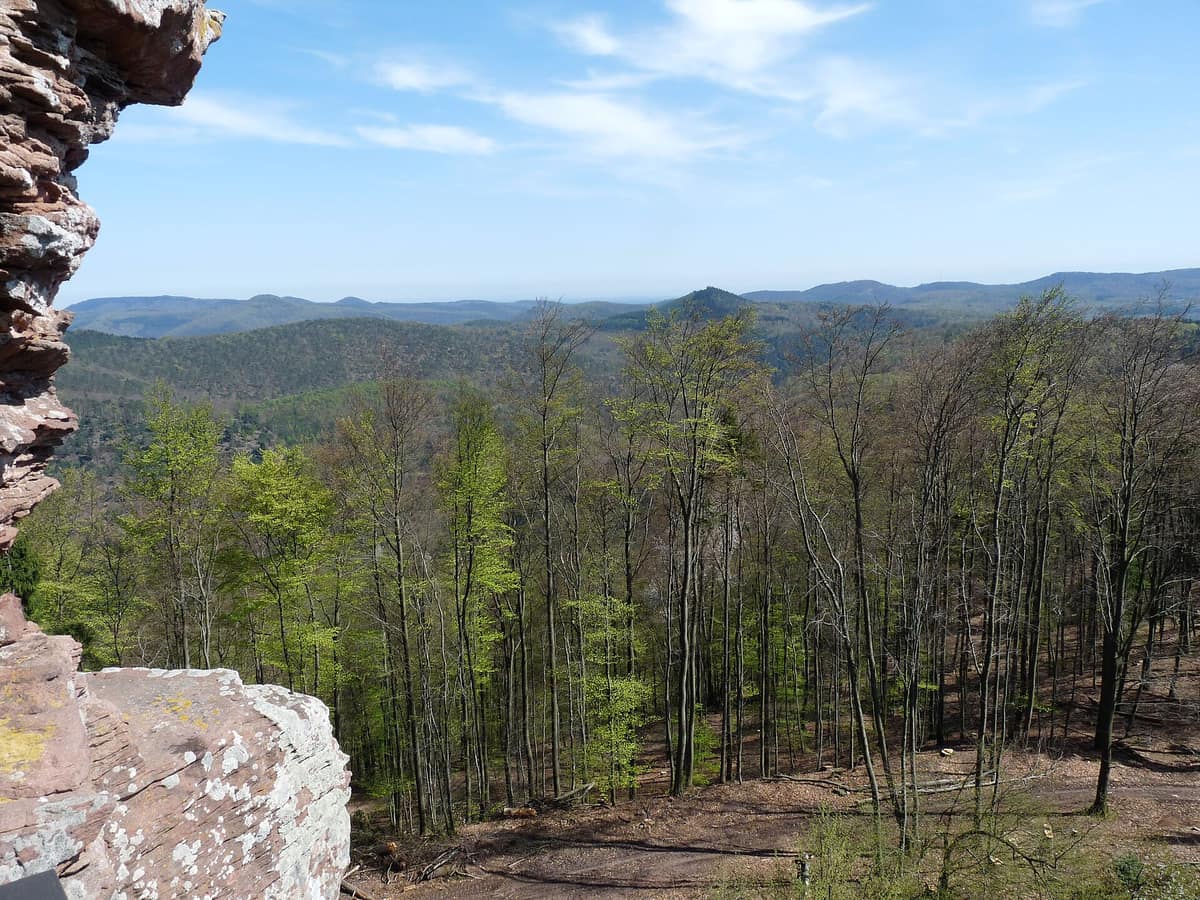
Northern Vosges Regional Nature Park
Parc Naturel Régional des Vosges du Nord
Bas-Rhin / Moselle (FR) / Rhineland-Palatinate (DE) · France / Germany
Photo: Ji-Elle · CC BY-SA 3.0 · Wikimedia Commons
A cross-border Biosphere Reserve shared with Germany, characterised by dense woodlands over pink sandstone cliffs and ruined medieval castles.
Despite its name, the Northern Vosges are not located in the Vosges department nor centred on the Vosges massif itself, whose high peaks lie several dozen kilometres to the south: they occupy only its northern fringe. What they do have is woodland. About 65% of the park, 83,500 hectares, is blanketed in trees and extends into Germany with the Pfälzerwald to form a continuous forest unit of some 2500 km², designated as a UNESCO cross-border biosphere reserve. The regional nature park was established on 30 December 1975.
What makes it unique
A borderless forest on pink sandstone where the lynx has once again crossed from Germany into France and bred.
The place
Nature
The landscape
The bedrock is predominantly sandstone, sculpted by water into deep-set valleys, crags and hollows. The castles are built from it: 35 medieval strongholds set upon sandstone promontories, 27 in Bas-Rhin and 8 in Moselle, alongside two Renaissance châteaux. Beechwoods, sessile oakwoods and Scots pine forests have grown on this sandstone for millennia, and the park encompasses beeches, oaks, alder groves and pine stands on peat and on sandstone. The forest breaks down into 45% broadleaf species, 30% conifers and 25% mixed stands.
The landscape is structured into three units: the piedmont in the east, the woodland heart in the centre and the Lorraine plateau to the west. Across open areas lie sandy and calcareous grasslands, heathlands and traditional orchards hosting orchids, gentians, skylarks, barn owls and hoopoes.
Wildlife and seasons
The park is home to red deer, lynx, bats and a few wolves, with birdlife featuring woodpeckers, white storks, eagle owls, peregrine falcons and pygmy owls. The lynx is the most closely followed conservation story, recounted below.
Another world of life inhabits the rocks and ruins. The walls, crags, subterranean vaults and lofts of the castles harbour ravens, jackdaws, kestrels and occasionally peregrine falcons, together with bats such as the common pipistrelle, common noctule and barbastelle. Smooth snakes may be spotted among rock boulders beneath the sandstone escarpments. In the sphagnum bogs of the Rochers et tourbières du pays de Bitche reserve thrives a distinctive flora, including the graceful marsh helleborine orchid.
Species
With a page in the atlas
Being mentioned in a source doesn't guarantee sightings: check with the people who manage the area.
Memory and protection
History and conservation
The forest knows no borders, and neither does the lynx. Between 2016 and 2020, twenty lynx, 12 females and 8 males, were released into the German Pfälzerwald, originating from Switzerland and Slovakia. Lycka, a female released in 2020, quickly crossed over to the French side, settled in the Northern Vosges and bred in 2021 and in 2022. Today, around seven or eight lynx from the German project live in the massif, mainly in the Northern Vosges, and at least four have reached the central Vosges or the High Vosges. The Pfälzerwald and the Northern Vosges form a single continuous woodland unit.
Rewilding projects
Before you set off
Visiting
How to visit
There are 2,600 km of waymarked routes for walking, horse riding, mountain biking and cycling, 1,700 of which are maintained by the Club vosgien. The website RandoVosgesduNord.fr brings together around fifty walking circuits, some following the GR53, alongside several mountain bike and road cycling loops, complete with route descriptions, GPX tracks and points of interest.
If you are looking for a trail to grasp the essence of the park, begin with the Loosthal nature trail. It traverses the Northern Vosges Natura 2000 site between La Petite-Pierre and Neuwiller-lès-Saverne, spans four kilometres with twenty-six interpretive stations focused on local ecology, and its guide leaflet is available in French, English and German. The park asks you to show respect along a walk that crosses rare and protected natural habitats.
To discover water heritage, the Maison de l'Eau et de la Rivière in Frohmuhl, beside the Donnenbach pond, is an environmental education centre dedicated to water, aquatic ecosystems, woodland and biodiversity. It sits at the intersection of numerous trails, including the René Char trail.
Before you go
Prepare your outing: the Loosthal nature trail crosses a Natura 2000 site and protected environments, so keep to marked paths and observe the guidelines requested by the park.
Check access, rules and visiting conditions in the official information from the managing body before you set off.
Location
Where it is and how far it reaches
Boundary of Vosges Du Nord · IUCN V · © EEA, CDDA (CC-BY) The coordinate is estimated; it isn't a verified access point.
Transparency
Sources
The research data with its sources, and the official links for this place, are in the Spanish version of this page. See the Spanish version
Around it
At 3 km, the Altschlossfelsen - Pfälzerwald represents the other half of this forest unit, across on the German side.
Entry #364 of the original atlas.