Lagunas de Villafáfila Nature Reserve
Reserva Natural Lagunas de Villafáfila
Castile and León (Zamora / Villafáfila / Villarrín de Campos) · Spain
Photo: LBM1948 · CC BY-SA 4.0 · Wikimedia Commons
Seasonal salt lagoons and dry cereal farmland in Tierra de Campos, with waterbirds and steppe birds.
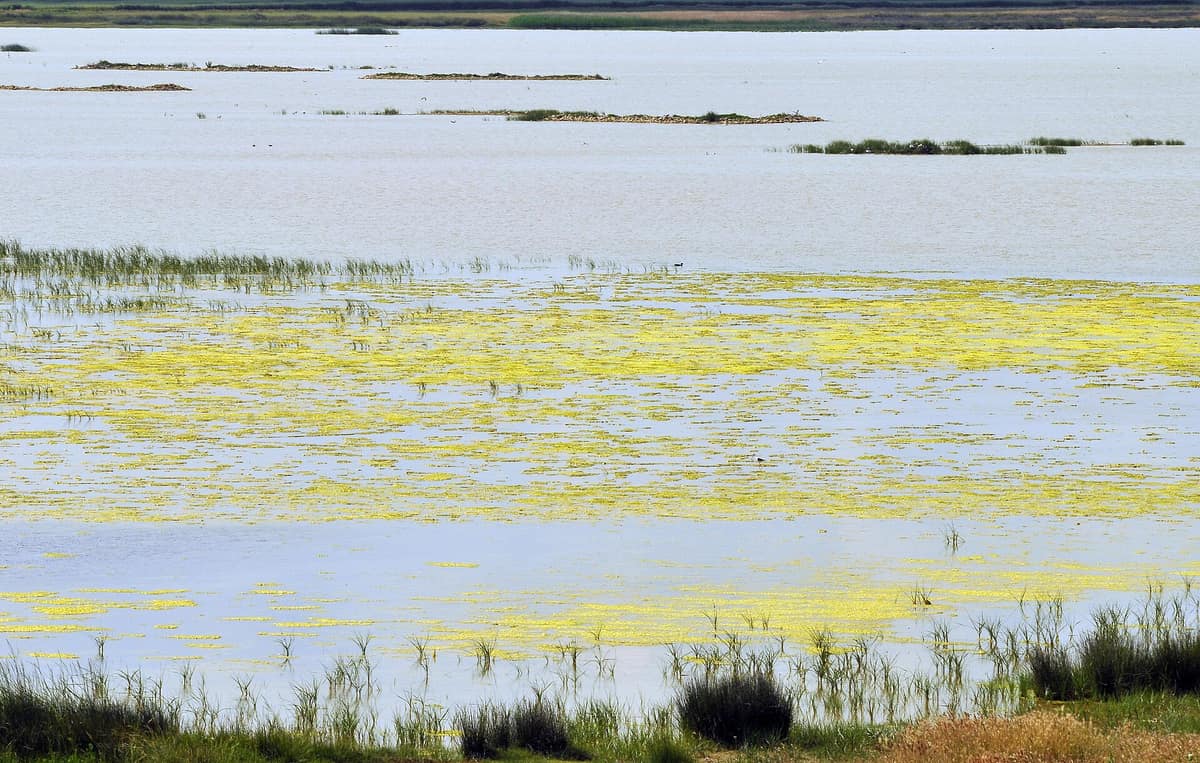
Some places change their face with the seasons, and Villafáfila is the extreme case. In the Tierra de Campos of Zamora, in the north-east of the province, a complex of temporary salt lagoons is surrounded by a dry cereal steppe. In winter, water; in summer, cracked lakebeds and crusts of salt. And all around, always, open country where the birds that made the reserve famous live.
What makes it unique
Salt lagoons that come and go with the water, and dry cereal farmland wrapped around them: wetland birds and steppe birds on the same horizon.
The place
Nature
The landscape
To understand Villafáfila you have to start with the salt. The complex lies in a valley formed on a weathered Miocene surface. Groundwater rises to the upper layers and, on the way, dissolves the salts that impregnate the Tertiary sediments: that's why the lagoons are salty. They are partly drained by the Salado stream.
Salina Grande, Barillos and Las Salinas are the main lagoons, and all of them are temporary. In summer, evaporation makes the water disappear and the lakebeds turn cracked and covered in a crust of salt. Then winter comes back and the landscape is a different one. Around the lagoons grow salt meadows, which together with them make up the botanically richest ecosystems in the reserve. On the lagoon edges and the nearby grasslands, a grass known locally as gramón dominates; among the plants of the salt meadows are those called escorzonera enana, pelujo and hinojillo de conejo, and in the wetland grows castañuela.
Beyond the water, the cereal steppe rules. Bitter winter cold and summer drought shape a steppe vegetation with few trees. Villafáfila's climate is semi-arid continental Mediterranean, and the landscape shows it: long horizons, few trees. The area completes the picture with traditional rammed-earth and adobe architecture, the «mud culture».
Wildlife and seasons
The best thing about Villafáfila is that you can follow its calendar month by month.
In March the display of the great bustard begins, and it carries on into April. May is the breeding season of the lesser kestrel, and the colony on the church of Otero de Sariegos is especially striking. In spring the great variety of waders comes into its own. Among the breeding birds, the black-winged stilt, the avocet and the marsh harrier stand out. In summer, when the water shrinks, the Revellinos hide lets you see gatherings of ducks and geese on the Rosa and Fuente lagoons.
Then autumn arrives, and November is the month with the most cranes in the reserve, along with the first greylag geese. In winter there are thousands of geese and ducks. From the Otero de Sariegos hide you can watch the geese flying in and out of the Laguna Grande in winter. Among the birds that use the area only in winter or on passage, the gadwall, the common teal and the spoonbill are also recorded.
And out in the fields, the steppe still holds great bustard, lesser kestrel, Montagu's harrier, little bustard and black-bellied sandgrouse.
Species
With a page in the atlas
Being mentioned in a source doesn't guarantee sightings: check with the people who manage the area.
Memory and protection
History and conservation
Salt was the area's great draw for people: extracting it attracted Chalcolithic and Bronze Age settlements. The Las Salinas lagoon was drained in 1970, and the Junta de Castilla y León restored it in 1989.
The pressures haven't gone away. Ramsar data identify increasing silting-up of the wetland, and in the countryside the threat to lizards is linked to the loss of woody vegetation and field margins and to the use of insecticides.
Before you set off
Visiting
How to visit
The Casa del Parque El Palomar visitor centre, in Villafáfila, is the best place to start. Its exhibition explains why the lagoons are seasonal and why they attract so many birds, and there's an audiovisual about the landscape, its people, daily life, wildlife and plants. Experienced staff give information about the reserve. From the viewpoint you look out over the wildlife park, and through some small openings you can peer inside the dovecote; a camera lets you watch the birds on one of its lagoons without them feeling watched.
For walking, the footpath around the Laguna Grande is 10 kilometres long and takes about three hours. It's a circular path that passes the Otero de Sariegos bird hide and the Roman bridge of Villafáfila. That hide is the best spot for the Salina Grande, with telescopes for public use and a car park where you can leave the car and do the route on foot. In winter, this path lets you look for geese and ducks; in spring, waders.
If you'd rather drive, there's a route through Tapioles, Revellinos, Villafáfila and Villarrín de Campos, taking roughly two hours, which covers the main lagoons and the best steppe area for seeing great bustards. There are also hides beside the Rosa lagoon, in Revellinos, and the San Pedro lagoon, in Villarrín de Campos, where an open-air themed area uses panels to show the importance of wetlands. The two routes in the technical guide are recommended for winter, when the lagoons hold water.
Before you go
In winter, some tracks can become impassable for motor vehicles; bring warm clothes. From Zamora, follow the N-630 towards Benavente and, after Granja de Moreruela, take the ZA-701 towards La Estación de la Tabla. Respect the signs, the routes and the no-access areas, and watch or take photos from the signposted spots. Loose dogs are not allowed in the viewing areas.
Check access, rules and visiting conditions in the official information from the managing body before you set off.
Location
Where it is and how far it reaches
Boundary of Lagunas de Villafafila · IUCN IV · © EEA, CDDA (CC-BY) The coordinate is estimated; it isn't a verified access point.
Transparency
Sources
The research data with its sources, and the official links for this place, are in the Spanish version of this page. See the Spanish version
Around it
The atlas records no close neighbours, but it does list distant steppes and wetlands with the same birds. Körös-Maros National Park - Dévaványa Plain and Fertő-Hanság National Park - Hanság Steppe share Montagu's harrier and the great bustard with Villafáfila; the Veliki Rit Pastures Special Nature Reserve shares the great bustard; and Neusiedler See - Seewinkel National Park, the greylag goose.
Entry #496 of the original atlas.