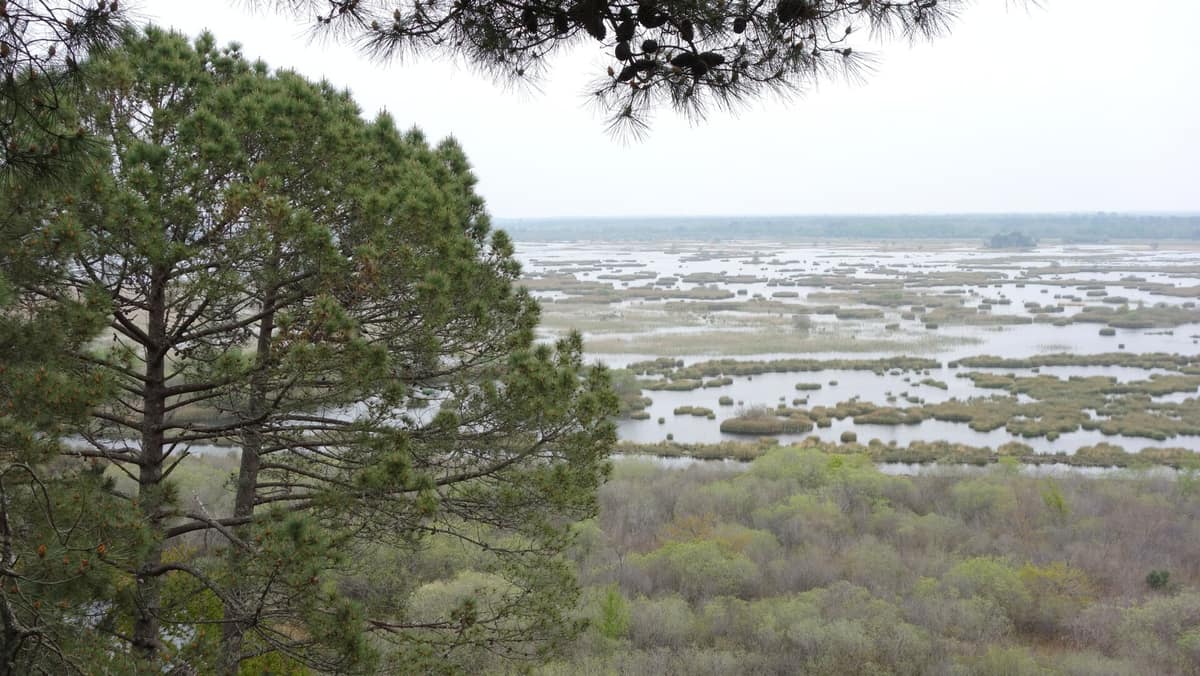
Cousseau Pond National Nature Reserve
Réserve Naturelle Nationale de l'Étang de Cousseau
Nouvelle-Aquitaine (Gironde / Lacanau) · France
Photo: Zlice · CC BY-SA 4.0 · Wikimedia Commons
Pristine dune pond and protected wooded marshes between the great Médoc lakes and the Atlantic Ocean.
Three kilometers from the Atlantic, between two of the great lakes of the Médoc, lies a small pond accessible only on foot or by bicycle. This is the Cousseau Pond National Nature Reserve in Lacanau, 50 km west of Bordeaux. The pond covers 50 ha, but the reserve spans six hundred hectares, with another three hundred acquired in its surrounding area: a miniature summary of the Landes of Gascony, with wooded dunes to the west and the Talaris marsh to the east.
What makes it unique
Within a very compact space lie forests on ancient dunes, a pond that never dries up, and a marsh where thousands of cranes land every winter.
The place
Nature
The landscape
It all began with the wind. Around 3000 years ago, winds carried beach sand inland, creating dunes that prevented rivers of the Landes of Gascony from flowing into the sea. This formed coastal lagoons parallel to the shoreline, cut off from the ocean by a dune cord. Until the seventeenth century, Cousseau was part of a vast body of water extending from north of Hourtin to south of Lacanau.
Three environments compose the reserve today. The woodland over ancient dunes blends planted pine stands and mixed oak-pine woods, with dry clearings and damp hollows known as barins. The pond of Cousseau holds water year-round. And the marsh: beside the pond reedbeds dominate, and further east, purple moor-grass moorland announces the wet heath that once covered most of the plateau.
On the western dunes grow heather moorlands and sage-leaved rockrose, with white corollas blooming between April and June. In the most flooded parts of the marsh, great fen-sedge prevails alongside alder buckthorn, willows, and colonizing birches. In the peaty hollows, spoonleaf sundew, Thorella, and pillwort thrive; rare flora includes hairy-fruited sedge, Thore's false watercress, and pillwort globulifera.
Wildlife and seasons
The reserve transforms with each passing season. During spring and autumn stopovers along this migration corridor, more than two hundred species can be spotted, including greylag geese, little egrets, the Eurasian spoonbill, and black-headed gulls; the osprey stays mainly from August to October. In winter, thousands of common cranes arrive, making the reserve a wintering ground of national importance.
In spring, more than 70 species breed here. On the shores of the pond, purple heron and western marsh harrier; in the marsh, red-backed shrike, Eurasian curlew, and the scarce common snipe; in the forest, raptors such as short-toed snake eagle and northern goshawk. The Eurasian otter and the common genet are discreet, finding quiet sanctuary and food here alongside roe deer, red deer, and wild boars.
When the Talaris marsh floods in winter and spring, it serves as breeding habitat for pike and feeding ground for young glass eels. There are pool frogs and Mediterranean tree frogs, natterjack toads, snakes such as asp viper and Aesculapian snake, and the European pond turtle. Since 1995 a total of 39 dragonfly species and about fifty butterfly species have been recorded, with the false ringlet as an emblem. In total, more than 3 000 species have been documented.
Species
With a page in the atlas
Being mentioned in a source doesn't guarantee sightings: check with the people who manage the area.
Memory and protection
History and conservation
Until the end of the eighteenth century, these were open moorlands flooded in winter, where shepherds let their sheep graze freely. In the nineteenth century, drainage and maritime pine plantations transformed the Landes; pine stands were worked for timber and resin, and an authentic gemmeur resin tapper's hut still stands in the reserve.
During the 1970s, waterskiing on the pond caused severe disturbance to wildlife. Its designation as a reserve in 1976 and the work of SEPANSO enabled a gradual recovery of biodiversity. Back then, the marsh had been invaded by woody scrub and disconnected from the drainage network; it was restored through controlled burning and brush clearing, and reconnected to its basin to recover natural water dynamics.
Restoration brought large grazing animals. In the early 1990s, SEPANSO acquired the last known herd of Marine landaise cattle in extremis, and their reintroduction helped restore biodiversity. Today, management utilizes Marine cattle and Landais ponies. The reserve is part of the Rewilding Europe network: in 2023 it launched the reintroduction of the dung beetle Scarabaeus laticollis, once vanished from Gironde—the first reintroduction of an extinct insect in France—and in 2024 a herd of water buffaloes was introduced to maintain open marshland. Among current threats is the Louisiana crayfish, an introduced species with heavy impacts on vegetation and aquatic fauna.
Rewilding projects
Before you set off
Visiting
How to visit
A marked nature trail skirts the pond from the observatory in the south to the western clearing. The walk from the Marmande car park on the D6E1 between Le Huga (Lacanau) and Carcans-Plage is 7,5 km round trip. You can also arrive by bicycle via the bike path between Lacanau-Océan and Maubuisson, with two entrances equipped with bicycle stands, Lesperon and Régue Verte. The reserve is open year-round from sunrise to sunset, and guided tours require booking.
Sturdy walking shoes, water, mosquito repellent from March to July, and binoculars are recommended. The best time for cranes is autumn and winter.
Before you go
Year-round, all vehicles are prohibited, including bicycles even if pushed on foot, swimming, boating, off-leash dogs, gathering plants and mushrooms, disturbing wildlife, camping, bivouacking, lighting fires, and flying over the reserve, including drones. Access is strictly confined to marked trails, and rangers patrol year-round to enforce the rules.
Check access, rules and visiting conditions in the official information from the managing body before you set off.
Location
Where it is and how far it reaches
Boundary of Étang Du Cousseau · IUCN IV · © EEA, CDDA (CC-BY) The coordinate is estimated; it isn't a verified access point.
Transparency
Sources
The research data with its sources, and the official links for this place, are in the Spanish version of this page. See the Spanish version
Around it
The great lakes of the Médoc lie to both sides of the pond: Carcans-Hourtin to the north and Lacanau to the south. Further afield, Słowiński National Park in Poland shares coastal wetlands with Cousseau, along with common cranes and otters.
Entry #182 of the original atlas.