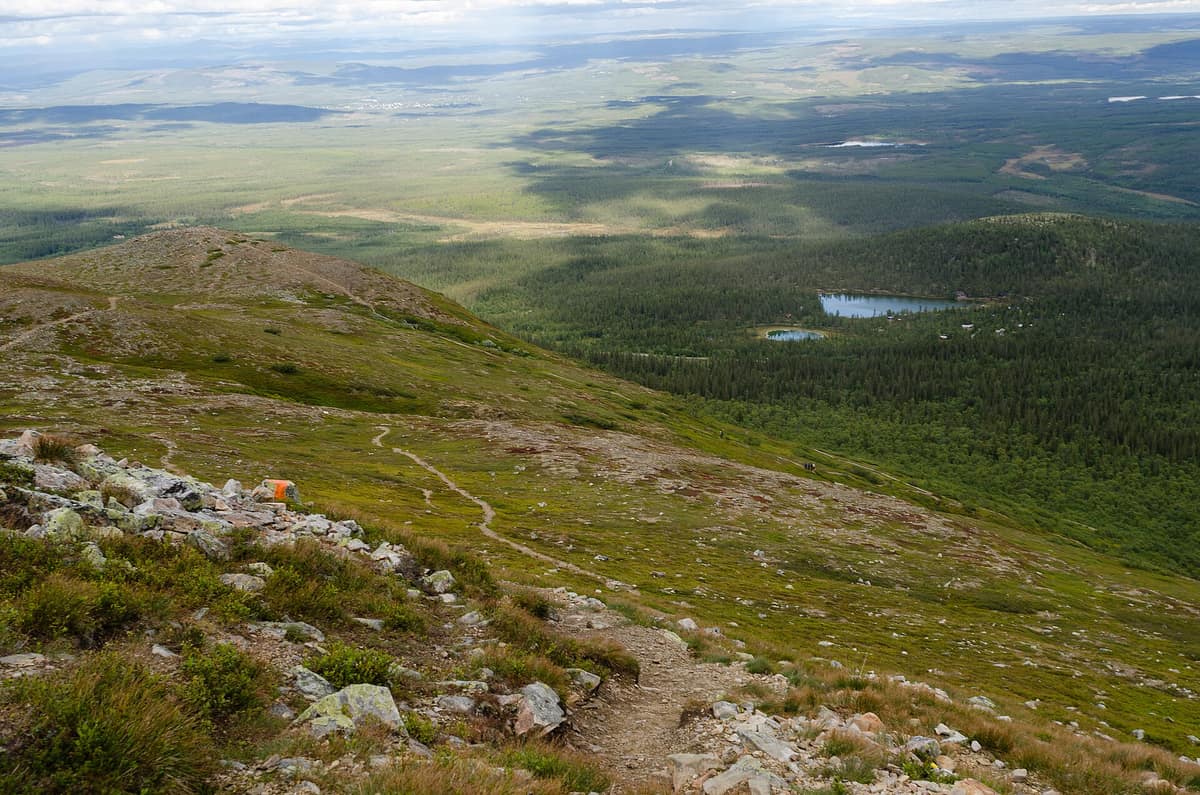
Sonfjället National Park
Jämtland (Härjedalen / Hede) · Sweden
Photo: Arild Vågen · CC BY-SA 4.0 · Wikimedia Commons
A solitary, isolated mountain in the heart of Sweden, an iconic historic sanctuary with one of the highest densities of brown bear (Ursus arctos) in the country.
From almost anywhere in Härjedalen, its silhouette is unmistakable. Sonfjället rises solitary above the rolling landscape, etching its profile against the horizon, with Högfjället, its highest peak, reaching 1,278 metres. It is an immense, lone mountain surrounded by continuous forest, and one of the premier bear refuges in Scandinavia.
A small part of the massif was set aside as a national park in 1909, making it one of the very first in Europe. Later the park was expanded and today encompasses the entire mountain and the encircling boreal forest.
What makes it unique
At Sonfjället the bear is almost never seen, yet its signs are everywhere: claw marks on tree trunks, torn anthills, and droppings laden with wild berries.
The place
Nature
The landscape
One vivid geological scene explains the place. Thousands of years ago, as the continental ice melted and the shrinking ice mass subsided, the highest western summits poked above the white expanse as nunataks. That is the mountain you see today. Meltwater from that ice left well-preserved geological features, such as the hillside meltwater channels (skvalrännor) gouged by torrents along the edge of the melting ice sheet, alongside patterned block fields arranged in regular geometric nets.
The park preserves coniferous and deciduous taiga forests, peatlands, and sweeping open heaths above the tree line. After Högfjället at 1,278 metres, the main peaks of the massif include Valmfjället, Gråsidan, Medstöten, and Korpflyet.
Wildlife and seasons
The bear is the emblematic animal of the park, though elusive: it is recognized far more through droppings, tracks, and raided anthills than by sight. Spotting one is rare, but in September and October during berry-rich years, bears may occasionally be seen foraging on black crowberries. Guided tours are offered to search for bears and their tracks.
Eurasian lynx also occurs alongside a healthy population of moose, and wolves, wolverines, and muskoxen turn up on occasion. Native alpine animals include Norwegian lemming and caribou. Common birds include European golden plover, Eurasian dotterel, willow ptarmigan, and rock ptarmigan; rough-legged buzzard, osprey, and golden eagle are also frequently sighted.
In winter, tracking signs of wolverine, lynx, fox, pine marten, lemming, and ptarmigan is far easier than spotting the animals themselves. In late winter, the western flank of Gråsidan becomes a popular backcountry ski-touring route. The finest season for hiking runs from June to September.
Species
With a page in the atlas
Being mentioned in a source doesn't guarantee sightings: check with the people who manage the area.
Memory and protection
History and conservation
This mountain fell was originally selected for its lichen-rich montane heaths, which were little grazed by domestic reindeer, and to protect the last remaining herd of truly wild reindeer in Sweden. In 1989 the national park was expanded from 27 to 104 square kilometres to safeguard the entire mountain and its surrounding old-growth forests. Human presence here may date back more than 8,000 years.
Before you set off
Visiting
How to visit
There are several access points. The main trailhead is Nyvallen, located at a working summer farm with mountain cows and goats that has operated since the early eighteenth century: Nyvallen is reached in summer by car from Hedeviken, some 16 kilometres away, where the public road ends. The Nyvallen information cabin is generally open from Midsummer until late September. Dalsvallen to the south allows hikes year-round with separate summer and winter trails, while from Valmen a summer path climbs into the high fell; there is an accessible rest area here.
Several marked summer trails span the terrain, ranging from short walks for children to full-day ascents and multi-day traverses. Marked with cairns or painted posts, Nyvallen, Nysätern, and Dalsvallen serve as the natural starting points. At Nyvallen, a short interpretive trail with nature panels invites children to find carved wooden forest animals.
If you want to head into the heart of the massif, a trail of about seven kilometres runs from Nysätern to the Sododalen cabin; this central valley is often described as the heart of Sonfjället. Inside the cabin, visitors can listen to recorded interviews and nature audios and view park photographs by connecting to a local wireless hotspot.
For ski touring, the road to Nyvallen is not plowed in winter; to access the park on skis, it is best to start at Nysätern, where the road is cleared and the marked winter trail commences.
Before you go
The Sododalen cabin remains open year-round and may be used for overnight shelter in emergencies. Digging up or damaging plants is prohibited, though foraging for wild berries and edible mushrooms is allowed; motor vehicles are strictly forbidden off designated roads and car parks. Campfires may be lit only at designated fire hearths located at the Nyvallen, Nysätern, and Valmen entrances, near the Sododalen cabin, and at the Stor-Ryvålen shelter.
Check access, rules and visiting conditions in the official information from the managing body before you set off.
Location
Where it is and how far it reaches
Boundary of 2000934 Sånfjället · IUCN II · © EEA, CDDA (CC-BY) The coordinate is estimated; it isn't a verified access point.
Transparency
Sources
The research data with its sources, and the official links for this place, are in the Spanish version of this page. See the Spanish version
Around it
Sonfjället shares distant kin with whom it shares moose, lynx, and bear: Lahemaa National Park, Slītere National Park, and Soomaa National Park offer similarly rich old-growth forests, while Sarek National Park adds high alpine wilderness.
Entry #578 of the original atlas.