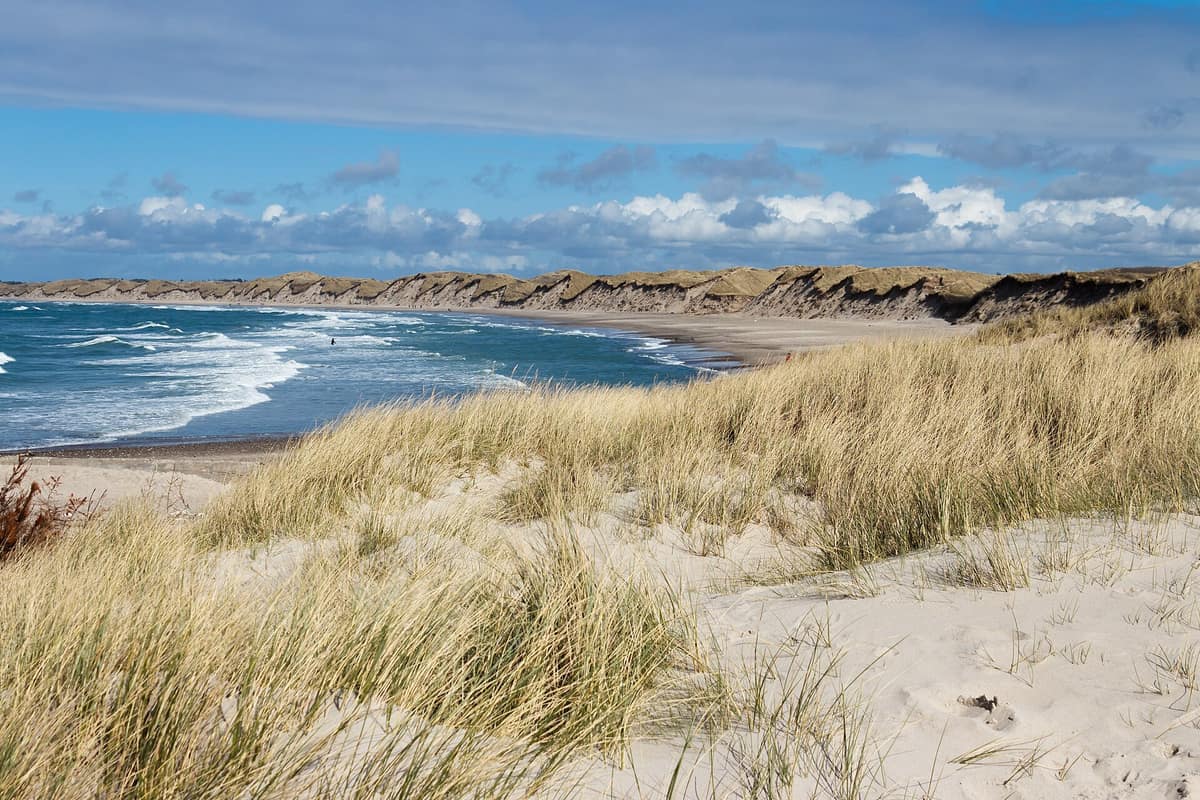
Thy National Park
North Jutland (Thisted / Hanstholm / Vorupør) · Denmark
Photo: Kim Hansen · CC BY-SA 4.0 · Wikimedia Commons
Denmark's first National Park (244 km²), a coastal wilderness of shifting dunes, littoral heathlands, and dune forests lashed by the North Sea.
For generations, drifting sand was the enemy. Across Thy in northwestern Jutland, shifting dunes swallowed cultivated fields and farmsteads, and only around the year 1800 did organized planting of marram grass and conifers begin to halt the sand drift. Today, that historic struggle has left behind extensive dune plantations and a wilderness of heather heaths, dune lakes, and open North Sea coast that in 2008 was inaugurated as Denmark's first national park. Covering 244 km², it traces the coast from Hanstholm south to Agger Tange, stretching 55 km from north to south. Here you can hike across wild dune heaths and watch red deer and cranes from observation towers.
What makes it unique
A vast expanse of coastal dune heath, globally rare in the European context, where red deer rut each autumn and cranes dance each spring.
The place
Nature
The landscape
Some 4.000 years ago, western Thy was an open archipelago of islands. The land has steadily rebounded through post-glacial uplift, pushing the shoreline kilometers westward. In the Stone Age, the terrain surrounding Isbjerg was open sea: the modern heath rests on ancient seabed, and Isbjerg was an isolated island. The former coastline persists as an inland escarpment: that is the slope you climb along the marked trail to Isbjerg.
As the land rose, immense volumes of sand were exposed to wind action, driving the dune migrations of later centuries. Thy's coastal dune heaths represent an internationally rare habitat protected under European law. They are dominated by heather, sand sedge, marram grass, crowberry, and cross-leaved heath, interspersed with diverse lichens.
At Vangså Klithede grow all three Danish sundew species, and in June wild orchids tint parts of the heath in vivid pink. To prevent succession into scrub and trees, the heath is actively managed through clearing, controlled burning, and conservation grazing.
Wildlife and seasons
The natural year in Thy features two headline spectacles. The first arrives in spring: in March and April common cranes perform their trumpeting courtship dances in the marshes beneath the Sårup observation tower; on quiet April mornings and evenings their resonant bugling carries across the wetlands. Crane breeding numbers have surged in Thy: up to 100 pairs out of Denmark's national total of 600-800 pairs. Cranes are sensitive to human intrusion during nesting: observe them discreetly from the towers with binoculars.
The second spectacle is autumn. Red deer are most easily observed during the rut, from late August to late October. By late summer up to 400 stags and hinds congregate in the open dunes before the Sårup tower. From Hanstholmskrænten at Brunbjerg or from the Hanstholm lighthouse, you overlook the vast reserve and can hear the roaring of rutting stags.
Between these seasons pass migratory flocks. Agger Tange, situated directly on the West Jutland flyway, is an EU Special Protection Area. On September evenings thousands of greylag geese arrive from the east to roost on the lagoon, visible from the Arbejdsvejen bird hide. On the southern spit, common seals haul out regularly; in July and August during their annual moult, human disturbance can be fatal.
Smaller wildlife also abounds. Ålvand shelters Eurasian otters, natterjack toads, spadefoot toads, and viviparous lizards, while whimbrel, cranes, and geese forage across the heath. Since 2009, confirmed wolf sightings were documented in Thy and Hanstholm reserve. In 2012 a dead wolf was found, confirming the predator's return after having been extirpated from Denmark in 1813.
Species
With a page in the atlas
Being mentioned in a source doesn't guarantee sightings: check with the people who manage the area.
Memory and protection
History and conservation
On 29 June 2007 the Minister for the Environment selected Thy as Denmark's inaugural national park; official opening celebrations followed on 22 August 2008. Ecological restoration began much earlier in the Hanstholm reserve. In the thirties the Danish State purchased 34 km² and prohibited hunting; in 1939 drainage ditches were blocked, allowing natural regeneration as the nation's earliest nature restoration initiative. Today it forms Denmark's largest dune heath, a mosaic of plains, dune slacks, and heather hummocks.
Before you set off
Visiting
How to visit
Begin at the Nationalparkcenter Thy in Nr. Vorupør: Denmark's first national park visitor center, opened on 15 June 2021 and built seamlessly into the coastal dunes. Its interactive exhibition explains coastal landforms, heathlands, wildlife, sand drifts, and cultural history. The park maintains five visitor gateways offering information, inspiration, and trail maps.
Thy offers 49 waymarked trails, including short nature strolls such as the 800 m Hulvejsruten. The long-distance Vestkyststien/Redningsvejen measures 67 km from Agger Tange to Hanstholm and onwards to Bulbjerg. You can explore on foot or by bicycle; cycling is permitted on designated tracks suitable for standard bikes, but strictly barred from beaches, archaeological barrows, dunes, and grazing meadows. During westerly gales and spring tides the beach route at Sorte Næse in Lodbjerg is impassable, and heavy rain floods parts of Redningsvejen north of Lyngby.
For wildlife viewing, three vantage points stand out: the Sårup tower on the ancient coastal cliff gives expansive views across the Hanstholm reserve; the Tvorup Klitplantage tower overlooks the wilderness of Ålvand; and Agger Tange is premier for coastal waterbirds.
Before you go
Entering the core sanctuary of the Hanstholm reserve is prohibited year-round, while the remaining eastern section beyond the Coastal Road is closed from 1 April to 15 July. Dogs are barred from the reserve. Ålvand Klithede and Færgegårds Sig close from 1 April to 15 July during bird breeding season; in Ålvand you must stay on established trails. At Agger Tange, access to the coastal sand spit waters and bird island is prohibited year-round, and the wet meadows close from 1 April to 15 July.
Throughout the rest of the park, dogs are welcome on a leash; only in winter may they run off-lead on the beach, and in summer solely within the water below the high-tide line. The premier season spans May to October.
Check access, rules and visiting conditions in the official information from the managing body before you set off.
Location
Where it is and how far it reaches
Boundary of Nationalpark Thy · © OpenStreetMap contributors (ODbL) The coordinate is estimated; it isn't a verified access point.
Transparency
Sources
The research data with its sources, and the official links for this place, are in the Spanish version of this page. See the Spanish version
Entry #582 of the original atlas.