Tiveden National Park
Västra Götaland / Örebro (Laxå / Karlsborg) · Sweden
Photo: Silverkey (Mickaël Delcey) · CC BY-SA 4.0 · Wikimedia Commons
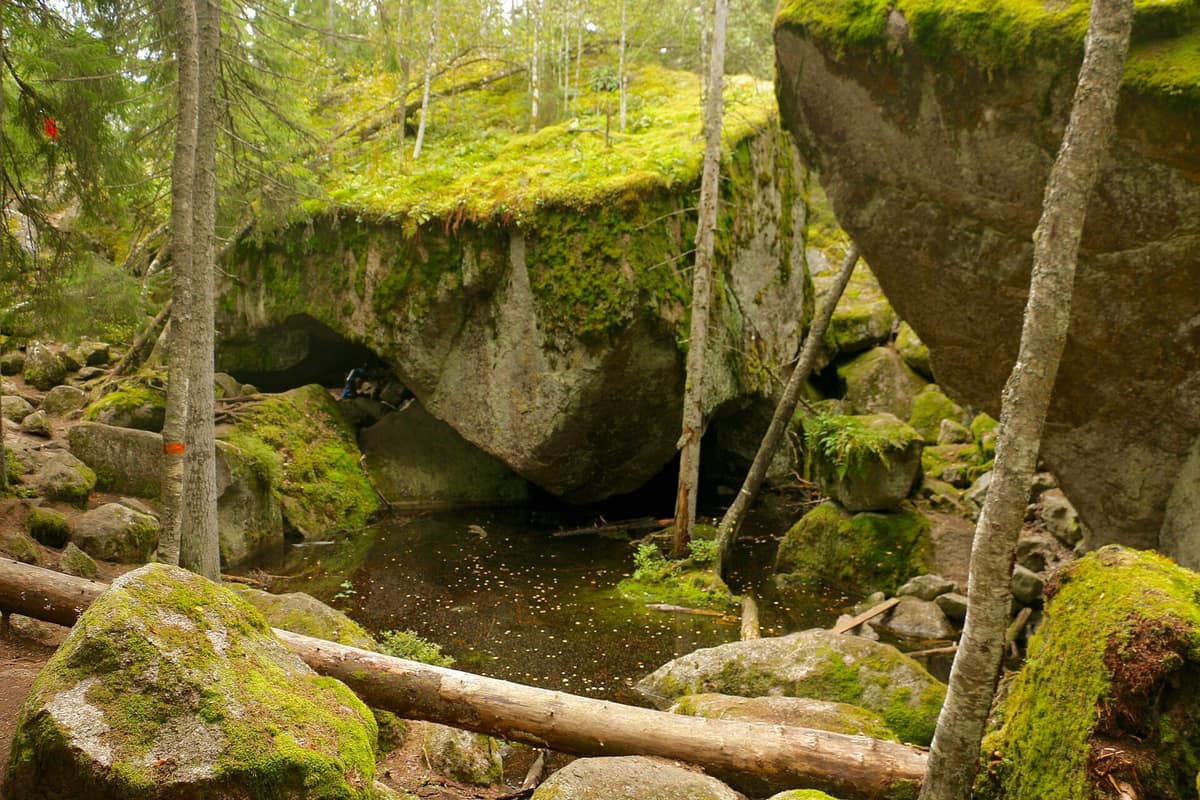
A chaotic wild maze of moss-cloaked granite boulder fields and centuries-old pines between lakes Vänern and Vättern.
Imagine a forest where the ground is a grid of deep chasms, lakes fill the fractures, and rock boulders larger than houses rest exactly where the glacier abandoned them. That is Tiveden, lying between the great lakes Vättern and Vänern on the border of Västergötland and Närke. It has been a national park since 1983 and remains one of the wildest primeval-like forests in southern Sweden: a terrain to trek among gnarled pines, thick moss, and stone, understanding why folklore populated these woods with trolls.
What makes it unique
An ancient pine forest shaped by fire, strewn with ice-transported boulders and carved into granite fractured into a grid.
The place
Nature
The landscape
It all originates in the granite bedrock. When Lake Vättern took shape between 900 and 1 400 million years ago, the bedrock of Tiveden fractured into a perpendicular grid pattern that is clearly legible today. Lakes and peat mosses settled into the fissures, while intact crustal blocks remained as steep ridges.
Then the continental ice sheet advanced. Melting away roughly 11.000 years ago, it ripped away rock slabs and scattered them across the plateaus. The largest and densest accumulations of boulders jammed into the fracture valleys, creating monumental block fields such as Stenkälla. Rushing meltwater flushed away virtually all fine sediments, leaving behind bare rock. Boulders rise up to ten metres high, hiding cave labyrinths in their interstices.
Vegetation clings stubbornly to this sparse terrain. Scots pine alone perseveres on bare rock, growing slowly into dwarf forms; in places the forest floor is just an uninterrupted carpet of reindeer lichen. Wherever soil gathers, Norway spruce establishes, while broadleaved trees are rare. Portions of very old, open pine woodland shaped by historic wild fires survive with extraordinarily high biodiversity, among the last remnants of its kind in southern Sweden. Because precipitous cliffs, barren rock, and early protection kept modern commercial forestry away, the forest is allowed to develop freely toward natural climax woodland. Dwarf birch flourishes in the mires, a subarctic shrub largely confined to Norrland.
Wildlife and seasons
Tiveden forms a biogeographical transition zone between northern and southern biotas. Consequently, western capercaillie and Eurasian pygmy owlet co-occur with diverse woodpeckers, and the three-toed woodpecker approaches the southern limit of its breeding range here. Moose and roe deer are scarce; red fox, badger, pine marten, and red squirrel are widespread. Eurasian beaver has also recolonized, occasionally damming streams alongside park roads. Over 770 species of beetles find a haven in the decaying deadwood.
Each season unfolds distinct impressions. In spring, fresh green growth and birdsong; with good fortune, on an early summer dawn, a capercaillie displaying on his lek. In summer, you walk upon sun-warmed rock, swim in Lake Trehörningen from Vitsand beach, and seek cool shelter among the shaded boulder caves. In October, deciduous trees blaze with autumn color while crystal air opens broad vistas. Winter access is more demanding, but you can marvel at the ice curtains of Stigmanspasset or snowshoe through the silent forest.
Species
With a page in the atlas
Being mentioned in a source doesn't guarantee sightings: check with the people who manage the area.
Memory and protection
History and conservation
In the early Middle Ages, the dense wilderness of Tiveden was a notorious refuge for outlaws. Its maze of fissures, caves, and perched boulders fostered folklore of trolls, gnomes, and mythical creatures.
The national park was established in 1983 encompassing some 1.350 hectares, and expanded in 2017 to approximately 2.030 hectares, adding a circuit around Stora Trehörningen and two new trailheads at Vitsand and Ösjönäs. Its primary purpose is preserving an intact wilderness of fracture valleys, lakes, and ancient woodlands, letting the forest age into true primeval condition. To maintain fire-adapted pine communities, controlled prescribed burning is applied, invigorating pine regeneration while suppressing spruce.
Before you set off
Visiting
How to visit
Most visits begin at the main entrance in the park's center: featuring parking, toilets, visitor information, and an interpretive exhibition, serving as the hub for most trails. Two alternative entrances exist at Vitsand and Ösjönäs. Marked paths span over 34 km, featuring scrambles into deep gorges and climbs onto lichen-clad ridges. Many are strenuous.
If you have limited time, Stenkällerundan (2.2 km, hour and a half) is the most frequented, leading to fire-shaped old-growth pine and colossal glacial boulders; the Stenkällan rock formation ("the stone temple") has been a classic destination since the late nineteenth century. Trollkyrkorundan (4.6 km, about three hours) climbs several ridges, including Stora Trollkyrkan and Lilla Trollkyrkan, with numbered interpretive stops. Stigmansrundan (4.2 km) descends into the chasm of Stigmanspasset. Oxögabergsrundan (6.7 km) traverses damp spruce forests, boggy swales, and capercaillie habitat. The 9.5 km Trehörningsrundan circles the central lake, displaying most park habitats. Mellannäsrundan (1.9 km) is the gentlest: at Mellannäsudden you will see relics of historic charcoal and tar production from early ironworks.
Through the eastern boundary runs the Bergslagsleden, a 280 km long-distance trail, accessible on foot, by bike, or on horseback from Tived village. Surrounding the park are roughly 150 km of signposted cycle routes and over 300 km of equestrian trails.
Before you go
There is no electricity or certified drinking water in the park. Beside the main entrance information cabin stands a manual pump well, but its water is unmonitored. During peak summer from June to September, visitor numbers peak between 11:00 and 14:00; the Vitsand entrance provides additional parking.
Regulations are clear. Dogs must be kept leashed. Overnight camping is restricted to a single night at designated campsites between 18.00 and 10.00. Lighting fires outside designated fire hearths, disturbing raptor nests or animal dens, and operating motorized watercraft are strictly forbidden. You may harvest edible wild berries and mushrooms; collecting plants, mosses, or lichens requires research authorization. All three entrances feature accessible facilities, with boardwalk ramps leading to a viewpoint and a lake promontory.
Check access, rules and visiting conditions in the official information from the managing body before you set off.
Location
Where it is and how far it reaches
Boundary of 2001216 Tiveden · © EEA, CDDA (CC-BY) The coordinate is estimated; it isn't a verified access point.
Transparency
Sources
The research data with its sources, and the official links for this place, are in the Spanish version of this page. See the Spanish version
Entry #591 of the original atlas.