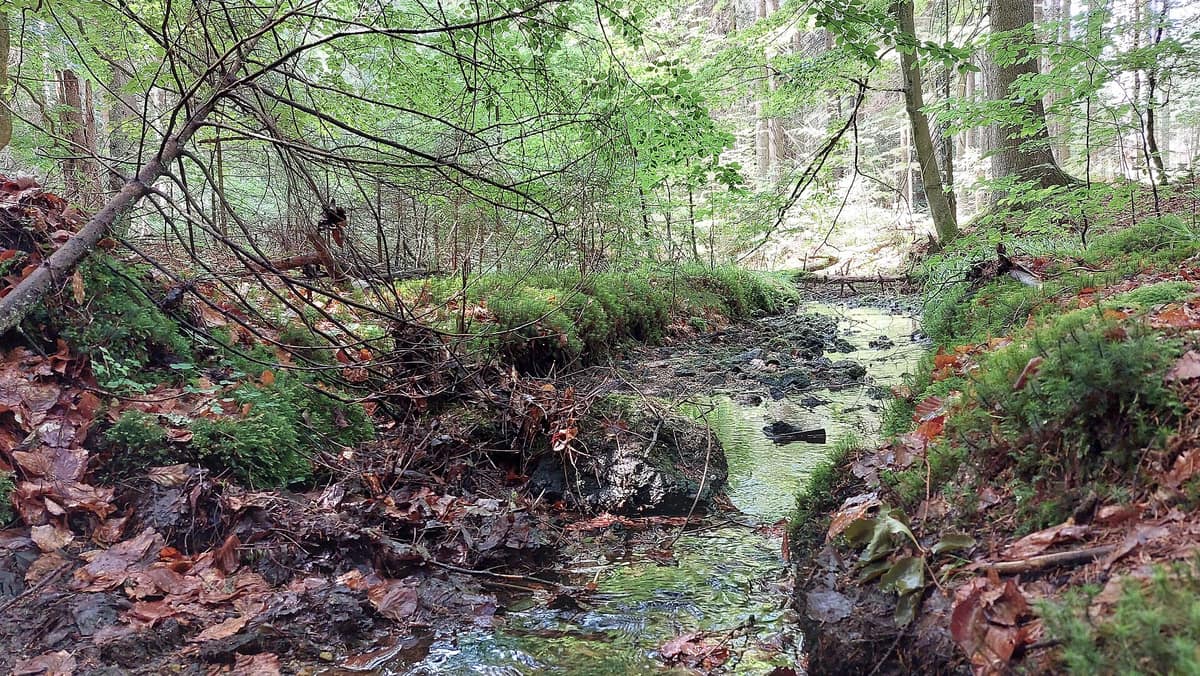
Žofín Primeval Forest and Surrounding Massif
Žofínský prales - Okolní lesy
South Bohemia (Novohradské hory) · Czechia
Photo: Chmee2 · CC BY-SA 4.0 · Wikimedia Commons
The oldest strict forest reserve in continental Europe (declared protected in 1838 by Count Buquoy).
In 1838 a count did something almost nobody did: he stopped logging. Count Buquoy, owner of the Nové Hrady estate, took this hillside out of forestry use and banned felling trees and gathering firewood. His forest engineer, Rowland, reproached him for it and predicted that the forest, already ageing, would collapse within fifty years under storms and snow. 170 years went by almost without human influence and the forest was still standing. Today Žofínský prales, together with Hojná Voda, is the oldest reserve in continental Europe, 15 km south-west of Nové Hrady, right on the border with Austria.
What makes it unique
A reserve from 1838 that proved an old forest can look after itself.
The place
Nature
The landscape
The forest spreads between 735 and 830 m, on a north-east-facing slope of Stříbrný vrch, a 936 m mountain. The bedrock is granodiorite, which breaks down into a deep, well-drained sandy loam, and dozens of seepage springs feed small streams whose ravines shape the ground. Almost the whole reserve is forest: clearings and water cover just 2.59 ha.
In that forest a slow changeover took place. In Buquoy's forest silver fir dominated, with spruce and beech, and here and there sycamore and wych elm. After the reserve was created the firs died off little by little, spruce took over and then beech rose, which today makes up more than 80 % of the trees. The dominant forest types are beech woods with sweet woodruff and with wood barley; on damp soils, montane beech forest, and around the springs, spruce with horsetails. The oldest trees are between 300 and 400 years old and stand 40 to 50 m tall.
And there was one famous tree: until 1975 the Queen of the Firs grew here, 425 years old, 553 cm in girth and 51 m tall, until a gust of wind brought it down on 6 January 1975.
Wildlife and seasons
This is a forest to look at from a distance. In the understorey grow toothwort, sweet woodruff and other characteristic species, and a regional rarity is the three-leaved bittercress. The reserve protects the threatened moss Dicranum viride and is key for rare mosses (181 species), fungi (600 species), snails and insects. Every year 35 to 40 bird species breed here, and a survey in 1997 counted 163 species of beetle.
Among the mammals, the wild boar gets into the reserve without any trouble, and its effect is considered positive, because turning over the soil helps natural regeneration. Red deer and roe deer are another story: from 1849 until the nineties the forest was part of a fenced hunting estate, and they damaged above all spruces up to 150 years old. That's why, since 1991, a 2 m fence has surrounded 80 % of the reserve and keeps them out.
Species
With a page in the atlas
Being mentioned in a source doesn't guarantee sightings: check with the people who manage the area.
Memory and protection
History and conservation
Rowland cut the original reserve of 172.6 ha down to 1.7 ha. Until 1882 deadwood and fallen trunks were removed from the core, and in 1947–50 there was a campaign against bark beetles. In 1882 an absolute ban on felling was issued, and in 1933 the ministry declared it a full state reserve of 97.72 ha. Since the middle of the eighteenth century most of the area has developed as primary forest without human intervention.
Because it lay right by the Iron Curtain, the German population was expelled after the Second World War and the area stayed closed to tourism. In 2026 the reserve was enlarged from 102 to 441 ha, and it protects mixed montane beech woods with fir and fragments of wet spruce forest and peat bogs.
Before you set off
Visiting
How to visit
Let's be clear: the forest isn't open to ordinary tourism, and since 1991 entering without a permit has been forbidden. To see these centuries-old trees, all that's left is the path that runs alongside the fence. The reserve is part of the Novohradské hory nature park, with attractions such as Terčino údolí and Hojná Voda; these mountains cover 162 km² on the Czech side. Around three quarters of the area is coniferous and broadleaf forest.
Before you go
Don't try to go in: the forest is closed and fenced, and entry is only possible with a permit. What's left is the path beside the fence and the rest of the Novohradské mountains.
Check access, rules and visiting conditions in the official information from the managing body before you set off.
Location
Where it is and how far it reaches
Boundary of Žofínský prales · IUCN IV · © EEA, CDDA (CC-BY) The coordinate is estimated; it isn't a verified access point.
Transparency
Sources
The research data with its sources, and the official links for this place, are in the Spanish version of this page. See the Spanish version
Around it
The reserve shares territory with the Novohradské Mountains - Forest Massif, the forest massif it lies in.
Entry #111 of the original atlas.