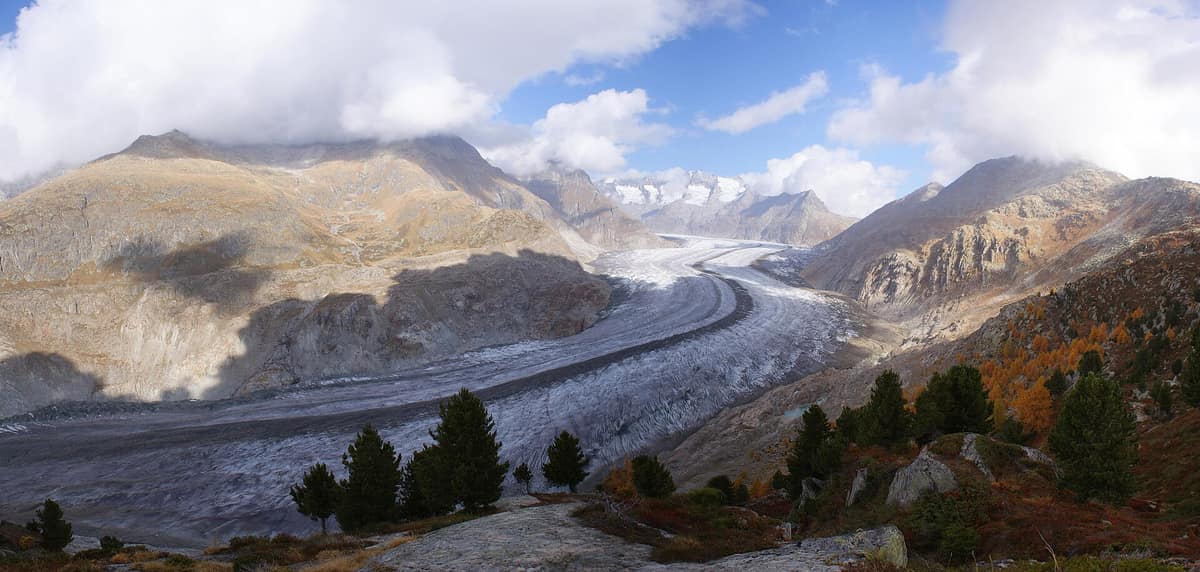
Great Aletsch Glacier - Unspoiled Sectors
Aletschgebiet Unspoiled Sectors
Valais (Fiesch / Riederalp) · Switzerland
Photo: Gab01 · Public domain · Wikimedia Commons
The largest glacier in the Alps (20 km long) bordered by ancient stone pine and larch stands in the Aletschwald.
In just seven kilometres you ascend from warmth into eternal ice. That is Aletsch: from Mediterranean-like rocky steppe basking on south-facing valley slopes to the Great Aletsch Glacier, the largest ice stream in the Alps. Between those two extremes, across a few hundred vertical metres, meadowlands, cool mountain forests, and glacial terrain follow in rapid succession. Because of this dramatic gradient, the Eiger, Mönch, and Jungfrau, together with the glacier, ancient woodland, and arid valley steppes, have been inscribed as a UNESCO World Heritage site since 2001.
What makes it unique
In a single day you can journey from warm rocky steppe to the largest glacier in the Alps.
The place
Nature
The landscape
Ice dominates everything and sets the scale. The main glacier forms where four tributary glaciers converge at Konkordiaplatz, where an ice thickness of 905 m was recorded. The highest summit flanking the western catchment is the Aletschhorn at 4,193 m. Some 18,000 years ago the lower ridge between Riederalp and the glacier tongue was completely submerged by ice; only the Bettmerhorn, Eggishorn, and Fusshörner projected as nunataks. Today the glacier is in steady retreat: since 1980 it has lost 1.3 km of its length and since 1870, 3.2 km, alongside over 300 m in vertical thickness.
Flanking the glacier tongue on the slopes of Moosfluh and Hohfluh, between 1,600 and 2,200 m, grows the protected Aletschwald. Its upper zone consists of Swiss stone pine and scattered European larch, cushioned by dwarf shrubs including alpine rose, heather, and bilberry. Dense stands incorporate Norway spruce. Stone pine is the signature tree, remarkably adapted to summer drought and severe winter gales on northern aspects, surviving for several centuries.
What makes the forest remarkable is the morainic succession. Within short walking distances you witness every stage of primary plant colonization across lateral moraines abandoned by the receding glacier, from initial pioneer crusts to ancient stone pines. Protected for decades, coarse woody debris remains in place, nurturing fungi, bryophytes, and beetles while serving as nurse logs for young larch and stone pine seedlings.
Wildlife and seasons
The woodland year centers around two seasonal events. In summer, rusty-leaved alpenrose blooms in pink carpets; in autumn, red deer stags roar across the slopes. Regular residents include red deer, chamois, and the spotted nutcracker, which feeds on stone pine seeds and caches them across the mountainside, alongside the alpine marmot. With patience and luck you may spot the black grouse, golden eagle, and Eurasian pygmy owl, Europe's smallest owl.
Ecological contrasts extend to smaller creatures: the green lizard, unexpected in an alpine setting, shares the wider region with cold-adapted glacier fleas thriving directly on ice surfaces.
Species
With a page in the atlas
Being mentioned in a source doesn't guarantee sightings: check with the people who manage the area.
Memory and protection
History and conservation
At the start of the twentieth century, unregulated timber felling, goat grazing, and intensive berry gathering left the Aletschwald severely degraded. Long-term protection was secured in 1933 when Pro Natura negotiated a 99-year conservation lease. Spared from forestry ever since, the woodland has regained primary old-growth characteristics.
Before you set off
Visiting
How to visit
The natural starting point is Villa Cassel, sitting at 2,000 m on the threshold of the forest reserve and the glacier. From Riederalp West it is reached on foot in about 30 minutes via a well-marked mountain path; Riederalp itself is entirely car-free. The Pro Natura Centre, open since 1976, operates from mid-June to mid-October with multimedia exhibits. It features interactive displays detailing glacier retreat, climate change, and energy transitions, accompanied by an alpine garden showcasing over 200 plant species adapted to high-altitude extremes.
Three walking routes depart from the centre. The shortest, Riederfurka–Moränenweg–Hohfluh, requires an hour-and-a-half with gentle climbing, tracing the lateral moraine formed during the last glacial advance and offering panoramas of the glacier and the Valais Alps. Riederfurka–Bischofssitz–Silbersand–Riederfurka takes around two hours of moderate effort, weaving through ancient gnarled stone pines, peat hollows, and nutcracker habitat. Riederfurka–Teiffe Wald–Grünsee–Silbersand–Riederfurka takes roughly four and a half hours at a strenuous pace; just over 80 years ago the basin around Lake Grünsee was buried beneath glacier ice.
Since 2008 a pedestrian suspension bridge spanning the Massa Gorge links the Aletschwald to Belalp, while the Bettmerhorn and Eggishorn summits offer famous panoramic viewpoints easily accessible by cable car.
Before you go
Inside the protected area you must remain strictly on marked trails, keep dogs on a leash, and never remove plants or enter with vehicles. Respect wildlife and fragile flora: keep disturbance to a minimum.
Check access, rules and visiting conditions in the official information from the managing body before you set off.
Location
Where it is and how far it reaches
Boundary of Aletschwald · © EEA, CDDA (CC-BY) The coordinate is estimated; it isn't a verified access point.
Transparency
Sources
The research data with its sources, and the official links for this place, are in the Spanish version of this page. See the Spanish version
Around it
Lötschental Upper Valley lies about nine kilometres away. Binntal Nature Park partially overlaps with the wider regional perimeter.
What else to explore nearby
Approximate straight-line distance between the edges of each area. It doesn't indicate access, routes or driving times.
- Binntal Nature Park
Valais (Binn / Ernen)
About 3 km away
Alpine valley in Valais world-renowned for its extraordinary diversity of rare minerals.
JFMAMJJASONDJune – October · Crowding low
Entry #339 of the original atlas.