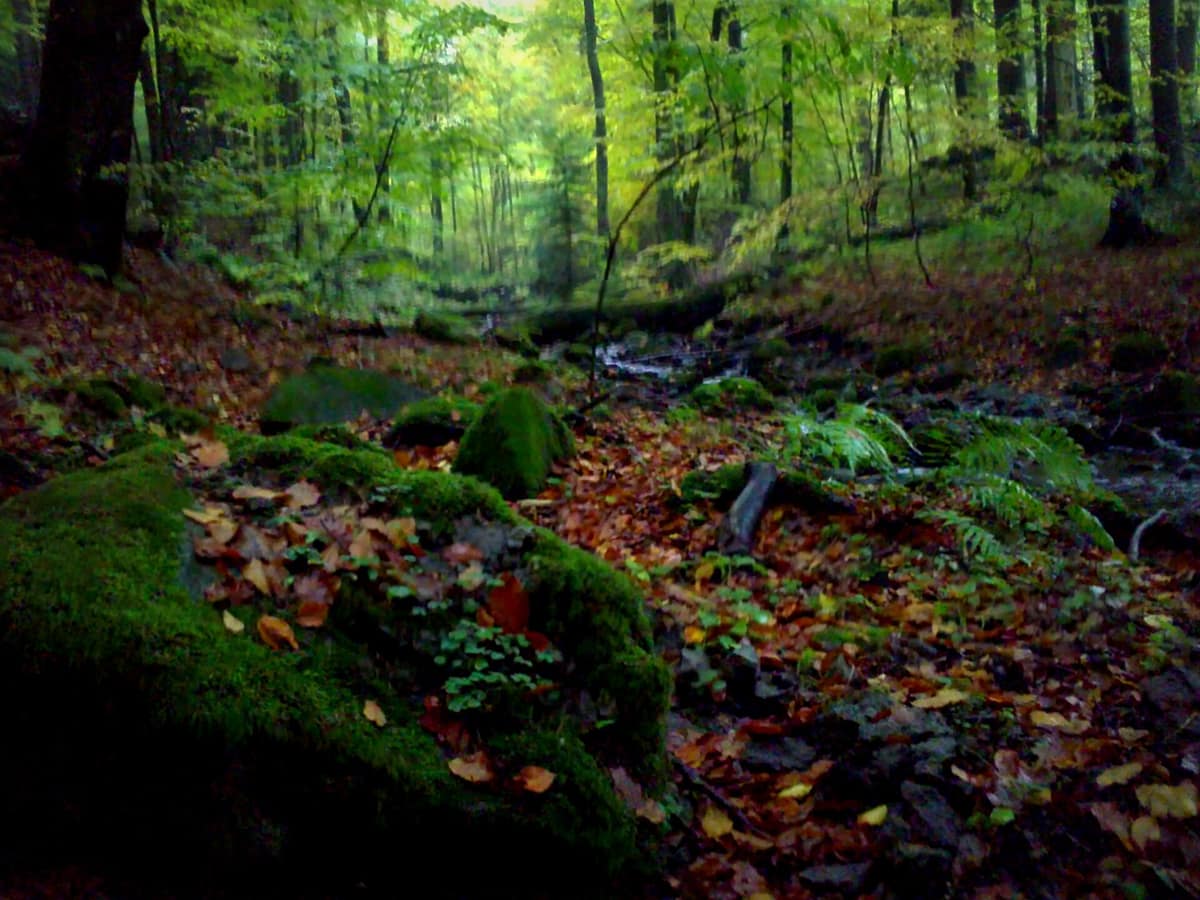
Badínsky Prales Primeval Forest
Banská Bystrica (Badín / Banská Bystrica) · Slovakia
Photo: Gasparct · CC BY-SA 3.0 · Wikimedia Commons
Virgin fir and beech forest over 400 years old protected since 1913, famous for receiving an official visit by Charles III of the United Kingdom for its ecological value.
There are forests that you visit, and forests that you study. Badínsky prales is firmly among the latter: an ancient primeval fir-beech woodland in the Kremnica Mountains of central Slovakia, protected since 1913 and closed to casual public access. It was one of the earliest nature reserves established on Slovak territory, left ever since to natural processes. Today it serves as an open-air laboratory where scientists track the complete lifecycle of Carpathian primeval forests: how trees germinate, reach mature canopy dominance, and eventually collapse in decay.
What makes it unique
A primeval forest protected for over a century where all three lifecycle phases of a natural European forest coexist side by side.
The place
Nature
The landscape
Badínsky prales lies 5 km from the village of Badín, overlooking the valley of the Badínsky brook on the eastern slopes of the Kremnica Mountains. About 10 km southwest of Banská Bystrica, the terrain climbs between 620 and 1 025 m, predominantly across northern, north-western, and north-eastern aspects. The bedrock reveals its volcanic origins: pyroclastic rocks with lava flows that jut out in the buffer zone as sheer cliffs, rock overhangs, and basaltic columns. Where storms have felled ancient giants, the ground is pitted with classic pit-and-mound microtopography.
The climate is cold and wet: the vegetative season lasts between 120 and 140 days, with snowblanketing the ground for 140 to 150 days annually. In this setting thrives a forest radically unlike commercial timber plantations. All three classic lifecycle stages of a European primeval woodland (growth, optimum, and disintegration) are visibly present, with roughly 70 % consisting of herb-rich beech and fir-beech forest. European beech and silver fir dominate; the buffer zone also includes Norway spruce, with sycamore maple, European ash, and large-leaved lime occurring frequently. Surviving firs are between 200 and 400 years old, the tallest reaching 46 metres. The fluttering elm (Ulmus laevis), now endangered across Europe, maintains a substantial presence here. In total, over 140 vascular plant species have been documented, alongside rare wood-decay fungi such as Phellinus pouzarii, confined strictly to virgin old-growth.
Wildlife and seasons
This is a realm of secretive woodland creatures. Large carnivores include the brown bear, Eurasian lynx, and wolf. The white-backed woodpecker and red-breasted flycatcher breed in the deadwood, alongside robust populations of western capercaillie, Eurasian eagle-owl, Eurasian hoopoe, and Eurasian pygmy owl. Small mammals feature the alpine shrew, Bechstein's bat, and greater mouse-eared bat.
Widespread amphibians include the endemic Carpathian newt, fire salamander, European tree frog, common toad, and yellow-bellied toad; reptiles range from the viviparous lizard and wall lizard to the common European viper, western green lizard, and smooth snake. Saproxylic insects flourish, including rare carabids such as Carabus clathratus auraniensis, Eurythyrea austriaca, and the magnificent alpine longhorn beetle.
Species
With a page in the atlas
Being mentioned in a source doesn't guarantee sightings: check with the people who manage the area.
Memory and protection
History and conservation
The reserve was officially designated in 1913. Its creation, along with that of the neighbouring Dobročský primeval forest, arose from an initiative by the Hungarian Ministry of Agriculture, which in 1908 ordered comprehensive inventories of natural monuments. In 1994 it gained national nature reserve status. Scattered traces of historical charcoal hearths and an overgrown ancient timber track survive beneath the canopy. In 2000, Prince Charles visited the reserve, taking several young tree seedlings back to England.
Management adheres to absolute non-intervention. Fallen trunks are cleared only where they obstruct maintenance access on the forest track. In Zone A, the primeval sanctuary itself, the highest fifth-level protection applies, ensuring zero human intervention in perpetuity. In Zone B, the buffer belt, 16 distinct forest types are identified, and non-native Norway spruce is being gradually reduced. The Natura 2000 network here protects siliceous rocky slopes, herb-rich beech forests, and ravines with maple and lime scree woods.
Before you set off
Visiting
How to visit
You cannot enter on your own. The core primeval forest is closed to the general public; entry is strictly restricted to the designated educational trail on pre-arranged tours led by a specialist conservation guide. Stepping off the marked nature trail in this fifth-degree nature reserve constitutes a punishable offence subject to steep fines. However, the surrounding valley remains open to hikers: just above the forest boundary lies the scenic Badínsky waterfall, a favourite walking destination.
Before you go
Access requires joining a specialized guided tour with an authorized escort. Contact the Poľana Protected Landscape Area administration well in advance to inquire about available dates and permit procedures. Never wander off designated trails.
Check access, rules and visiting conditions in the official information from the managing body before you set off.
Location
Where it is and how far it reaches
Boundary of Badínsky prales · IUCN Ia · © EEA, CDDA (CC-BY) The coordinate is estimated; it isn't a verified access point.
Transparency
Sources
The research data with its sources, and the official links for this place, are in the Spanish version of this page. See the Spanish version
Around it
Badínsky prales has no immediate neighbours in this atlas, but shares virgin forest ecosystems and wildlife with other European reserves. It connects with Havešová Strict Nature Reserve through alpine longhorn beetle, black woodpecker, and lynx; with Strâmbu-Băiuț Primeval Forest through black woodpecker, lynx, and wolf; and with Cozia National Park and Krokar Primeval Forest through alpine longhorn beetle, lynx, and wolf.
If you like this place, elsewhere in Europe
Distant places with uncommon wildlife and habitats in common. The most widespread species don't count. Sharing species doesn't imply a corridor or guaranteed presence.
- Havešová Strict Nature Reserve
Prešov Region (Poloniny National Park)
In common: Vipera berus · Bombina variegata · Rosalia longicorn — primary forest
Virgin beech forest with record-breaking trees exceeding 50 metres in height in the Eastern Carpathians.
JFMAMJJASONDMay – October · Crowding very low
- Bucegi National Park - Western Slopes
Dâmbovița, Argeș, and Prahova Counties
In common: Triturus montandoni · Vipera berus · Bombina variegata — old-growth forest
Dramatic conglomerate cliffs rising toward the plateau of the Babele and Sphinx wind-sculpted rock formations.
JFMAMJJASONDJune – October · Crowding low
- Sasso Fratino Strict Nature Reserve
Emilia-Romagna / Tuscany (Forlì-Cesena / Bagno di Romagna)
In common: Silver fir · Black woodpecker · Fagus sylvatica — primary forest, old-growth forest
The first Strict Nature Reserve established in Italy (1959), an intact primary beech forest over 500 years old untouched by logging.
JFMAMJJASONDMay – November · Crowding none
Entry #662 of the original atlas.