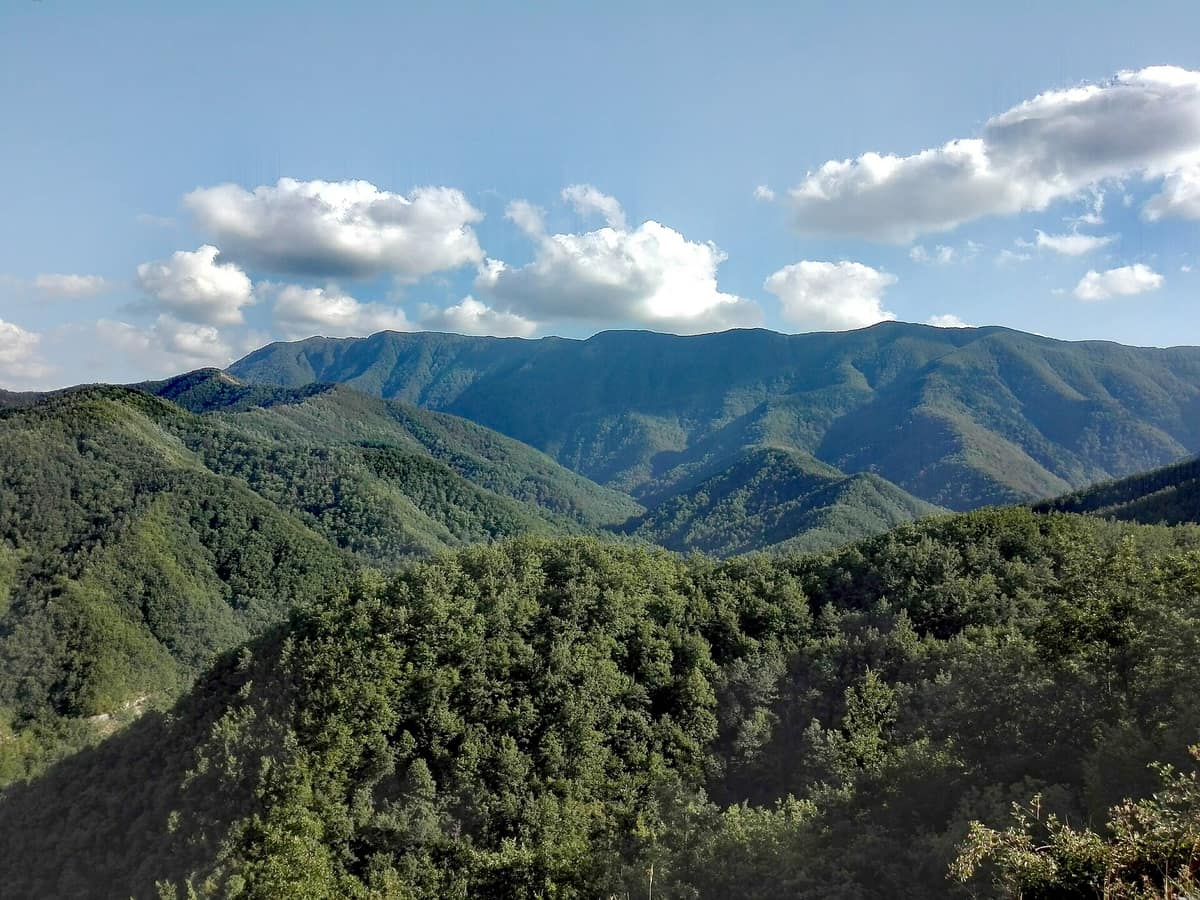
Sasso Fratino Strict Nature Reserve
Riserva Naturale Integrale di Sasso Fratino
Emilia-Romagna / Tuscany (Forlì-Cesena / Bagno di Romagna) · Italy
Photo: Nicola Andrucci · CC BY-SA 4.0 · Wikimedia Commons
The first Strict Nature Reserve established in Italy (1959), an intact primary beech forest over 500 years old untouched by logging.
You do not enter Sasso Fratino. That is its foremost rule and its very reason for being: it is a strict nature reserve, the first created in Italy in 1959, and its interior remains open only to those who apply for approved scientific research. What it safeguards is an old-growth beech and silver fir forest left to grow, fall, and decompose without human interference. Spanning 764.25 hectares across the municipalities of Bagno di Romagna and Santa Sofia in Emilia-Romagna, the forest keeps its own natural pace.
What makes it unique
It is a forest studied from afar because you cannot enter it, preserving deadwood dynamics and trophic webs long gone from managed woodlands.
The place
Nature
The landscape
The geological base is a Miocene formation known as Marnoso Arenacea, characterized by alternating beds of sandstone of varying thickness and thinner layers of marl. That geological mix sculpts the relief: water erodes the soft marls, destabilizing overlying sandstone banks and carving steep ravines crossed by torrents. Elevations rise from 650 m at Ponte di Campo alla Sega to 1520 m atop Poggio Scali.
European beech dominates the entire reserve. In the historic core it forms beechwoods and mixed stands with silver fir, joined by maples, elms, limes, ashes, and yews. Above 1300 m the canopy becomes almost pure beech. The climate is temperate oceanic, marked by Apennine rainfall patterns, erratic winter snowfall, and persistent fog and low clouds even in summer.
The greatest treasure lies on the ground. Coarse woody debris, standing or fallen, plays a vital ecological role by sustaining trophic webs that have vanished from commercial forests. The figures testify to this: inventories record 554 species of higher fungi, many tied strictly to decaying wood, and 102 species of lichens, including epiphytic forms on veteran trees. Among vascular plants, twenty are endemic to the Apennines, including Filipendula ulmaria subsp. denudata, Carex macrolepis, and Leucopoa dimorpha.
Wildlife and seasons
National tourism records cite red deer, roe deer, fallow deer, wild boar, mouflon, grey wolves, and nocturnal raptors around Sasso Fratino. These are denizens of a sanctuary where, by regulation, none can be sought out from within.
The seasons manifest primarily in the elements: irregular winter snows giving way to summer mists. For hiking along the surrounding perimeter, the most favourable window runs from May to November.
Species
With a page in the atlas
Being mentioned in a source doesn't guarantee sightings: check with the people who manage the area.
Memory and protection
History and conservation
In 1955, as administrator of the Foreste Casentinesi, Fabio Clauser proposed setting aside the woodland when logging was planned for the northern slopes of Poggio Scali. That was how it began. The reserve started with 113 hectares, expanded through subsequent acquisitions, and achieved formal recognition as a strict nature reserve in 1959. In 1985 the Council of Europe awarded it the European Diploma of Protected Areas.
Before you set off
Visiting
How to visit
What you visit is not the reserve itself, but its perimeter. The boundaries are clearly indicated by numerous signs, and walking peripheral trails does not grant entry.
There are two main external circuits. The loop from Passo Fangacci to La Lama, returning via Fosso degli Scalandrini with a detour to Monte Penna, covers 13 km in total, taking about five hours with an elevation gain of 800 to 900 m. The trail from Passo della Calla to Poggio Scali spans roughly 9 km round-trip, with 250 m of ascent on the outward leg, requiring around two and a half hours each way.
To understand the forest without entering it, the national park maintains several visitor centres. In Santa Sofia, the centre interprets the communities of the park, devotes a gallery to territorial history, preserves the study of naturalist Pietro Zangheri, and exhibits Giorgio Graziani's ethnographic collection. Badia Prataglia explores traditional woodworking and spiritual ties to the woods, adjoining the arboretum and the Carlo Siemoni Forest Museum. In Bagno di Romagna, the Palazzo del Capitano focuses on geology and thermal waters. In Campigna, the information point occupies La villetta with a screening room, near the Guido Campedelli Forest Museum. Camaldoli adds an ornithological museum housing the Biggeri collection, while the Valbonella botanical garden offers guided tours. None of these facilities lie inside the strict reserve.
Before you go
Entering the reserve is prohibited. Access to the interior is granted only upon request for authorized scientific research, and strict protection excludes ordinary hiking. There are no recreational activities permitted within its borders. You can, however, hike the perimeter routes and explore the interpretive centres in the vicinity; check their respective schedules and accessibility before setting out.
Check access, rules and visiting conditions in the official information from the managing body before you set off.
Location
Where it is and how far it reaches
Boundary of RISERVA NATURALE INTEGRALE SASSO FRATINO · IUCN Ia · © EEA, CDDA (CC-BY) The coordinate is estimated; it isn't a verified access point.
Transparency
Sources
The research data with its sources, and the official links for this place, are in the Spanish version of this page. See the Spanish version
How it fits into the territory
Calculated from the Atlas boundaries. «Part of» is only stated with an official boundary; an estimated area only means that they overlap.
Part of Foreste Casentinesi, Monte Falterona and Campigna National Park
Around it
While it has no immediate neighbouring sites in the atlas, it shares ecological kinships with other primeval forests. The Havešová Strict Nature Reserve shares wych elm, Norway maple, and European ash. The Lom Primeval Forest shares Norway maple, sycamore maple, and silver fir. The Hainich National Park coincides in ash, black woodpecker, and beech, and the Strâmbu-Băiuț Primeval Forest in silver fir, black woodpecker, and beech.
If you like this place, elsewhere in Europe
Distant places with uncommon wildlife and habitats in common. The most widespread species don't count. Sharing species doesn't imply a corridor or guaranteed presence.
- Havešová Strict Nature Reserve
Prešov Region (Poloniny National Park)
In common: Ulmus glabra · Acer platanoides · Fraxinus excelsior — primary forest
Virgin beech forest with record-breaking trees exceeding 50 metres in height in the Eastern Carpathians.
JFMAMJJASONDMay – October · Crowding very low
- Lom Primeval Forest Strict Nature Reserve
Republika Srpska (Petrovac / Klekovača)
In common: Acer platanoides · Acer pseudoplatanus · Silver fir — primary forest
Beech and fir reserve set upon the deep karstic terrain of Mount Klekovača.
JFMAMJJASONDJune – October · Crowding very low
- Hainich National Park
Thuringia (Unstrut-Hainich-Kreis)
In common: Fraxinus excelsior · Black woodpecker · Fagus sylvatica — primary forest, old-growth forest
Ancient beechwoods rich in deadwood and former military training grounds where woodland regenerates, in Thuringia.
JFMAMJJASONDApril – October · Crowding low
- Badínsky Prales Primeval Forest
Banská Bystrica (Badín / Banská Bystrica)
In common: Silver fir · Black woodpecker · Fagus sylvatica — primary forest, old-growth forest
Virgin fir and beech forest over 400 years old protected since 1913, famous for receiving an official visit by Charles III of the United Kingdom for its ecological value.
JFMAMJJASONDMay – October · Crowding none
Entry #534 of the original atlas.