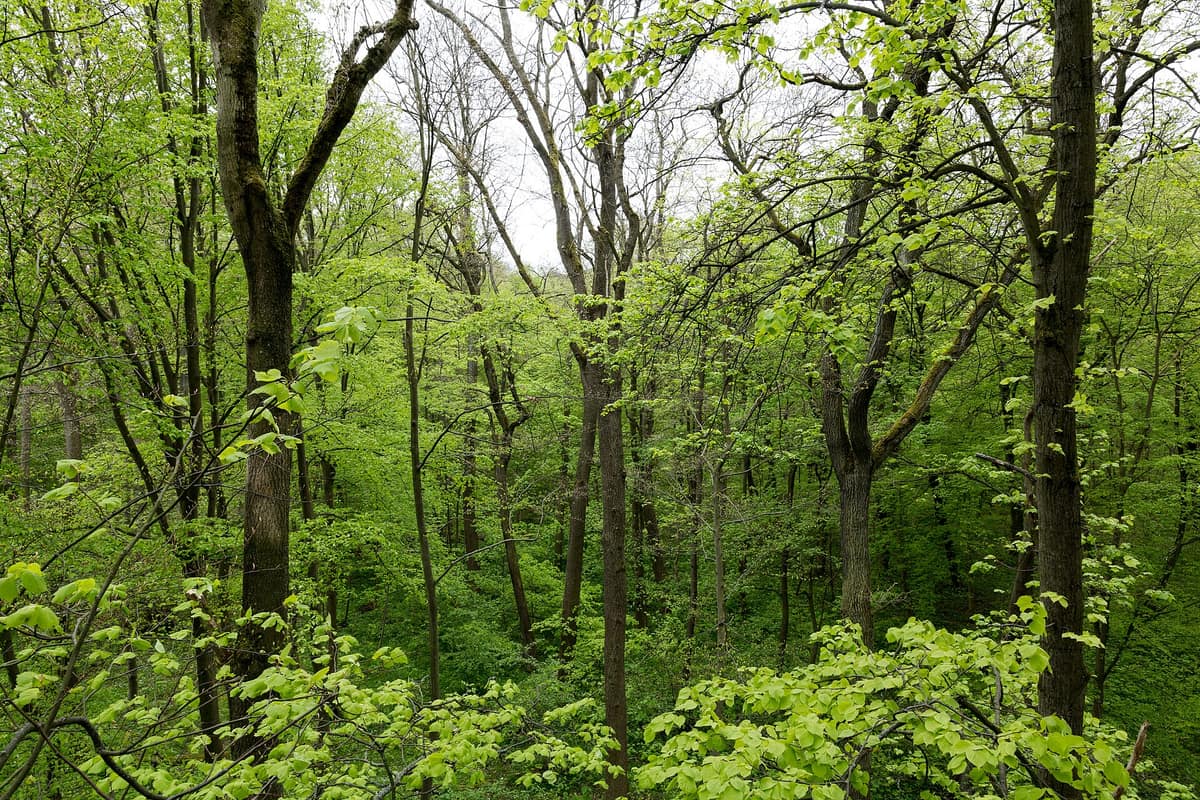
Hainich National Park
Nationalpark Hainich - UNESCO Weltkulturerbe Urwald
Thuringia (Unstrut-Hainich-Kreis) · Germany
Photo: Dietmar Rabich · CC BY-SA 4.0 · Wikimedia Commons
Ancient beechwoods rich in deadwood and former military training grounds where woodland regenerates, in Thuringia.
A forest allowed to grow old. In western Thuringia, nestled within the triangle formed by Eisenach, Mühlhausen, and Bad Langensalza, Hainich National Park occupies the southern part of a larger ridge, protecting veteran beechwoods where trees germinate, mature, fall, and decompose without human interference. A portion of these woodlands forms an inscribed component of the UNESCO World Heritage site. Traversing them reveals, above all, how a forest transforms when granted the freedom to follow its natural trajectory.
What makes it unique
Here you can contrast in a single day ancient beechwoods teeming with deadwood against open ground where the forest naturally reclaims the land.
The place
Nature
The landscape
The underlying story begins beneath your boots. The geological substrate consists of Upper Muschelkalk limestone, overlaid by weathering, erosion, and fertile loess deposits that have shaped the modern relief. The park’s predominant soil is rendzina, shallow and carbonate-rich. The western slopes falling toward the Werra valley are noticeably steeper than the gentle eastern gradients.
European beech dominates this terrain, yet it does not stand alone: the broadleaf forest embraces ashes, maples, lindens, and the rare wild service tree. The World Heritage core preserves the oldest beech stands closest to a primeval condition. Within them, prostrate trunks and standing dead trees are colonized by tinder bracket fungi and bustle with life. This is not disorder: it is an old-growth ecosystem functioning.
Other sectors tell the opposite tale. To the south, forest tracts were cleared around the beginning of the 1980 decade for a military training area, subsequently abandoned to natural succession. What grows there now are young pioneering cohorts—silver birch and aspen—that spearhead natural recolonization across open terrain. Ancient canopy beside emergent woodland: age is an intrinsic dimension of this landscape.
Wildlife and seasons
The Hainich sits at the ecological transition between oceanic and continental climates, and the seasons leave an indelible mark on the forest floor. In early spring, before the canopy closes, the ground is carpeted with wildflowers: snowdrops, liverworts, and wood anemones. By early summer the pungent aroma of ramsons pervades the air, accompanying hikers along the Welterbepfad; among studied understorey plants, ramsons and wood anemone reign supreme.
The most elusive predator lends its name to a trail. The European wildcat is among the park’s signature mammals, though glimpsing one in the wild is rare. There are ample other reasons to watch closely: 15 bat species, seven species of woodpeckers, and over 500 species of saproxylic beetles have been recorded. Across the open expanse of Kindel, lucky walkers can spot roe deer, wild boars, and red deer. In high summer this open grassland abounds with flowers and butterflies; dense hedgerows shelter nesting red-backed and great grey shrikes. Extensive conservation grazing preserves habitat for the yellow-bellied toad and the marsh fritillary butterfly.
Species
With a page in the atlas
Being mentioned in a source doesn't guarantee sightings: check with the people who manage the area.
Memory and protection
History and conservation
The national park was officially established on 31 December 1997. Its master plan focuses on safeguarding undisturbed ecological processes across the woodland core without logging, while implementing a specialized management strategy to maintain valuable open grassland habitats.
Not all is serene. Scientists at DLR monitor canopy dieback, crown thinning, and reduced leaf development across the Hainich linked to recent prolonged droughts. Veteran trees remain an integral part of natural forest dynamics, even in adversity.
Before you set off
Visiting
How to visit
To understand the park before stepping into the woods, the Nationalparkzentrum at Thiemsburg offers interpretive films, panoramic exhibition displays, and interactive discovery stations. Rangers are on hand to answer questions and guide your itinerary, and the building is fully accessible. Adjacent to the centre rises the canopy walkway, the Baumkronenpfad, which experiences moderate visitor numbers. Both Thiemsburg and the Wildkatzendorf in Hütscheroda are directly accessible via public transit.
For a full day immersed among trees, the Welterbepfad spans 9,5 kilometres starting from the Craulaer Kreuz car park near Craula, featuring a stairway of one hundred steps and moderate difficulty. Along its route you encounter abundant standing and fallen deadwood colonized by bracket fungi.
If you are fascinated by wildcats, the Wildkatzenpfad extends 7 kilometres through varied scenery in and around the park. In Hütscheroda, the Wildkatzenscheune presents an exhibition on the wildcat, the Eurasian lynx, and the Rettungsnetz Wildkatze conservation initiative, while the Wildkatzenlichtung clearing allows visitors to view four wildcats within a spacious semi-natural enclosure. Shorter and gentler is the Wildkatzenschleichpfad, covering 2 kilometres from the same clearing through dense woods and sunny glades with ancient oaks and decaying wood.
Further information hubs enrich the visit. Harsberg, near Lauterbach, showcases native wildlife through taxidermy, displays, and nature games, open daily from April to October. On the northern boundary near Kammerforst, the UBiS facility serves as a hands-on environmental research station for children and youths in a repurposed military post. It loans virtual-reality headsets to explore German beechwood World Heritage components, and serves as trailhead for the 2-kilometre Germanischer Kultpfad, reconstructing ancient pagan sanctuaries unearthed at Niederdorla, alongside the 5,5-kilometre Hünenteich circuit.
Before you go
Stick strictly to marked trails and keep dogs on a leash at all times. Remain alert to strong winds and falling dead branches. Visitor centres at UBiS, Harsberg, Hütscheroda, and Thiemsburg provide exhibitions, maps, and ranger assistance; Harsberg closes from November through March. UBiS features accessible restrooms and loans an all-terrain hiking wheelchair by advance reservation; both Harsberg and Hütscheroda are certified accessible. The park provides an interactive map of parking areas and public transport stops; check return schedules beforehand.
Check access, rules and visiting conditions in the official information from the managing body before you set off.
Location
Where it is and how far it reaches
Boundary of Hainich · IUCN II · © EEA, CDDA (CC-BY) The coordinate is estimated; it isn't a verified access point.
Transparency
Sources
The research data with its sources, and the official links for this place, are in the Spanish version of this page. See the Spanish version
Around it
The atlas registers no immediate neighbouring destinations, yet several distant old-growth forests share its ecological character. The Sasso Fratino Strict Nature Reserve shares primeval beech and ash woodland with Hainich. The Strâmbu-Băiuț Primeval Forest likewise preserves old-growth beech and wild garlic carpets; the Lom Virgin Forest - Strict Nature Reserve combines beech and wood anemone; and the Havešová Strict Nature Reserve protects towering ash trees in primeval forest.
If you like this place, elsewhere in Europe
Distant places with uncommon wildlife and habitats in common. The most widespread species don't count. Sharing species doesn't imply a corridor or guaranteed presence.
- Havešová Strict Nature Reserve
Prešov Region (Poloniny National Park)
In common: Fraxinus excelsior · Collared flycatcher · Black woodpecker — primary forest
Virgin beech forest with record-breaking trees exceeding 50 metres in height in the Eastern Carpathians.
JFMAMJJASONDMay – October · Crowding very low
- Strâmbu-Băiuț Primeval Forest
Maramureș County
In common: Allium ursinum · Black woodpecker · Fagus sylvatica — primary forest
Continuous virgin beech forest of the Northern Carpathians designated as a UNESCO World Heritage site.
JFMAMJJASONDMay – October · Crowding very low
- Sasso Fratino Strict Nature Reserve
Emilia-Romagna / Tuscany (Forlì-Cesena / Bagno di Romagna)
In common: Fraxinus excelsior · Black woodpecker · Fagus sylvatica — primary forest, old-growth forest
The first Strict Nature Reserve established in Italy (1959), an intact primary beech forest over 500 years old untouched by logging.
JFMAMJJASONDMay – November · Crowding none
- Fuentes del Narcea, Degaña and Ibias Natural Park and Muniellos Reserve
Asturias (Cangas del Narcea / Degaña / San Antolín de Ibias)
In common: Black woodpecker · Fagus sylvatica · European wildcat — primary forest, old-growth forest
The largest sessile oak (Quercus petraea) forest in Spain and one of the best preserved in Europe (Muniellos).
JFMAMJJASONDMay – November · Crowding very low
Entry #52 of the original atlas.