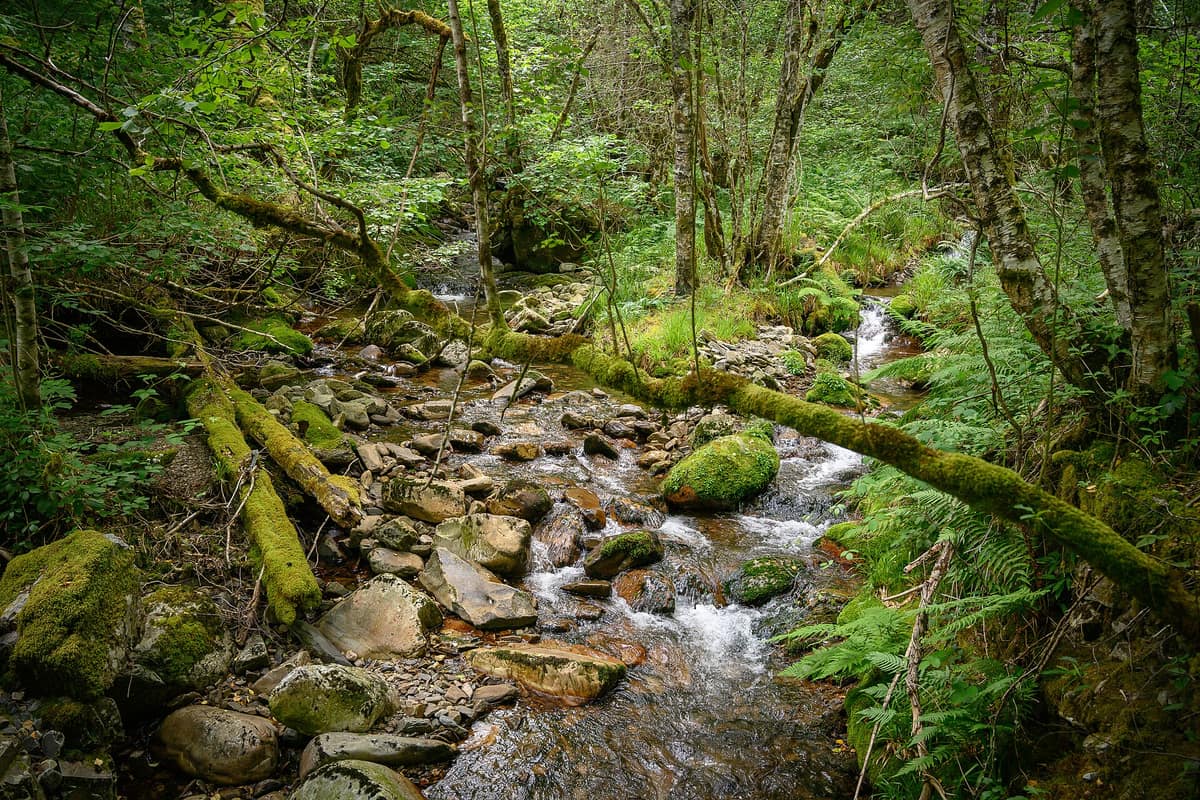
Fuentes del Narcea, Degaña and Ibias Natural Park and Muniellos Reserve
Fuentes del Narcea, Degaña e Ibias & Reserva de Muniellos
Asturias (Cangas del Narcea / Degaña / San Antolín de Ibias) · Spain
Photo: Teseum · CC BY-SA 4.0 · Wikimedia Commons
The largest sessile oak (Quercus petraea) forest in Spain and one of the best preserved in Europe (Muniellos).
To enter Muniellos you need an official permit, a designated date, and your national ID. The most celebrated forest of the Cantabrian Mountains cannot simply be visited: it must be booked well in advance. This is the Muniellos Integral Nature Reserve, 59,7 km² encompassing three massifs (Muniellos, La Viliella, and Valdebois) within the Natural Park of Fuentes del Narcea, Degaña e Ibias, in southwestern Asturias. It safeguards the largest sessile oak woodland on the Iberian Peninsula and one of the most intact surviving in Europe.
What makes it unique
An oak forest that has remained closed to almost everything for decades, with a strict maximum of twenty visitors a day.
The place
Nature
The landscape
The reserve rises from 680 m up to 1640 m at the peak of La Candanosa. The forest is rooted on an ancient Palaeozoic substrate dating back some 500 million years, overwhelmingly siliceous, with tectonic activity having carved a deeply rugged topography. Ancient glacial cirques and lleronas—scree slopes of shattered quartzite—are clearly visible; the mountain tarns beneath the peak of La Candanosa bear witness to glacial origins, while the alpine tarns and peat bogs of Cueto de Arbás occupy glacially excavated hollows.
Upon this nutrient-poor ground thrives the forest. Sessile oak, sweet chestnut, and beech dominate; throughout the valley floors grow hazel, sycamore, ash, willow, and alder, giving way to birch at higher elevations. Within the broader natural park, the beech forest of the Hermo Valley, stretching for about ten kilometres, is the largest and best preserved of its kind, while the high mountains feature dwarf juniper, heather, and bilberry scrub, particularly characteristic across Cueto de Arbás.
Wildlife and seasons
Muniellos is core territory for the brown bear. The grey wolf also roams here, preying primarily on roe deer and wild boar, alongside the Eurasian otter, red fox, and European wildcat. All told, more than 150 vertebrate species and over 100 bird species inhabit the reserve, with the gold-striped salamander dwelling in mountain pools and peatlands, and the broom hare standing among its emblematic fauna.
Among birds, the western capercaillie and the black woodpecker are of prime conservation interest and deeply bound to mature woodland. The capercaillie, critically endangered in the Cantabrian range, persists in the forests of Hermo, Degaña, and Muniellos. Tawny owls are the most abundant nocturnal raptors. Roe deer and Cantabrian chamois are widespread throughout the park, and otters patrol the river corridors.
The best visiting season spans May to November, with autumn displaying extraordinary foliage.
Species
With a page in the atlas
Being mentioned in a source doesn't guarantee sightings: check with the people who manage the area.
Memory and protection
History and conservation
Timber exploitation for the Royal Navy shipyards in Ferrol began around 1766, continuing until logging for naval vessels was halted in 1789. In 1973 the Spanish state purchased the woodland, declaring it a national hunting preserve, thereby immediately banning all hunting and placing all wildlife under strict protection. In 1982 daily visitation was capped at 20 people, and wild camping, bringing dogs, fishing, and overnight stays in the forest were strictly forbidden. It was designated a UNESCO Biosphere Reserve in 2000 and established as an Integral Nature Reserve by regional law in 2002.
Human heritage reaches back far earlier: widespread evidence of Roman mining activity survives, alongside ancient hillfort settlements (castros). The palloza, a traditional circular drystone dwelling thatched with rye straw, preserves close architectural ties to Celtic-era hillfort houses, while cortinos are two-metre-high circular drystone enclosures built without roofs to shield traditional beehives from bears.
Before you set off
Visiting
How to visit
Permits can be requested starting on 15 December of the previous year; each person is granted only a single permit per calendar year. You must reconfirm your reservation between 23 and 15 days prior to the booked visit: failure to do so will result in immediate cancellation. Entry and exit take place strictly via Tablizas, where the visitor reception centre is located. Two marked routes are available: the Fonculebrera circuit, a challenging circular hike of 20 km with steep elevation changes, and the river trail, an out-and-back walk; both itineraries lead to the first glacial tarn, Laguna de la Isla.
The reserve interpretation centre at Obacho is a modern facility set atop a commanding natural viewpoint overlooking the forest canopy. Outside the strict reserve, the natural park maintains the Casa del Parque in Courias, the Nature Classroom and Palloza visitor centre of Ibias in San Antolín, and Casa Florencio in Zarréu (Degaña). For walking without special permits, notable excursions include the ascent of Cueto de Arbas, Pomar de las Montañas, Laguna de Chagüeños, and the dolmen of A Hucha, alongside the Alto del Acebo viewpoint; the long-distance trail GR 203, «Where the Bear Walks», traverses the entire biosphere reserve.
Before you go
Always carry your official authorization document and the national ID card used during the reservation process. Muniellos closes on 1 and 6 January and on 24, 25, and 31 December. The reserve may close without notice due to wildfire danger, severe weather, or pressing conservation imperatives, which automatically cancels all existing permits. The standard circular hike covers about twenty kilometres over rugged, steep mountain terrain, demanding solid physical fitness. Within the surrounding natural park, dogs must be kept on a leash at all times.
Check access, rules and visiting conditions in the official information from the managing body before you set off.
Location
Where it is and how far it reaches
Boundary of Fuentes del Narcea, Degaña e Ibias · IUCN VI · © EEA, CDDA (CC-BY) The coordinate is estimated; it isn't a verified access point.
Transparency
Sources
The research data with its sources, and the official links for this place, are in the Spanish version of this page. See the Spanish version
Around it
Somiedo Natural Park lies just 1 km away, and Serra do Courel is 5 km distant, both occupying the western Cantabrian Mountains.
What else to explore nearby
Approximate straight-line distance between the edges of each area. It doesn't indicate access, routes or driving times.
- Somiedo Natural Park
Asturias (Pola de Somiedo / Valle de Lago / Saliencia)
About 1 km away
The iconic sanctuary of the Cantabrian brown bear, with deep glacial troughs, the lakes of Saliencia, and traditional thatched teito cabins.
JFMAMJJASONDMay – October · Crowding low
If you like this place, elsewhere in Europe
Distant places with uncommon wildlife and habitats in common. The most widespread species don't count. Sharing species doesn't imply a corridor or guaranteed presence.
- Strâmbu-Băiuț Primeval Forest
Maramureș County
In common: Strix aluco · Fagus sylvatica · Black woodpecker — primary forest
Continuous virgin beech forest of the Northern Carpathians designated as a UNESCO World Heritage site.
JFMAMJJASONDMay – October · Crowding very low
- Călimani National Park - Volcanic Forest Massif
Suceava, Mureș, Bistrița-Năsăud, and Harghita Counties
In common: Fagus sylvatica · Western capercaillie · European wildcat — old-growth forest, high mountain
The largest extinct volcanic crater in Europe (10 km in diameter) covered with high-mountain fir and spruce forests.
JFMAMJJASONDJune – October · Crowding very low
- Bukovské Vrchy Primeval Forest Complex - NP Poloniny
Prešov Region (Snina District)
In common: Fagus sylvatica · European wildcat · Eurasian otter — primary forest, high mountain
Slovakia’s largest tract of virgin primeval beech forests contiguous with subalpine ridge meadows (poloniny).
JFMAMJJASONDMay – October · Crowding very low
- Badínsky Prales Primeval Forest
Banská Bystrica (Badín / Banská Bystrica)
In common: Fagus sylvatica · Black woodpecker · Brown bear — primary forest, old-growth forest
Virgin fir and beech forest over 400 years old protected since 1913, famous for receiving an official visit by Charles III of the United Kingdom for its ecological value.
JFMAMJJASONDMay – October · Crowding none
Entry #486 of the original atlas.