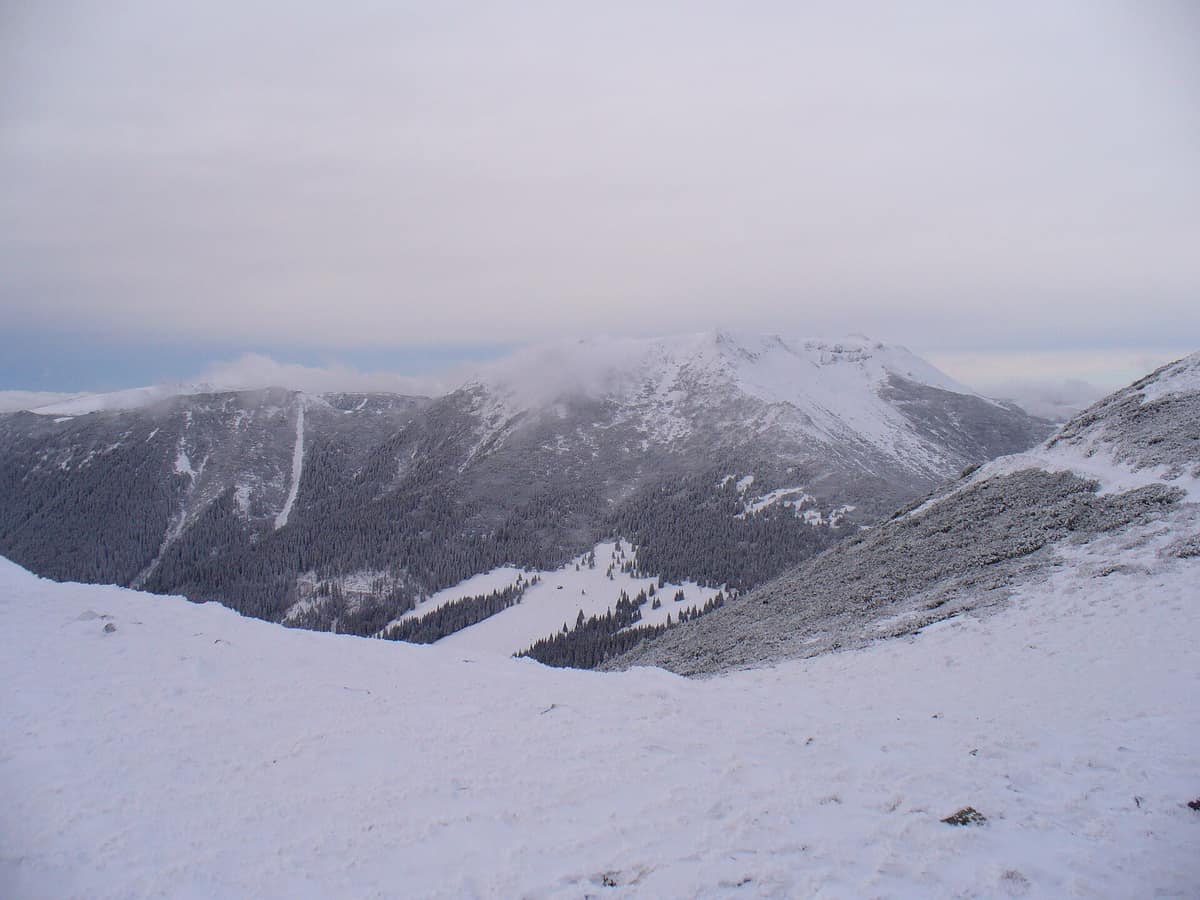
Călimani National Park - Volcanic Forest Massif
Parcul Național Călimani - Șumski masiv volcanic
Suceava, Mureș, Bistrița-Năsăud, and Harghita Counties · Romania
Photo: Original uploader was Utilizator:Kluand at ro.wikipedia · Public domain · Wikimedia Commons
The largest extinct volcanic crater in Europe (10 km in diameter) covered with high-mountain fir and spruce forests.
An extinct volcano so vast you can hike inside it. The Călimani shelter Romania's largest volcanic crater, around 10 km in diameter, encircled by peaks exceeding 2000 metres: Pietrosul, at 2102 m, is the country's tallest volcanic summit. The national park safeguards this ring, blanketed in spruce and beech forests, Swiss stone pine, subalpine scrub, and alpine pastures.
What makes it unique
A volcanic caldera unique in Romania and Europe, with bizarre rock towers, rhododendron thickets tinting the summit pink, and a former sulphur quarry showing the cost of healing a mountain.
The place
Nature
The landscape
The Călimani rank among Romania's youngest and highest volcanic ranges. After catastrophic eruptions millions of years ago, massive blocks of volcanic rock tumbled haphazardly, giving rise to strangely sculpted crags. The rock is predominantly andesite, rich in hornblende and pyroxene, alongside dacites and basalts. The volcanic cones encircle a caldera unrivaled in Romania and Europe.
This rock emerges in curious configurations: the 12 Apostles, Pietrele Roșii, and Dealul Tătarului. At the 12 Apostles, the stone has carved human-like effigies named Moșul, Mareșalul, Godzilla, Gușterul, Ramses, and Dragonii. Historically, locals ascended on 29 June to celebrate "Moșii din Călimani", rooted in an ancient Dacian cult of sun, fir, and fire.
An alpine crest holding Pietrosul (2100 m) and Negoiu Unguresc (2081 m) forms the massif's highest, most dramatic sector. At its base beneath Răchitiș peak, the Lake Iezer reserve protects a naturally dammed tarn framed by mountain pine and juniper scrub.
And there is the scar. In 1976 an open-pit sulphur quarry commenced operations, affecting over 300 hectares of vegetation and topsoil. The former works left behind spoil heaps, access tracks, and a terraced hillside where plant life struggles against substrate acidity.
Wildlife and seasons
Park surveys document 1004 vascular plant species. Swiss stone pine is a glacial relict present in select Romanian Carpathian massifs, and from June to early July swathes of blooming rhododendron paint the heights in green and pink. The finest vantage point is Retitis peak, reached via the blue-triangle trail ascending from the former sulphur mine.
Large carnivores include the brown bear, grey wolf, and Eurasian lynx; the Eurasian otter, European pine marten, badger, and European wildcat round out the mammalian roster. The roe deer, red deer, and wild boar animate the forest expanses, while the common viper is highlighted among reptiles.
The administration highlights the autumn deer rut as a prime period for mammal observation. Further seasonal highlights include the lekking displays of the western capercaillie and the rhododendron bloom. For wildlife watching, visiting in small groups accompanied by a ranger or park biologist is strongly advised. Snow dominates the landscape from November through April or May.
Species
With a page in the atlas
Being mentioned in a source doesn't guarantee sightings: check with the people who manage the area.
Memory and protection
History and conservation
The park was initially declared in 1990, spanning 15.300 ha, and officially established under law in 2000, covering 24.041 ha. Inside lie three reserves: the scientific mountain pine and Swiss pine reserve, the Lake Iezer reserve, and the geological 12 Apostles reserve. Each year park authorities organize volunteer conservation initiatives.
Before you set off
Visiting
How to visit
The visitor centre in Șaru Dornei and two info points in Panaci and Poiana Stampei opened in 2013. The main centre houses educational exhibits on park heritage and a courtyard showcasing local crafts and landscapes, alongside an interpretive boardwalk requiring two hours through the Șaru Dornei peat bog.
Among the hiking trails, the red-dot route connects Neagra Șarului with the 12 Apostles, Iezerul Călimanilor, and Rețițiș: completing the entire route takes between eighteen and twenty-one hours and is strenuous. The blue-cross trail between Gura Haitii, Pietrele Roșii, and Dornișoara is moderate, requiring seven to eight hours. The day outing to the 12 Apostles winds through spruce woods and subalpine pastures from Gura Haitii via Pietrele Roșii and back.
The former sulphur mine is reached via Vatra Dornei and Gura Hăitii (about 25 km) followed by roughly 12 km along a concrete road; vehicular access ends at the designated parking area.
Before you go
Due to severe substrate acidity around the old sulphur quarry, stay strictly on marked paths. In bear territory, make noise while walking and avoid travelling at dusk. Dress in layers, as weather changes abruptly on the caldera rim.
Check access, rules and visiting conditions in the official information from the managing body before you set off.
Location
Where it is and how far it reaches
Boundary of Parcul Național Călimani · IUCN II · © EEA, CDDA (CC-BY) The coordinate is estimated; it isn't a verified access point.
Transparency
Sources
The research data with its sources, and the official links for this place, are in the Spanish version of this page. See the Spanish version
Around it
With Retezat National Park it shares the common viper, marten, and capercaillie, as well as old-growth forests and high-alpine realms; with the Vlădeasa Massif, marten, wildcat, and otter.
If you like this place, elsewhere in Europe
Distant places with uncommon wildlife and habitats in common. The most widespread species don't count. Sharing species doesn't imply a corridor or guaranteed presence.
- Retezat National Park
Hunedoara County (Hațeg)
In common: Pinus cembra · Vipera berus · European pine marten — old-growth forest, high mountain
The realm of the granitic and glacial Retezat, with over 80 crystal tarns and the Gemenele scientific reserve.
JFMAMJJASONDJune – October · Crowding low
- Bucegi National Park - Western Slopes
Dâmbovița, Argeș, and Prahova Counties
In common: Pinus cembra · Vipera berus · European pine marten — old-growth forest, high mountain
Dramatic conglomerate cliffs rising toward the plateau of the Babele and Sphinx wind-sculpted rock formations.
JFMAMJJASONDJune – October · Crowding low
- Bukovské Vrchy Primeval Forest Complex - NP Poloniny
Prešov Region (Snina District)
In common: Lesser spotted eagle · Fagus sylvatica · European wildcat — high mountain
Slovakia’s largest tract of virgin primeval beech forests contiguous with subalpine ridge meadows (poloniny).
JFMAMJJASONDMay – October · Crowding very low
Entry #95 of the original atlas.