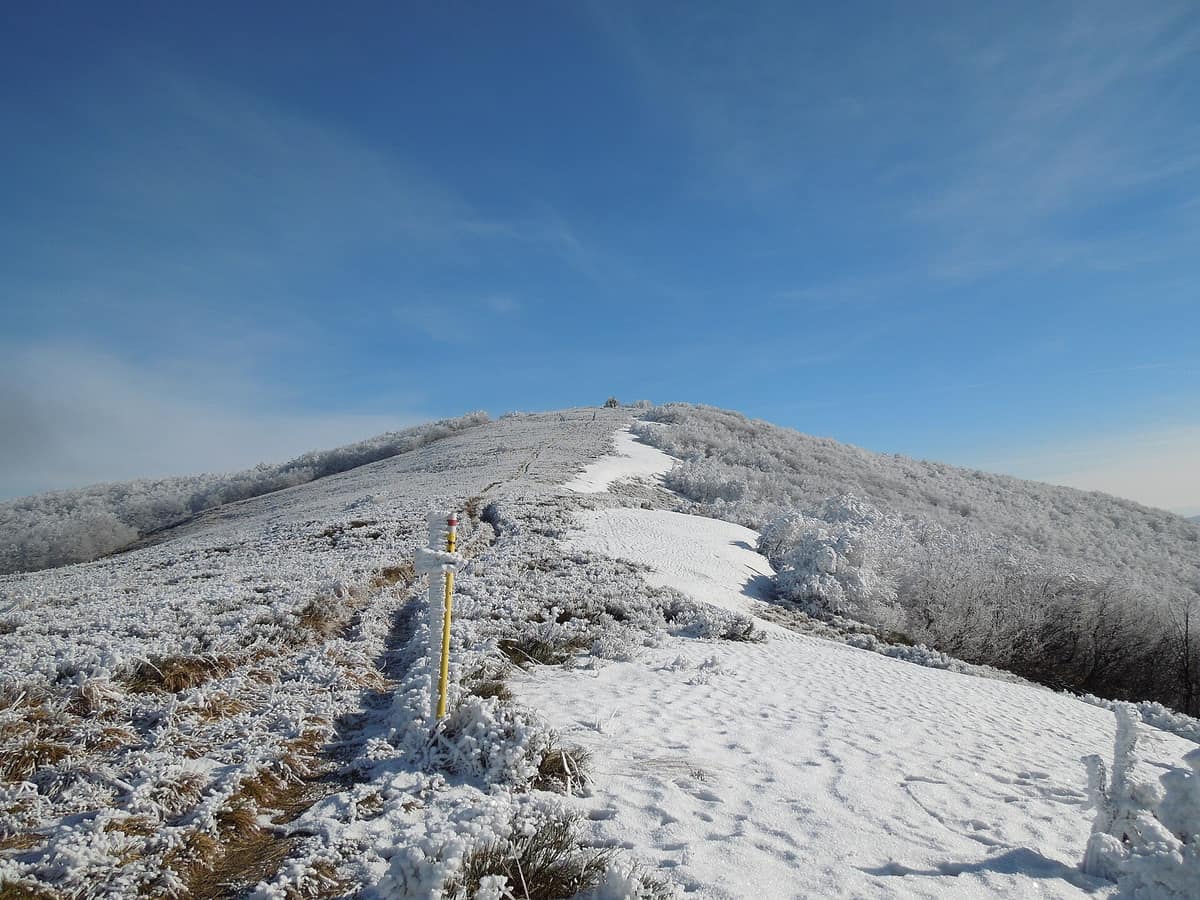
Bukovské Vrchy Primeval Forest Complex - NP Poloniny
Bukovské vrchy pralesový komplex - NP Poloniny
Prešov Region (Snina District) · Slovakia
Photo: Milan Bališin · CC BY-SA 4.0 · Wikimedia Commons
Slovakia’s largest tract of virgin primeval beech forests contiguous with subalpine ridge meadows (poloniny).
In Slovakia's easternmost corner, where the country touches Poland and Ukraine, the forest does not stop at a border. Poloniny is the nation's easternmost national park and harbours the greatest concentration of virgin primeval forests in Slovakia: nearly 80 % of its territory is forested, dominated by beech and mixed beech-fir stands, while along the high mountain crests unfurl the poloniny, flower-rich subalpine meadows that give the park its name. Three of its primeval forests—Stužica, Havešová, and Rožok—have been inscribed on the UNESCO World Heritage list since 28 June 2007, and the park is the only place in Slovakia where the European bison roams freely in the wild.
What makes it unique
Brings together three World Heritage primeval beech forests and Slovakia’s only wild bison herd beneath subalpine ridge meadows found nowhere else in the country.
The place
Nature
The landscape
The park belongs to the Dukla tectonic unit of the Flysch Belt: rhythmic strata of shales and sandstones deposited between 70 and 42 million years ago when the Tethys Ocean covered the region. The topography features long parallel ridges and deep valleys, and the border crest with Poland marks the European continental divide between the Baltic and Black seas. Winters are long: snow blankets the ground from November to April, lasting over 160 days on the windswept crests. Total annual precipitation ranges between 800 and 1 000 mm.
With such relief, the vegetation shifts as you ascend. In the warmest lower reaches grow oak-hornbeam woods. Beech forest covers the largest expanse, while silver fir climbs into the high, humid valleys. Above 1000 m, beneath the upper timberline, the harsh mountain climate dwarfs beech and sycamore maple into gnarled, stunted forms. Higher still lie the poloniny, semi-natural subalpine meadows shaped by centuries of traditional livestock grazing along the ridges.
Poloniny also marks the botanical boundary between the Eastern and Western Carpathians, boasting more than 1000 vascular plant species. The Carpathian buttercup (Ranunculus carpaticus), endemic to the Eastern Carpathians, is known in Slovakia from only a single station in this park. The park's emblem flower is the purple hellebore, chosen because when the logo was designed the plant was known in Slovakia exclusively from this territory. Lowland and mid-elevation meadows also nurture numerous wild orchids.
Wildlife and seasons
The undisputed star is the European bison, Europe's largest native land mammal. In 2004, a reintroduction project was launched to establish a free-ranging herd, initially importing 11 bison (8 females and three males), with subsequent animals introduced from Polish populations. The release site was the secluded Ruské valley within the Starina reservoir protection zone, an area depopulated in the 80s where wandering bison tracks had already been spotted. In late June 2006, the first wild-born bison calf was born in the park.
Other native inhabitants include the brown bear, wolf, Eurasian lynx, Eurasian otter, and European wildcat. Poloniny ranks among the five most vital areas in Slovakia for breeding European nightjar, corncrake, and hazel grouse, while regular breeders include the lesser spotted eagle, Ural owl, and white-backed woodpecker. Reptiles are represented by the rare Aesculapian snake.
Species
With a page in the atlas
Being mentioned in a source doesn't guarantee sightings: check with the people who manage the area.
Memory and protection
History and conservation
Poloniny National Park was officially established on 1 October 1997, sharing its northern border with Bieszczady National Park in Poland. In 1998 it was awarded the Council of Europe Diploma. In 1993 it was incorporated into the East Carpathians Biosphere Reserve alongside Poland, and in 1999 Ukrainian sectors were added to create the world's first trilateral biosphere reserve. More than a third of woodland animal species and over half of forest fungi depend directly on deadwood, a crucial ecological pillar of reserves like Havešová. At Rožok, the volume of standing and lying deadwood during the climax phase reaches 1029,42 m³/ha, the highest recorded in any Slovak primeval beech forest.
Before you set off
Visiting
How to visit
The three primeval forests are experienced in three distinct ways. Stužica, the largest reserve, is traversed by the red-marked ridge trail from Nová Sedlica to Mount Kremenec; here beech trees reach 220-250 years of age, while majestic silver firs exceed 400 years. Rožok features a circular green-marked educational trail of moderate difficulty with five interpretive stops. Havešová, by contrast, has no tourist paths: it can be visited only on official park ranger excursions along an unpaved historical logging lane. There, on nutrient-rich clay soils, beeches achieve record dimensions, with trunks soaring up to 58 m according to park measurements.
The red ridge trail departs from Nová Sedlica, Slovakia's easternmost settlement (416 m), crosses the Stužica reserve, and reaches Kremenec, the tripoint where Slovakia, Poland, and Ukraine meet. From Nová Sedlica, a trail through the park's longest valley ascends to Riaba Skala for panoramic vistas. From Runina, a route climbs to the Komúrny saddle, home to the park's finest poloniny meadows. A yellow-marked cycling trail runs 7,0 km from Nová Sedlica to Zboj for mountain biking, while in winter marked cross-country ski trails open across the snowbound landscape.
A dedicated heritage trail links historic wooden churches at Uličské Krivé (1718), Ruský Potok (1740), and Topoľa (1650).
Before you go
To avoid bear encounters, park authorities advise avoiding hiking at dawn and dusk, staying on marked trails, making presence known without shouting, and keeping dogs strictly leashed. Open campfires are permitted only at designated fire pits located within 10 metres of shelter buildings. Havešová may be visited only when accompanied by park rangers: contact the park administration in advance to arrange dates. Check the operational status of the Nová Sedlica information centre before setting out.
Check access, rules and visiting conditions in the official information from the managing body before you set off.
Location
Where it is and how far it reaches
Boundary of Poloniny · IUCN V · © EEA, CDDA (CC-BY) The coordinate is estimated; it isn't a verified access point.
Transparency
Sources
The research data with its sources, and the official links for this place, are in the Spanish version of this page. See the Spanish version
How it fits into the territory
Calculated from the Atlas boundaries. «Part of» is only stated with an official boundary; an estimated area only means that they overlap.
Within this area · 3
- Havešová Strict Nature Reserve
Prešov Region (Poloniny National Park)
Inside its official boundary
Virgin beech forest with record-breaking trees exceeding 50 metres in height in the Eastern Carpathians.
JFMAMJJASONDMay – October · Crowding very low
- Rožok Strict Nature Reserve
Prešov Region (Uličské Krivé)
Inside its official boundary
Dense montane primeval beech forest on steep karst slopes protected by UNESCO.
JFMAMJJASONDMay – October · Crowding very low
- Stužica Strict Nature Reserve
Prešov Region (Slovakia-Poland-Ukraine tripoint)
Inside its official boundary
Virgin mountain fir and beech forest at the meeting point of three Carpathian frontiers.
JFMAMJJASONDJune – October · Crowding very low
Around it
The park encompasses three reserves detailed in this atlas: Havešová, Rožok, and Stužica. Immediately adjacent, 1 km away, lies Bieszczady National Park - Forest Complex in Poland, sharing the trilateral biosphere reserve, while Vihorlat Primeval Forest - Morské Oko lies 11 km to the southwest.
Further afield, other ancient reserves share virgin beech woods, lynx, and wolves: Slătioara Primeval Forest Reserve, Hajdučki and Rožanski Kukovi Strict Reserve, and Perućica Primeval Forest; while Białowieża National Park also shares the free-roaming European bison.
What else to explore nearby
Approximate straight-line distance between the edges of each area. It doesn't indicate access, routes or driving times.
- Bieszczady National Park - Forest Complex
Subcarpathian Voivodeship (Ustrzyki Górne)
About 1 km away
Poland’s wildest realm in the Eastern Carpathians, famed for sweeping alpine summit meadows (połoniny) and free-ranging European bison.
JFMAMJJASONDMay – October · Crowding low
- Vihorlat Primeval Forest - Lake Morské Oko
Košice Region (Vihorlat Mountains)
About 11 km away
Ancient virgin beech forest surrounding a naturally dammed volcanic caldera lake in the Carpathians.
JFMAMJJASONDMay – October · Crowding low
If you like this place, elsewhere in Europe
Distant places with uncommon wildlife and habitats in common. The most widespread species don't count. Sharing species doesn't imply a corridor or guaranteed presence.
- Călimani National Park - Volcanic Forest Massif
Suceava, Mureș, Bistrița-Năsăud, and Harghita Counties
In common: Lesser spotted eagle · Fagus sylvatica · European wildcat — high mountain
The largest extinct volcanic crater in Europe (10 km in diameter) covered with high-mountain fir and spruce forests.
JFMAMJJASONDJune – October · Crowding very low
- Muránska Planina National Park - Primeval Forest Remnants
Banská Bystrica Region
In common: Ural owl · European wildcat · Eurasian otter — primary forest, high mountain
Karst plateau with limestone chasms, primeval beech woods, and meadows grazed by semi-feral mountain horses.
JFMAMJJASONDMay – October · Crowding very low
- Badínsky Prales Primeval Forest
Banská Bystrica (Badín / Banská Bystrica)
In common: Triturus montandoni · Fagus sylvatica · Eurasian lynx — primary forest
Virgin fir and beech forest over 400 years old protected since 1913, famous for receiving an official visit by Charles III of the United Kingdom for its ecological value.
JFMAMJJASONDMay – October · Crowding none
Entry #67 of the original atlas.