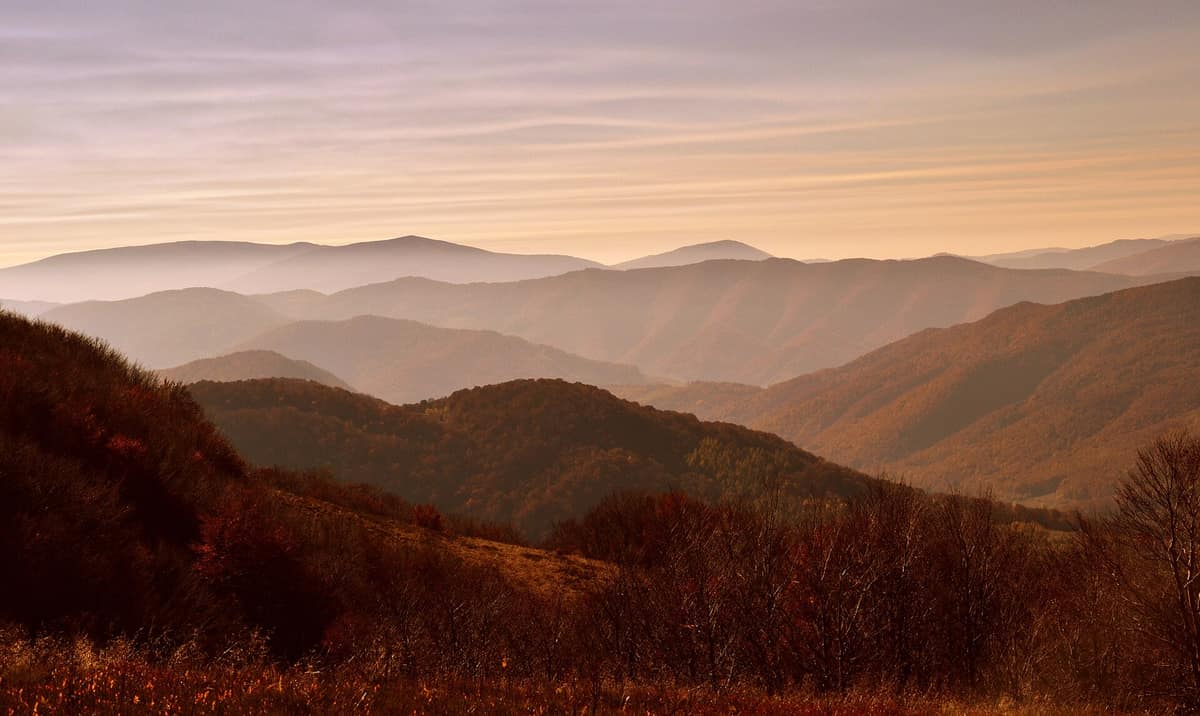
Bieszczady National Park - Forest Complex
Bieszczadzki Park Narodowy - Kompleks leśny
Subcarpathian Voivodeship (Ustrzyki Górne) · Poland
Photo: Stap22 · CC BY 3.0 · Wikimedia Commons
Poland’s wildest realm in the Eastern Carpathians, famed for sweeping alpine summit meadows (połoniny) and free-ranging European bison.
Walk along a valley in the Bieszczady and you quickly realize the forest did not start from scratch: beneath the trees lie overgrown field terraces, stone boundary walls, collapsed cellars, sunken stone wells, house foundations, and feral orchards. Between 1944 and 1947 the Ukrainian population was forcibly expelled from what is now the park, and the former village sites slowly reverted to brush and woodland. This created a poignant cultural landscape known locally as krainy dolin, the land of the valleys.
Bieszczady National Park, created in 1973, protects the southernmost corner of Poland across the highest ridge of the range. There, right along the Ukrainian border, rises Mount Opołonek at 1.028 m, the southernmost point in the country. Today the park encompasses 292,02 km², ranking as Poland's largest mountain national park.
What makes it unique
Home to the world’s largest wild herd of mountain European bison.
The place
Nature
The landscape
The park is divided into two distinct ecological belts. Down below, nearly 80 % is natural deciduous and mixed forest dominated by European beech, grey alder, sycamore maple, Norway spruce, and silver fir, with roughly 15 % classified as old-growth primeval stands. Up above, between 1.150 and 1.250 m, the trees abrupt and the połoniny begin: alpine ridgeline meadows unique within Poland to the Eastern Carpathians, covering some 1.800 ha.
The iconic summits are Tarnica (1.346 m), Krzemień (1.335 m), and Halicz (1.333 m), forming the historic core of the park upon its creation. Nearly 70 % of the territory is under strict protection, the highest proportion among all Polish national parks.
To preserve the open cultural valleys from shrub encroachment, meadows are mown regularly and, since 1993, grazed by Hucul ponies, an ancient mountain horse native to the Eastern Carpathians.
Plant life is exceptionally rich: nearly 780 vascular plants, some 30 of them endemic to the Eastern Carpathians, alongside 250 species of mosses, 500 lichens, and 1.000 fungi.
Wildlife and seasons
The park shelters more than 230 vertebrate species, including 58 mammals. It sustains virtually all of Poland's large carnivores: brown bear, wolf, Eurasian lynx, and European wildcat, alongside large herbivores like the European bison and Carpathian red deer.
The bison represents a conservation triumph. In the 60s, close to twenty animals were brought to the Bieszczady from breeding centres in Pszczyna and Niepołomice; today their herd forms the largest free-ranging mountain population in the world.
Over 140 bird species breed in the park, featuring apex raptors such as the golden eagle, lesser spotted eagle, and short-toed snake eagle. Nocturnal predators include Eurasian eagle-owl, boreal owl, and Ural owl, the latter occurring at one of Europe's highest densities. On windy summits you can spot rare montane passerines like the water pipit (siwerniak) and alpine accentor (płochacz halny).
The best season runs from May to October.
Species
With a page in the atlas
Being mentioned in a source doesn't guarantee sightings: check with the people who manage the area.
Memory and protection
History and conservation
Beyond the wartime displacement of 1944-1947, the landscape preserves other historic chapters. In 1992 it became part of the East Carpathians Biosphere Reserve, and since 2021 roughly 11 % of its territory has been inscribed as UNESCO World Heritage.
Before you set off
Visiting
How to visit
Begin at the Nature Museum in Ustrzyki Dolne, which preserves one of Poland's finest natural history collections, showcasing the park's ecosystems from valley floor to windswept połoniny. If approaching from Ustrzyki Dolne, the Lutowiska visitor centre stays open year-round. The park maintains 20 information and ticket kiosks alongside 11 parking areas.
For hiking, the park offers over a dozen natural and historical trails, mostly along established paths. Three classic benchmarks: Wołosate–Tarnica spans 4.40 km with an ascent taking two hours and five minutes; Rozsypaniec–Krzemień measures 13.50 km with an ascent of four and a half hours; and Tarnawa Niżna–Dźwiniacz Górny covers close to ten kilometres, taking about two hours and forty minutes each way.
Before you go
Hike strictly along marked trails during daylight hours. Carry out all trash, as abandoned food habituates wildlife. Information kiosks do not keep fixed hours, so check ahead whether you need to purchase trail admission online.
Check access, rules and visiting conditions in the official information from the managing body before you set off.
Location
Where it is and how far it reaches
Boundary of Bieszczadzki Park Narodowy · IUCN II · © EEA, CDDA (CC-BY) The coordinate is estimated; it isn't a verified access point.
Transparency
Sources
The research data with its sources, and the official links for this place, are in the Spanish version of this page. See the Spanish version
Around it
One kilometre away lie the Bukovské Vrchy Primeval Forest Complex - NP Poloniny and the Stužica Strict Nature Reserve; thirteen kilometres distant are Havešová Strict Nature Reserve and Rožok Strict Nature Reserve. Białowieża National Park - Strict Reserve shares bison, lynx, and wolf, though located far to the north.
What else to explore nearby
Approximate straight-line distance between the edges of each area. It doesn't indicate access, routes or driving times.
- Bukovské Vrchy Primeval Forest Complex - NP Poloniny
Prešov Region (Snina District)
About 1 km away
Slovakia’s largest tract of virgin primeval beech forests contiguous with subalpine ridge meadows (poloniny).
JFMAMJJASONDMay – October · Crowding very low
- Stužica Strict Nature Reserve
Prešov Region (Slovakia-Poland-Ukraine tripoint)
About 1 km away
Virgin mountain fir and beech forest at the meeting point of three Carpathian frontiers.
JFMAMJJASONDJune – October · Crowding very low
- Havešová Strict Nature Reserve
Prešov Region (Poloniny National Park)
About 13 km away
Virgin beech forest with record-breaking trees exceeding 50 metres in height in the Eastern Carpathians.
JFMAMJJASONDMay – October · Crowding very low
- Rožok Strict Nature Reserve
Prešov Region (Uličské Krivé)
About 13 km away
Dense montane primeval beech forest on steep karst slopes protected by UNESCO.
JFMAMJJASONDMay – October · Crowding very low
- Vihorlat Primeval Forest - Lake Morské Oko
Košice Region (Vihorlat Mountains)
About 28 km away
Ancient virgin beech forest surrounding a naturally dammed volcanic caldera lake in the Carpathians.
JFMAMJJASONDMay – October · Crowding low
If you like this place, elsewhere in Europe
Distant places with uncommon wildlife and habitats in common. The most widespread species don't count. Sharing species doesn't imply a corridor or guaranteed presence.
- Białowieża National Park - Strict Reserve
Podlaskie Voivodeship (Białowieża)
In common: European bison · Eurasian lynx · Brown bear
The last lowland primeval forest of Central Europe, historic refuge of the European bison.
JFMAMJJASONDMay – October · Crowding moderate
- Belovezhskaya Pushcha - Belarusian Sector
Brest and Grodno Voblasts
In common: European bison · Eurasian lynx · Grey wolf — old-growth forest
The largest portion of the primeval Białowieża Forest on Belarusian territory, sheltering Europe's largest free-roaming herd of bison.
JFMAMJJASONDMay – October · Crowding low
Entry #99 of the original atlas.