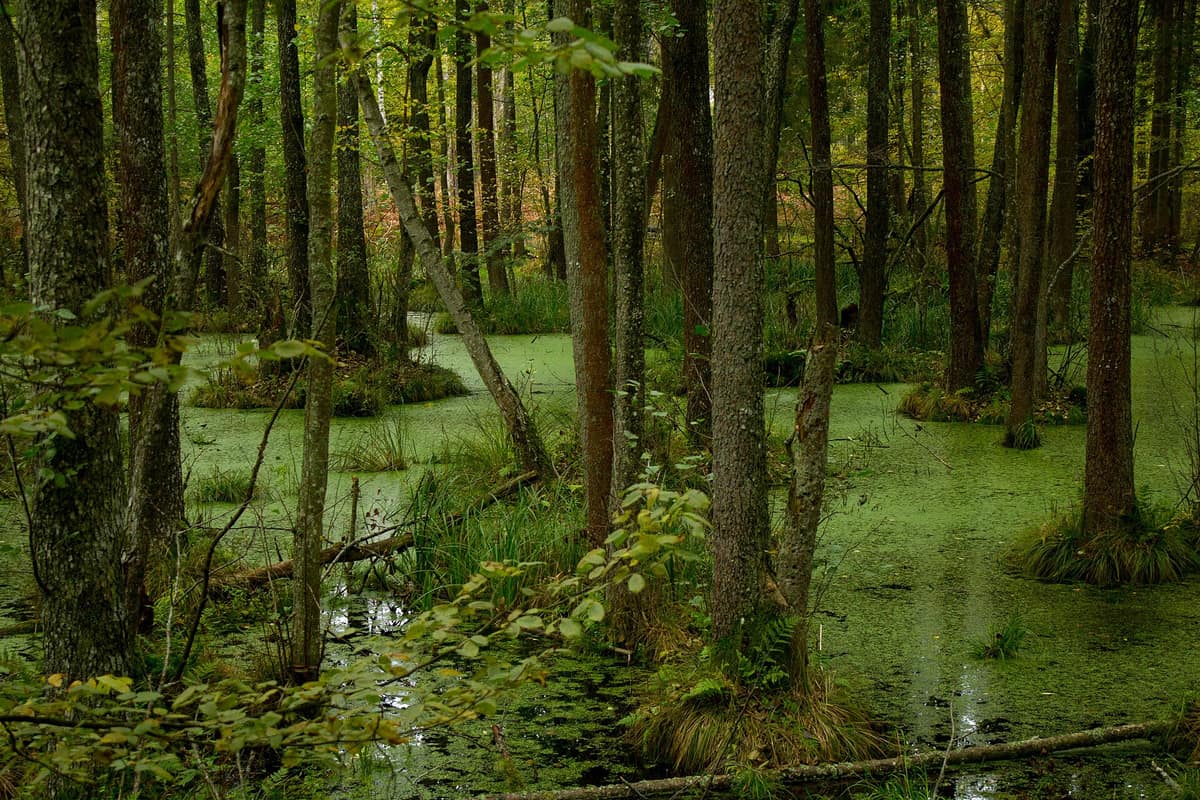
Belovezhskaya Pushcha - Belarusian Sector
Belovezhskaya Pushcha - Sector Belaruso
Brest and Grodno Voblasts · Belarus
Photo: Hanna Lushchyk · CC BY-SA 4.0 · Wikimedia Commons
The largest portion of the primeval Białowieża Forest on Belarusian territory, sheltering Europe's largest free-roaming herd of bison.
In 1991, in a secluded corner of this forest, the leaders of Ukraine, Russia, and Belarus signed the accord that dissolved the Soviet Union. Yet this woodland is far older than any state frontier. Belovezhskaya Pushcha National Park spans 150,069 ha of the Belarusian sector, 70 km north of Brest, and has formed part of the Białowieża Forest World Heritage site since 1992: the final remnant of primeval lowland forest in Europe. Here lives the European bison, the continent's heaviest land animal, with a forest-wide population exceeding 800 individuals.
What makes it unique
The Belarusian heartland of the European lowland's last primeval forest, home to the largest free-ranging bison population.
The place
Nature
The landscape
The terrain is lowland plain, where snow cover lingers between 70 and 75 days, and close by runs the continental watershed dividing the Baltic and Black seas. Pine forests occupy 59.3% of the woodland, dominated by bilberry and moss understoreys; woodland as a whole covers 86% of the reserve.
Inside, trees of radically differing generations stand side by side. The average tree age is 81 years, yet in undisturbed stands specimens reach between 250 and 350 years. Norway spruce is the tallest species, climbing up to 50 m. Among the oaks, one stands out by name: the Patriarch, one of the oldest in the Belarusian park, reaching 31 m, over 2 m in trunk diameter, and more than 550 years old, situated 1 km from the estate of Ded Moroz.
A huge portion of forest life depends on coarse woody debris. Nearly half the wood volume is dead wood—ten times more than in commercial forestry—and half of the forest's 12,000 recorded species depend directly on decaying timber. In the mires, such as along the Lake Ring route, peat discolours the waters of small artificial reservoirs created to regulate hydrological flow.
The flora is remarkably rich: 958 vascular plants, 260 mosses, over 290 lichens, and 570 fungi. Rare elements include silver fir, sessile oak, Turk's cap lily, and greater masterwort.
Wildlife and seasons
The wisent is the living emblem, with the forest harbouring over 800 animals. Yet large wildlife abounds: among big herbivores, red deer, wild boar, roe deer, and elk; among carnivores, wolf, red fox, lynx, badger, pine marten, and otter. Red deer had been extirpated locally and was successfully reintroduced in the 1890s.
The avifauna is outstanding. The park ranks as an Important Bird Area for its breeding black and white storks, eagle owl, European honey buzzard, and lesser and greater spotted eagles. Species listed in the Belarusian Red Data Book include white-tailed eagle, short-toed snake eagle, common crane, great grey owl, Eurasian pygmy owl, white-backed woodpecker, three-toed woodpecker, European roller, and aquatic warbler. Over 250 bird species occur in the forest, with 186 breeding on site. From the Lake Ring path, northern goshawks and western marsh harriers are frequently observed circling overhead.
Come autumn, varied wild mushrooms can be found along the Lake Ring.
Species
With a page in the atlas
Being mentioned in a source doesn't guarantee sightings: check with the people who manage the area.
Memory and protection
History and conservation
The forest was first documented in the Hypatian Chronicle under the year 983, and royal decrees protected bison for centuries: in 1553, Sigismund I decreed capital punishment for poaching one. Comprehensive protection arrived late. By 1923 only 54 European bison survived in captivity worldwide, with none left in Poland.
In 1991 the forest acquired its modern national park status, and in 2009 it marked 600 years of reserve protection. In 1993 the Belarusian section was designated a biosphere reserve. The park is partitioned into zones: the strictly protected core covers 39%; the regulated nature zone covers 25%; and recreational and economic zones together account for the remaining 36%.
Before you set off
Visiting
How to visit
The park welcomes around 300,000 visitors annually, with its headquarters in Kamieniuki. There, an open-air enclosure complex exhibits bison (reintroduced in 1929), konik horses, wild boars, and elk. The Eco-Education Centre houses the Nature Museum.
To view bison in the wild, the Dokudovo walking trail spans six kilometres across the mire of the same name; bison, red deer, roe deer, and boar are frequently observed grazing at dawn and dusk from purpose-built observation towers. Lake Ring covers 5.8 kilometres and takes about five hours. Northern Path measures 3.8 kilometres, starting beside Count Tyshkevich's manor.
The woodland is bisected by an international border. Since May 2015, hikers and cyclists can cross visa-free at the Pierarova-Białowieża border gate.
Before you go
A substantial portion of the park, 39%, is a strictly protected core zone, while 25% is under regulated use.
Check access, rules and visiting conditions in the official information from the managing body before you set off.
Location
Where it is and how far it reaches
Boundary of Нацыянальны парк «Белавежская пушча» · © OpenStreetMap contributors (ODbL) The coordinate is estimated; it isn't a verified access point.
Transparency
Sources
The research data with its sources, and the official links for this place, are in the Spanish version of this page. See the Spanish version
Around it
The Białowieża National Park - Strict Reserve lies just across the border in the Polish sector of the same forest. Further afield, Bieszczady National Park, the Bukovské Vrchy Primeval Forest Complex, and the Knyszyn Forest Landscape Park also support European bison, wolf, and lynx. The Stužica Strict Nature Reserve shares bison, lynx, and ancient virgin forest.
What else to explore nearby
Approximate straight-line distance between the edges of each area. It doesn't indicate access, routes or driving times.
- Białowieża National Park - Strict Reserve
Podlaskie Voivodeship (Białowieża)
About 1 km away
The last lowland primeval forest of Central Europe, historic refuge of the European bison.
JFMAMJJASONDMay – October · Crowding moderate
If you like this place, elsewhere in Europe
Distant places with uncommon wildlife and habitats in common. The most widespread species don't count. Sharing species doesn't imply a corridor or guaranteed presence.
- Bieszczady National Park - Forest Complex
Subcarpathian Voivodeship (Ustrzyki Górne)
In common: European bison · Eurasian lynx · Grey wolf — old-growth forest
Poland’s wildest realm in the Eastern Carpathians, famed for sweeping alpine summit meadows (połoniny) and free-ranging European bison.
JFMAMJJASONDMay – October · Crowding low
- Bukovské Vrchy Primeval Forest Complex - NP Poloniny
Prešov Region (Snina District)
In common: European bison · Eurasian lynx · Grey wolf — primary forest
Slovakia’s largest tract of virgin primeval beech forests contiguous with subalpine ridge meadows (poloniny).
JFMAMJJASONDMay – October · Crowding very low
- Borecka Forest - Natura 2000 Area
Warmian-Masurian Voivodeship (Kruklanki)
In common: European bison · Eurasian lynx · Grey wolf — old-growth forest
Diverse Masurian old-growth woodland harbouring a significant reintroduced free-ranging European bison population.
JFMAMJJASONDMay – October · Crowding very low
- Gerês-Xurés Transboundary Biosphere Reserve
Northern Portugal (Viana do Castelo / Braga / Vila Real) (PT) / Galicia (Ourense / Lobios) (ES)
In common: Quercus robur · Grey wolf — old-growth forest
Portugal's sole National Park joined with Galicia's Serra do Xurés Natural Park, forming a transboundary reserve of granite monoliths and herds of free-roaming Garrano horses.
JFMAMJJASONDMay – October · Crowding low
Entry #51 of the original atlas.