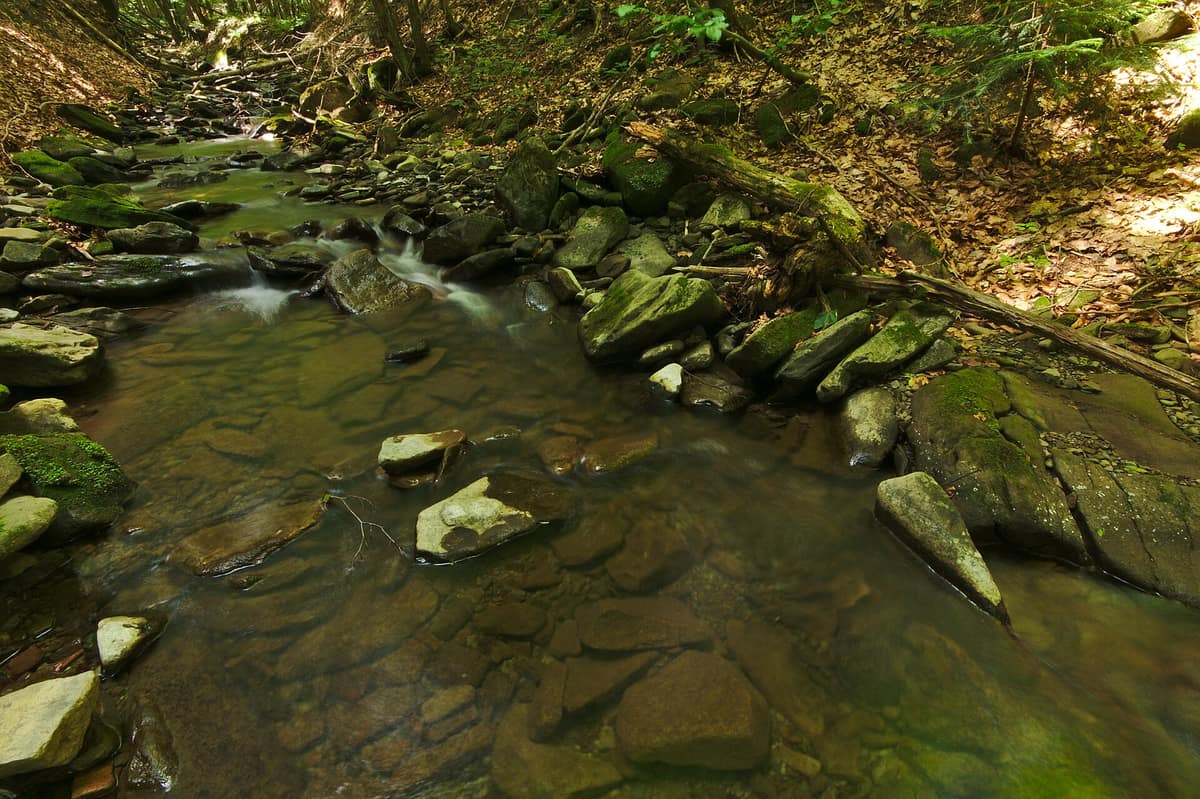
Stužica Strict Nature Reserve
Národná prírodná rezervácia Stužica
Prešov Region (Slovakia-Poland-Ukraine tripoint) · Slovakia
Photo: Jiří Komárek · CC BY-SA 4.0 · Wikimedia Commons
Virgin mountain fir and beech forest at the meeting point of three Carpathian frontiers.
There is a spot in the Carpathians where three countries converge, and a trail that climbs up to it through one of the range's finest virgin woodlands. You set out from Nová Sedlica, Slovakia's easternmost village, at 416 metres above sea level; you cross the Národná prírodná rezervácia Stužica, a primary beech forest of the outer Eastern Carpathians; and you reach Mount Kremenec at 1210 metres, where the borders of Slovakia, Poland, and Ukraine meet. Stužica has enjoyed protection since 1908 and is today a national nature reserve.
What makes it unique
A primeval beech forest, preserved without human alteration, right on the boundary marker where three countries touch.
The place
Nature
The landscape
This forest took root in the wake of the last ice age, and has followed its own uninterrupted rhythms ever since. The terrain climbs from 620 to 1208 metres, and ecological conditions shift markedly with altitude: below and along slopes stretch primeval beech and mixed fir-beech woods; above emerge high mountain grasslands known as poloniny, which give the national park its name. The bedrock consists of micaceous sandstones and shales, while the mean annual temperature hovers between 5 and 6 °C.
European beech, common ash, wych elm, and above all sycamore maple dominate the canopy. Through the reserve flows the Stužická stream, joined by its tributary Kamenistý potok. And the ancient woodland does not stop at the border: it continues uninterrupted into Ukraine as the Stužycia-Užok massif.
Wildlife and seasons
The reserve is prime habitat for large carnivores. Wildlife recorded for Stužica includes the grey wolf, the brown bear, the Eurasian lynx, and the Eurasian otter. In its dedicated reserve inventory, the park authority also lists the European bison and the moose.
What dominates the senses, however, is the forest itself: monumental beeches, ashes, and sycamores that have grown through centuries without the touch of an axe.
Species
With a page in the atlas
Being mentioned in a source doesn't guarantee sightings: check with the people who manage the area.
Memory and protection
History and conservation
The forest has been legally protected for more than a century: initial conservation dates to 1908, and in 1993 the territory was elevated to a national nature reserve. In 2007, Stužica and other ancient Carpathian sites, including six components in Ukraine, were inscribed as a UNESCO World Heritage property. Note that the Slovak national reserve and the UNESCO Stužica–Bukovské vrchy component cover slightly different administrative boundaries.
UNESCO mandates strict non-intervention management for all component parts. In other words, leaving the forest entirely free to remain what it is.
Before you set off
Visiting
How to visit
Park authorities count the virgin forest of Stužica among the most visited destinations in Poloniny, explored along marked hiking route TCH 0918, which links Nová Sedlica, the Stužica forest, and Kremenec. This is the red-marked Carpathian ridge trail: departing Nová Sedlica, it bisects the reserve and climbs directly to Kremenec at the tripoint.
From Kremenec, the red route follows the main crest of the Bukovské vrchy across the summits of Kamenná lúka (1201 m), Riaba skala (1167 m), and Pľaša (1162 m), leading down to the Ruské sedlo pass (797 m). An alternative option is the yellow-marked trail along the Hlboký potok valley, which climbs to the Riaba skala viewpoint—reputed by the park service to offer the finest panorama in the national park.
In Nová Sedlica you will find the local information centre, providing park maps and regional background. Its small natural history display features Arči, a mounted European bison. This is a village facility, situated outside the actual reserve.
Before you go
The visitor centre in Nová Sedlica is closed this summer season due to renovation works. Dogs must be kept on a leash and muzzled at all times, and damaging or disturbing plants, trees, or wildlife is strictly prohibited.
Check access, rules and visiting conditions in the official information from the managing body before you set off.
Location
Where it is and how far it reaches
Boundary of Stužica · IUCN Ia · © EEA, CDDA (CC-BY) The coordinate is estimated; it isn't a verified access point.
Transparency
Sources
The research data with its sources, and the official links for this place, are in the Spanish version of this page. See the Spanish version
How it fits into the territory
Calculated from the Atlas boundaries. «Part of» is only stated with an official boundary; an estimated area only means that they overlap.
Part of Bukovské Vrchy Primeval Forest Complex - NP Poloniny
Around it
Stužica almost borders Bieszczadzki Park Narodowy - Kompleks leśny, situated just a kilometre away. A little further afield lie Národná prírodná rezervácia Rožok at roughly eleven km, and Národná prírodná rezervácia Havešová at about fourteen km. Both share with Stužica membership in the Bukovské vrchy pralesový komplex - NP Poloniny.
Among comparable protected areas, Białowieski Park Narodowy - Rezerwat ścisły and Belovezhskaya Pushcha - Sector Belaruso share primeval forest ecosystems, European bison, and lynx. Munții Godeanu coincide in bison and brown bear.
What else to explore nearby
Approximate straight-line distance between the edges of each area. It doesn't indicate access, routes or driving times.
- Bieszczady National Park - Forest Complex
Subcarpathian Voivodeship (Ustrzyki Górne)
About 1 km away
Poland’s wildest realm in the Eastern Carpathians, famed for sweeping alpine summit meadows (połoniny) and free-ranging European bison.
JFMAMJJASONDMay – October · Crowding low
- Rožok Strict Nature Reserve
Prešov Region (Uličské Krivé)
About 11 km away
Dense montane primeval beech forest on steep karst slopes protected by UNESCO.
JFMAMJJASONDMay – October · Crowding very low
- Havešová Strict Nature Reserve
Prešov Region (Poloniny National Park)
About 14 km away
Virgin beech forest with record-breaking trees exceeding 50 metres in height in the Eastern Carpathians.
JFMAMJJASONDMay – October · Crowding very low
- Vihorlat Primeval Forest - Lake Morské Oko
Košice Region (Vihorlat Mountains)
About 29 km away
Ancient virgin beech forest surrounding a naturally dammed volcanic caldera lake in the Carpathians.
JFMAMJJASONDMay – October · Crowding low
If you like this place, elsewhere in Europe
Distant places with uncommon wildlife and habitats in common. The most widespread species don't count. Sharing species doesn't imply a corridor or guaranteed presence.
- Białowieża National Park - Strict Reserve
Podlaskie Voivodeship (Białowieża)
In common: European bison · Eurasian lynx · Brown bear — primary forest
The last lowland primeval forest of Central Europe, historic refuge of the European bison.
JFMAMJJASONDMay – October · Crowding moderate
- Belovezhskaya Pushcha - Belarusian Sector
Brest and Grodno Voblasts
In common: European bison · Eurasian lynx — primary forest
The largest portion of the primeval Białowieża Forest on Belarusian territory, sheltering Europe's largest free-roaming herd of bison.
JFMAMJJASONDMay – October · Crowding low
Entry #39 of the original atlas.