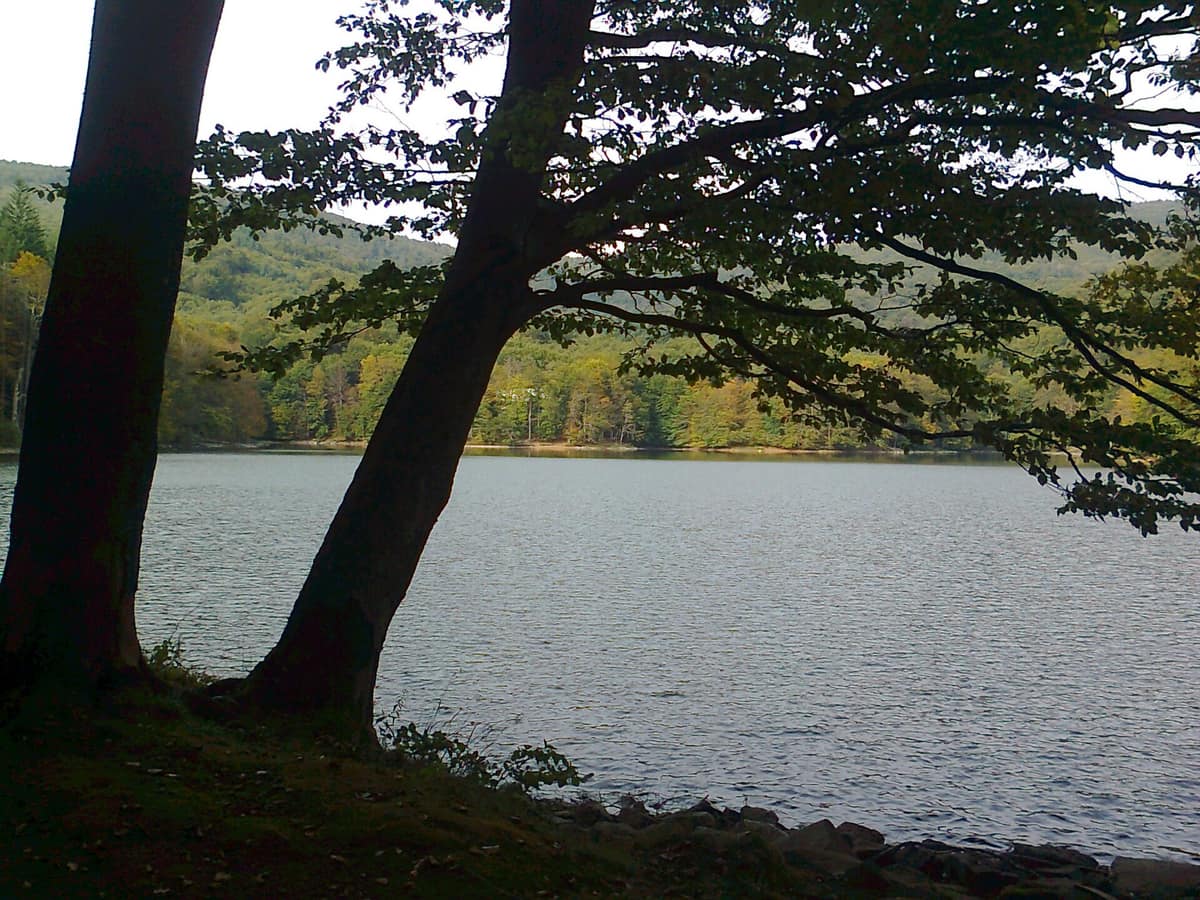
Vihorlat Primeval Forest - Lake Morské Oko
Prales Vihorlat - Morské oko
Košice Region (Vihorlat Mountains) · Slovakia
Photo: ZemplinTemplar · CC BY-SA 4.0 · Wikimedia Commons
Ancient virgin beech forest surrounding a naturally dammed volcanic caldera lake in the Carpathians.
A lake was born when a mountainside collapsed. As volcanic activity across Vihorlat waned, a catastrophic landslide tearing down the slopes of Motrogon and Jedlinka dammed the valley of the Okna stream, impounding pristine waters behind the debris. Today this lake is called Morské oko, the 'Eye of the Sea', surrounded by ancient beech forests that form part of a UNESCO World Heritage primeval forest network. It is a secluded haven in eastern Slovakia where you hike among dormant volcanoes, clear waters, and venerable trees.
What makes it unique
A mountain lake impounded by a prehistoric volcanic landslide, encircled by pristine old-growth beech woods inscribed on the UNESCO World Heritage list.
The place
Nature
The landscape
Vihorlat is a compact volcanic mountain chain rising sharply above the East Slovakian Lowland, with summits exceeding one thousand metres. Its biogeographical setting at the crossroads of Pannonian and Carpathian floras shapes its unique ecology: Lake Morské oko, the volcanic crags of Sninský kameň, high peat bogs, and a curious blend of northern and southern flora. On cooler northern aspects thrive alpine elements such as the Carpathian snowbell, while southern slopes shelter steppe-like forest communities adapted to warmer conditions.
The lake is the largest in the Vihorlat Mountains and the third largest natural waterbody in Slovakia, surpassed only by two glacial tarns in the High Tatras. It measures 750 m in length and plunges to a depth of 25.1 m. Its present outline was formalized in the late nineteenth century when a low stone masonry retaining wall was constructed. While the Slovak term 'morské oko' typically designates alpine glacial tarns, scientists' historical attempts to rechristen this volcanic lake never took root.
Everywhere, European beech reigns supreme. Vihorlat stands among the most densely forested ranges in the country, boasting broadleaf woodlands dominated by beech alongside oak, ash, sycamore maple, and silver fir. North of the lake, the World Heritage component encompasses a contiguous tract of primeval beech forest following the main crest towards the Nežabec massif. Across the northern slopes of Vihorlat peak survives another virgin tract between 800 and 1000 m. Beech survival history reveals that the species endured the last ice age in southern European glacial refugia, expanding its current hegemony over the past 4000 years.
Wildlife and seasons
In spring, the oak-hornbeam woods of the south-western foothills carpet themselves with Carpathian snowdrops: this is the most prolific wild locality of the species in Slovakia. Later come other botanical gems. The upland bogs nurture round-leaved sundew, marsh clubmoss, and tussock cottongrass, while a local endemic fescue, Festuca ovina vihorlatica, clings exclusively to the rocks of Sninský kameň. In total, botanists record some 400 fungal species, 60 lichens, 110 bryophytes, and 600 higher vascular plants.
Among vertebrates, around 100 bird species breed here: the beech canopy shelters nesting black stork and Ural owl. Diurnal raptors are led by the common buzzard, alongside European honey buzzard and lesser spotted eagle. These vast forests shelter the wolf, wildcat, Eurasian lynx, pine marten, and brown bear.
Invertebrate diversity is exceptionally rich, exceeding 2000 recorded taxa, including the saproxylic rosalia longicorn. Amphibians include common frog, fire salamander, and all four Slovakian newt species. Aesculapian snake is typical of the forest floor, whereas common viper occurs only sporadically. The optimal period for walking these trails is May to October.
Species
With a page in the atlas
Being mentioned in a source doesn't guarantee sightings: check with the people who manage the area.
Memory and protection
History and conservation
Two historical wooden hunting lodges were built beside the lake, representing the earliest tourist accommodation in Slovakia outside the High Tatras. Four Slovak forest reserves were inscribed on the UNESCO World Heritage list in 2007: three within Poloniny National Park and one in Vihorlat. The Vihorlat Protected Landscape Area was established on 28 December 1973.
Logging tracks and clear-cutting along peripheral zones pose erosion hazards for the lake, as silt washed into the basin reduces dissolved oxygen levels. A more subtle ecological challenge affects the semi-natural meadows of Starý Koňuš: they require regular mowing or extensive grazing to prevent scrub encroachment from returning them to dense forest.
Before you set off
Visiting
How to visit
The lake is reached from Remetské Hámre along a blue-marked educational trail. A car park, Krivec, lies approximately 15 minutes on foot below the lake. Beside the water, an information pavilion serves the Vihorlatský prales nature reserve.
The Morské oko educational circular route covers 4 km, is physically gentle, and interprets local geology, ornithology, and forest ecology. It traverses beech stands displaying old-growth structure, accessible from the lakeside parking area, Remetské Hámre, or Sninské rybníky. From the lake, Sninský kameň can be climbed via the blue-marked trail in one hour and 35 minutes on foot, while Malé Morské oko, an exquisitely preserved satellite lake, lies about 30 minutes away along yellow markings.
To venture deeper into the forest, follow the green-marked Vihorlatskými bučinami educational trail leading from Poruba pod Vihorlatom to Tri Table pass. In addition, since 2019 a marked hiking route links Podhoroď – Beňatina – Starý Koňuš – Koňuš, leading to the species-rich meadows of Starý Koňuš, renowned for elder-flowered orchid, green-winged orchid, and grassy iris (Iris graminea).
Before you go
Swimming, recreational boating, and angling are strictly prohibited in the lake and surrounding waters. The core reserve falls under Slovakia's strictest fifth level of nature protection. Large tracts of the World Heritage property lie within the Valaškovce military training area and are off-limits; the accessible sectors are traversed by marked trails.
Check access, rules and visiting conditions in the official information from the managing body before you set off.
Location
Where it is and how far it reaches
Boundary of Morské oko · © OpenStreetMap contributors (ODbL) The coordinate is estimated; it isn't a verified access point.
Transparency
Sources
The research data with its sources, and the official links for this place, are in the Spanish version of this page. See the Spanish version
Around it
In this same eastern corner of Slovakia lie other premier old-growth beech reserves: the Bukovské Vrchy Primeval Beech Complex in Poloniny National Park, 11 km away, is the closest; followed by Havešová Strict Nature Reserve, Rožok Strict Nature Reserve, and Stužica Strict Nature Reserve. Just across the border lies Bieszczady National Park. Further west, Prosiecka and Kvačianska Karst Valleys share with Vihorlat the Carpathian newt, lynx, and brown bear.
What else to explore nearby
Approximate straight-line distance between the edges of each area. It doesn't indicate access, routes or driving times.
- Bukovské Vrchy Primeval Forest Complex - NP Poloniny
Prešov Region (Snina District)
About 11 km away
Slovakia’s largest tract of virgin primeval beech forests contiguous with subalpine ridge meadows (poloniny).
JFMAMJJASONDMay – October · Crowding very low
- Havešová Strict Nature Reserve
Prešov Region (Poloniny National Park)
About 14 km away
Virgin beech forest with record-breaking trees exceeding 50 metres in height in the Eastern Carpathians.
JFMAMJJASONDMay – October · Crowding very low
- Rožok Strict Nature Reserve
Prešov Region (Uličské Krivé)
About 20 km away
Dense montane primeval beech forest on steep karst slopes protected by UNESCO.
JFMAMJJASONDMay – October · Crowding very low
- Bieszczady National Park - Forest Complex
Subcarpathian Voivodeship (Ustrzyki Górne)
About 28 km away
Poland’s wildest realm in the Eastern Carpathians, famed for sweeping alpine summit meadows (połoniny) and free-ranging European bison.
JFMAMJJASONDMay – October · Crowding low
- Stužica Strict Nature Reserve
Prešov Region (Slovakia-Poland-Ukraine tripoint)
About 29 km away
Virgin mountain fir and beech forest at the meeting point of three Carpathian frontiers.
JFMAMJJASONDJune – October · Crowding very low
If you like this place, elsewhere in Europe
Distant places with uncommon wildlife and habitats in common. The most widespread species don't count. Sharing species doesn't imply a corridor or guaranteed presence.
- Strâmbu-Băiuț Primeval Forest
Maramureș County
In common: European honey buzzard · Ural owl · European pine marten — primary forest
Continuous virgin beech forest of the Northern Carpathians designated as a UNESCO World Heritage site.
JFMAMJJASONDMay – October · Crowding very low
- Krokar Primeval Forest
Southeast Slovenia (Borovška Gora Mountains / Kočevje Municipality / Kolpa River Basin)
In common: Rosalia longicorn · Ural owl · European wildcat — primary forest
Primeval beech forest of Kočevsko, inscribed on the UNESCO World Heritage list, observed from the perimeter trail.
JFMAMJJASONDMay – October · Crowding very low
- Muránska Planina National Park - Primeval Forest Remnants
Banská Bystrica Region
In common: Ural owl · Black stork · European wildcat — primary forest
Karst plateau with limestone chasms, primeval beech woods, and meadows grazed by semi-feral mountain horses.
JFMAMJJASONDMay – October · Crowding very low
Entry #41 of the original atlas.