Krokar Primeval Forest
Pragozd Krokar
Southeast Slovenia (Borovška Gora Mountains / Kočevje Municipality / Kolpa River Basin) · Slovenia
Photo: Ljuba brank · CC BY-SA 3.0 · Wikimedia Commons
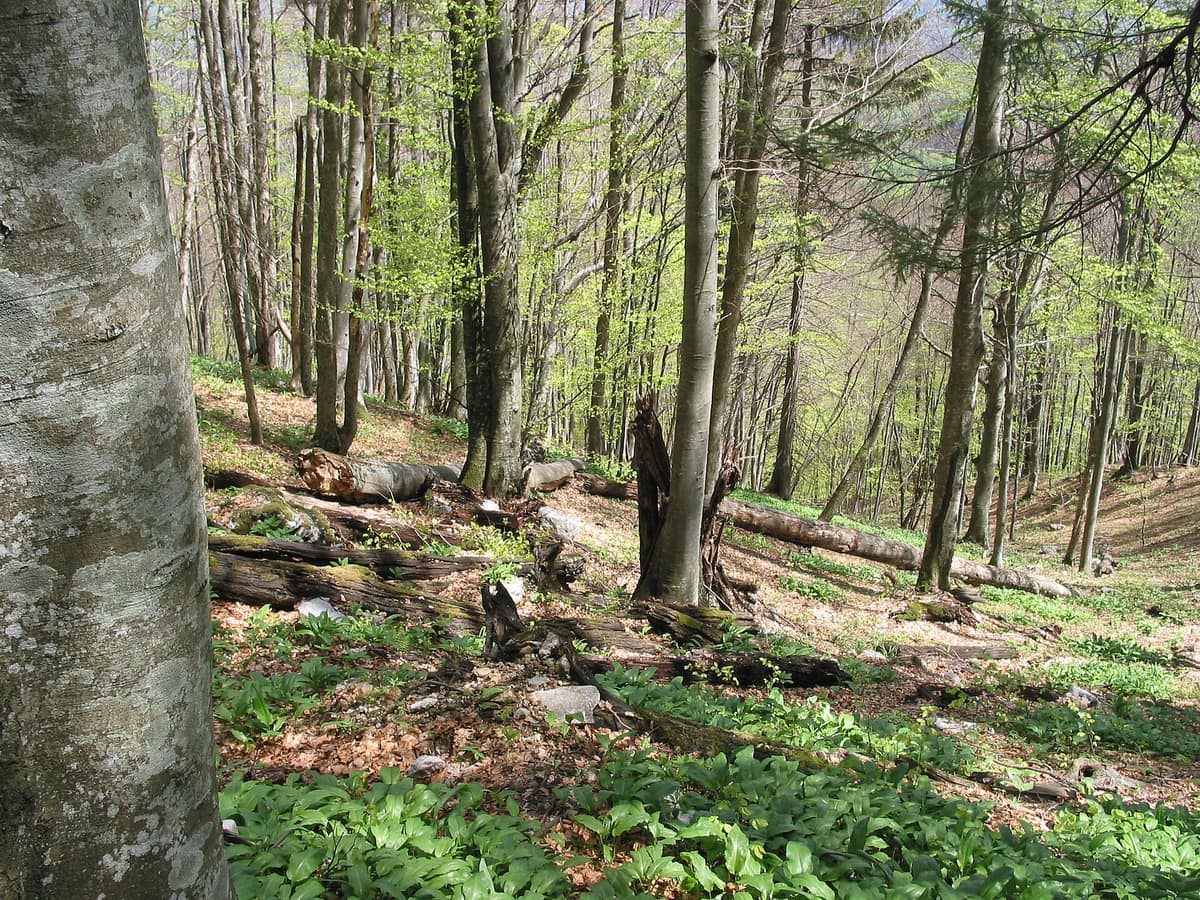
Primeval beech forest of Kočevsko, inscribed on the UNESCO World Heritage list, observed from the perimeter trail.
Krokar is a forest to admire, not to tread upon. The interior of this virgin beech forest in Kočevsko is strictly closed to all visitors, and that exact policy is what has kept it pristine: 74.5 hectares, the largest of the six relic primeval forest patches in the region, tucked away in south-eastern Slovenia. What you can do is circumnavigate it along a designated perimeter path, peer across the boundary line, and gaze from outside between monumental beech trees at the culmination of thousands of years of uninterrupted natural succession. UNESCO inscribed it on the World Heritage list in 2017.
What makes it unique
A primeval beech forest that survived the ice ages, today admired solely from its outer edge while its core remains pristine.
The place
Nature
The landscape
To understand Krokar, you must look back to the Ice Age. When vast ice sheets blanketed Europe, this refuge escaped glaciation and maintained a sheltered microclimate: it acted as an essential southern glacial refugium for European beech. As a result, its woods retain mesophilic forest flora that survived those frozen millennia, and the northward post-glacial expansion of beech is regarded as an ecological process that continues to this day.
The terrain is pure karst, sculpted from limestones and dolomites into an undulating plateau peppered with sinkholes. The southern and eastern flanks of the reserve plunge precipitously down toward the Kolpa River canyon. Vegetation reflects the montane zone of pure beechwoods and mixed beech-fir stands. Along dry ridge crests, continental and Mediterranean air masses converge, allowing cold-hardy alpine flora to grow alongside heat-loving sub-Mediterranean plants. The climate is temperate continental, receiving 1500 mm of annual rainfall with an average temperature of 7 °C.
The crowning asset, however, is the deadwood. A monumental volume of fallen trunks and standing snags provides habitat and nutrients for a myriad of living organisms, from bracket fungi to rare saproxylic beetles and cavity-nesting birds.
Wildlife and seasons
Management inventories document iconic denizens of the Dinaric wilderness within the area: brown bear, grey wolf, and Eurasian lynx. The deep woods also shelter the Ural owl and tawny owl, the white-backed woodpecker, and its preferred prey, the Rosalia longicorn beetle.
Along the rugged southern crags breed the golden eagle, the peregrine falcon, and of course the common raven, known as krokar in Slovene. Throughout the breeding season, strict off-limits rules inside the reserve are rigorously enforced.
The botanical calendar is best experienced on the Borovec circular trail around Krokar. In early spring, hellebores push through the leaf litter, and by late May the subalpine meadow beneath the Krempa pass transforms into a sea of wild white narcissi. These blooms belong to the outer walking trail, outside the virgin reserve itself.
Species
With a page in the atlas
Being mentioned in a source doesn't guarantee sightings: check with the people who manage the area.
Memory and protection
History and conservation
Formal conservation arrived in successive stages. In 1961, the regional forestry plan recognized the forest as a special-purpose woodland under the name Ravenski pragozd. In 1991, the Municipality of Kočevje granted it formal statutory protection. And in 2005 a state decree elevated it to a strict forest reserve.
The state forest service notes one historic challenge: the lack of precise visitor counts previously hindered tourism flow management. The surrounding Borovec forest reserve encircles Krokar as a buffer zone under a less restrictive conservation regime.
Before you set off
Visiting
How to visit
Two designated trails allow you to discover the outer boundary. The Pragozdna pot Krokar, or Primeval Forest Trail, is a loop of roughly two kilometres with 150 m of relatively steep climbing. It sets out from an established car park below the summit of Cerk, which marks the highest point along the trail, opening expansive views over the Kočevje forests and the village of Borovec. The other route is the Borovška naravoslovna pot, starting at the interpretive board by Borovec: it spans some 7.5 km with 280 m of vertical ascent, taking about three hours without stops. It threads past Ravne pod Cerkom and Krokar toward the Krempa saddle before looping back to Borovec, outfitted with waymarking, interpretive panels, and an accompanying guide booklet.
Nearby you will also find the alpine path to Firštov rep, affording dramatic views over the Krokar cliffs and the Kolpa valley.
For visitor assistance, the TIC in Kočevska Reka provides free maps and guidance for the Kočevsko region, while the Bearlog, Jezero, and Kočevska Reka centres stock hiking brochures.
Before you go
Entering the interior of Krokar is strictly prohibited. The forestry service bans all recreational entry into the reserve, including walking, trekking, and photography. You explore solely from marked external trails, and around Borovec you must keep to established paths. Removing plants, fungi, or natural souvenirs is prohibited.
Check access, rules and visiting conditions in the official information from the managing body before you set off.
Location
Where it is and how far it reaches
Boundary of Pragozd Krokar · © EEA, CDDA (CC-BY) The coordinate is estimated; it isn't a verified access point.
Transparency
Sources
The research data with its sources, and the official links for this place, are in the Spanish version of this page. See the Spanish version
Around it
Parque Nacional Risnjak lies roughly 5 km away, and the Snežnik Forest Massif sits at 11 km. At 19 km lies the Snježnik Massif; at 20 km are the Bosques y Meseta Kárstica de Javorniki; and a little over twenty kilometres away is the Bosque Virgen de Rajhenavski Rog.
Further afield, Reserva Natural Estricta Havešová and Parque Nacional del Bükk share the Ural owl, Rosalia longicorn, and white-backed woodpecker. Bosque Primario de Strâmbu-Băiuț and Bosque Primario de Groșii Țibleșului coincide in tawny owl, Ural owl, and peregrine falcon.
What else to explore nearby
Approximate straight-line distance between the edges of each area. It doesn't indicate access, routes or driving times.
- Risnjak National Park - Forest Complex
Gorski Kotar (Primorje-Gorski Kotar County)
About 5 km away
Karst mountain massif blanketed by dense beech and silver fir forests, serving as a prime refuge for the Eurasian lynx.
JFMAMJJASONDMay – October · Crowding low
- Javorniki Forests and Karst Plateau
Inner Carniola (Postojna / Cerknica)
About 20 km away
Forested karst plateau without continuous human settlements adjoining the intermittent lake of Cerknica.
JFMAMJJASONDMay – October · Crowding very low
- Rajhenavski Rog Virgin Forest
Lower Carniola / Kočevsko (Kočevje / Semič)
About 22 km away
The strict forest reserve of Kočevsko set aside in 1892 by the Counts of Auersperg, featuring monumental silver firs soaring 50 m high (Queen of Rog).
JFMAMJJASONDMay – October · Crowding none
If you like this place, elsewhere in Europe
Distant places with uncommon wildlife and habitats in common. The most widespread species don't count. Sharing species doesn't imply a corridor or guaranteed presence.
- Strâmbu-Băiuț Primeval Forest
Maramureș County
In common: Strix aluco · Ural owl · Peregrine falcon — primary forest
Continuous virgin beech forest of the Northern Carpathians designated as a UNESCO World Heritage site.
JFMAMJJASONDMay – October · Crowding very low
- Havešová Strict Nature Reserve
Prešov Region (Poloniny National Park)
In common: White-backed woodpecker · Rosalia longicorn · Ural owl — primary forest
Virgin beech forest with record-breaking trees exceeding 50 metres in height in the Eastern Carpathians.
JFMAMJJASONDMay – October · Crowding very low
- Muránska Planina National Park - Primeval Forest Remnants
Banská Bystrica Region
In common: Ural owl · Peregrine falcon · European wildcat — primary forest, karst and caves
Karst plateau with limestone chasms, primeval beech woods, and meadows grazed by semi-feral mountain horses.
JFMAMJJASONDMay – October · Crowding very low
Entry #664 of the original atlas.