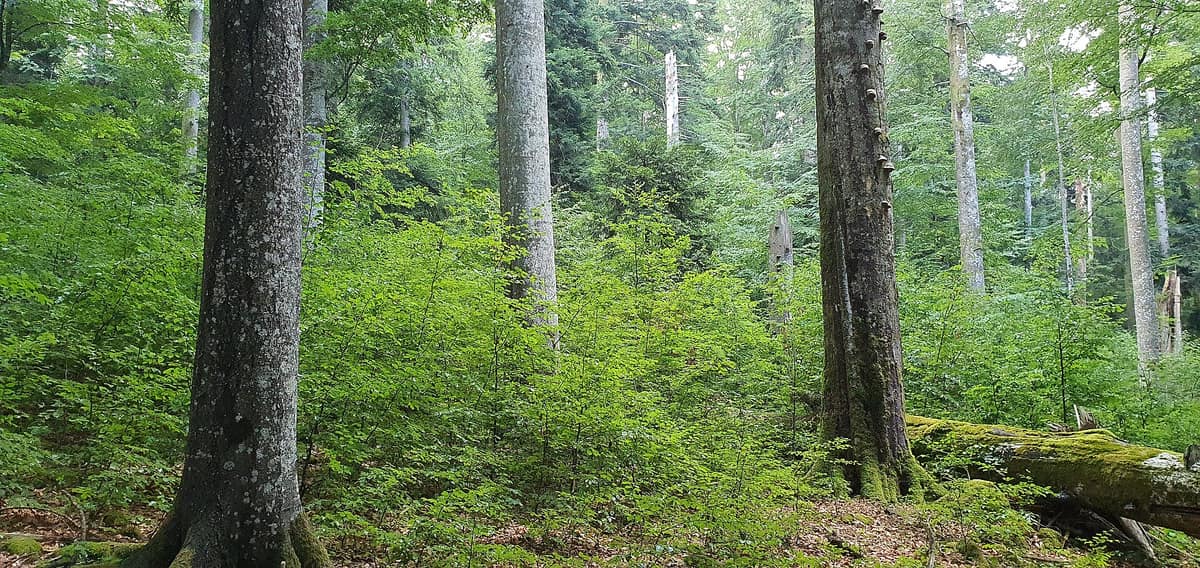
Rajhenavski Rog Virgin Forest
Lower Carniola / Kočevsko (Kočevje / Semič) · Slovenia
Photo: DuschanR · CC BY-SA 4.0 · Wikimedia Commons
The strict forest reserve of Kočevsko set aside in 1892 by the Counts of Auersperg, featuring monumental silver firs soaring 50 m high (Queen of Rog).
In 1892, an insightful forester inscribed a visionary clause in a forest management plan: a portion of the wild forest was to be preserved completely untouched. That man was Leopold Hufnagel, head forest engineer of Prince Auersperg's estates, and his decision gave rise in Kočevski Rog to the first protected natural area in Slovenia and the second anywhere on Earth, barely twenty years after Yellowstone. More than a century later, the Rajhenavski Rog virgin forest endures: 51 hectares of colossal silver firs and beeches in the heart of a karst plateau, entered by no one. It can only be admired from the outside.
What makes it unique
It is a primeval forest left completely undisturbed by human hands for well over a century, which can only ever be contemplated from its outer perimeter.
The place
Nature
The landscape
Kočevski Rog is a heavily forested karst plateau of the Dinaric Alps, whose central sector culminates at Veliki Rog at 1099 m. Nestled within lies the virgin forest of Rajhenavski Rog. Its canopy trees, predominantly silver firs and European beeches, are centuries-old giants reaching up to 50 metres in height, with venerable specimens aged up to five hundred years. The most magnificent fir measures 51 metres and is known as Debela Jelka, the Queen of Rog.
Stature alone does not tell the full story. In this primeval ecosystem, diverse life cycles intertwine over micro-topographies, yielding standing wood biomass far exceeding that of managed forestry: up to 800 m³/ha. Across the entire Kočevje region, intact primeval forest fragments encompass just 218 hectares, surviving solely because human saws never touched them. The best known among them are Rajhenavski Rog and Krokar.
Wildlife and seasons
Kočevsko has retained all three European apex predators: brown bear, wolf, and Eurasian lynx. The brown bear represents the living emblem of the region and has been listed in the Slovenian Red Data Book since 1993. The lynx, having vanished locally, was successfully reintroduced to the Kočevsko forests in the 1970s. The resident wolf pack is among the few purely indigenous lineages remaining in central Europe. Red deer, roe deer, red fox, and wild boar also thrive.
Spotting these elusive carnivores independently is rare. To encounter bears responsibly, expert-led forest excursions and nocturnal watches from reinforced timber blinds offer secure viewing. In autumn, red deer stags animate the woods with resonant rutting bellows.
Looking upward, the white-tailed eagle boasts a wingspan exceeding 2 metres; summer brings sightings of the Ural owl and northern goshawk, both well represented across the canopy. Meanwhile, Lake Kočevje supports more than 70 species of wetland birds.
Species
With a page in the atlas
Being mentioned in a source doesn't guarantee sightings: check with the people who manage the area.
Memory and protection
History and conservation
The Rog plateau is largely uninhabited today, but it was once heavily active. The industrial Rog steam sawmill operated from 1895 to 1932, supplied by a 35-kilometre narrow-gauge forest railway whose earthen embankments and culverts remain visible. To protect the primeval core, human entry remains forbidden: it is admired solely from designated boundary tracks.
Before you set off
Visiting
How to visit
Entering the virgin forest interior is strictly prohibited; the reserve may only be observed from the perimeter Rog Trail. This trail covers some 64 km connecting Lake Kočevje to the virgin forest of Rajhenavski Rog, marked throughout with bear-paw blazes. It leads past abandoned meadows and historic Gottschee settlements, across ancient woods where natural succession has operated unhindered for centuries. It suits hikers with basic to moderate fitness, and short sections are family-friendly. Hikers must carry sufficient provisions, as no potable springs exist along the ridge. Trail guidebooks are available from Kočevsko tourist info centres. A popular guided tour includes a 2 km circular loop along the outer fringe of the reserve.
Nearby, the Željne Caves form a horizontal subterranean network extending 1600 metres, easily walked thanks to natural skylights in the ceiling. In Gypsy Cave, excavations recovered more than 1400 prehistoric artefacts proving human occupation dating back roughly 20.000 years.
Before you go
Never cross the boundary into the virgin forest; view the trees exclusively from waymarked trails. Carry all required water and food for the entire outing. Guided excursions operate on varying seasonal schedules: verify booking details with local authorities in advance.
Check access, rules and visiting conditions in the official information from the managing body before you set off.
Location
Where it is and how far it reaches
Boundary of Pragozd Rajhenavski Rog · © EEA, CDDA (CC-BY) The coordinate is estimated; it isn't a verified access point.
Transparency
Sources
The research data with its sources, and the official links for this place, are in the Spanish version of this page. See the Spanish version
Around it
The virgin forest forms an integral component of the Kočevsko Forest Complex. Around twenty-two kilometres away lies Krokar Primeval Forest, Kočevsko's other great virgin beech enclave inscribed on the UNESCO World Heritage list; and at twenty-eight kilometres rises Risnjak National Park.
What else to explore nearby
Approximate straight-line distance between the edges of each area. It doesn't indicate access, routes or driving times.
- Krokar Primeval Forest
Southeast Slovenia (Borovška Gora Mountains / Kočevje Municipality / Kolpa River Basin)
About 22 km away
Primeval beech forest of Kočevsko, inscribed on the UNESCO World Heritage list, observed from the perimeter trail.
JFMAMJJASONDMay – October · Crowding very low
- Risnjak National Park - Forest Complex
Gorski Kotar (Primorje-Gorski Kotar County)
About 28 km away
Karst mountain massif blanketed by dense beech and silver fir forests, serving as a prime refuge for the Eurasian lynx.
JFMAMJJASONDMay – October · Crowding low
If you like this place, elsewhere in Europe
Distant places with uncommon wildlife and habitats in common. The most widespread species don't count. Sharing species doesn't imply a corridor or guaranteed presence.
- Badínsky Prales Primeval Forest
Banská Bystrica (Badín / Banská Bystrica)
In common: Silver fir · Eurasian lynx · Brown bear — primary forest, old-growth forest
Virgin fir and beech forest over 400 years old protected since 1913, famous for receiving an official visit by Charles III of the United Kingdom for its ecological value.
JFMAMJJASONDMay – October · Crowding none
- Strâmbu-Băiuț Primeval Forest
Maramureș County
In common: Silver fir · Eurasian lynx · Brown bear — primary forest
Continuous virgin beech forest of the Northern Carpathians designated as a UNESCO World Heritage site.
JFMAMJJASONDMay – October · Crowding very low
- Perućica Primeval Forest - Sutjeska National Park
Republika Srpska (Foča / Maglić)
In common: Silver fir · Eurasian lynx · Brown bear — primary forest
The best-preserved beech and fir primeval forest in Southeastern Europe, with trees over 300 years old and the Skakavac waterfall.
JFMAMJJASONDJune – October · Crowding very low
Entry #663 of the original atlas.