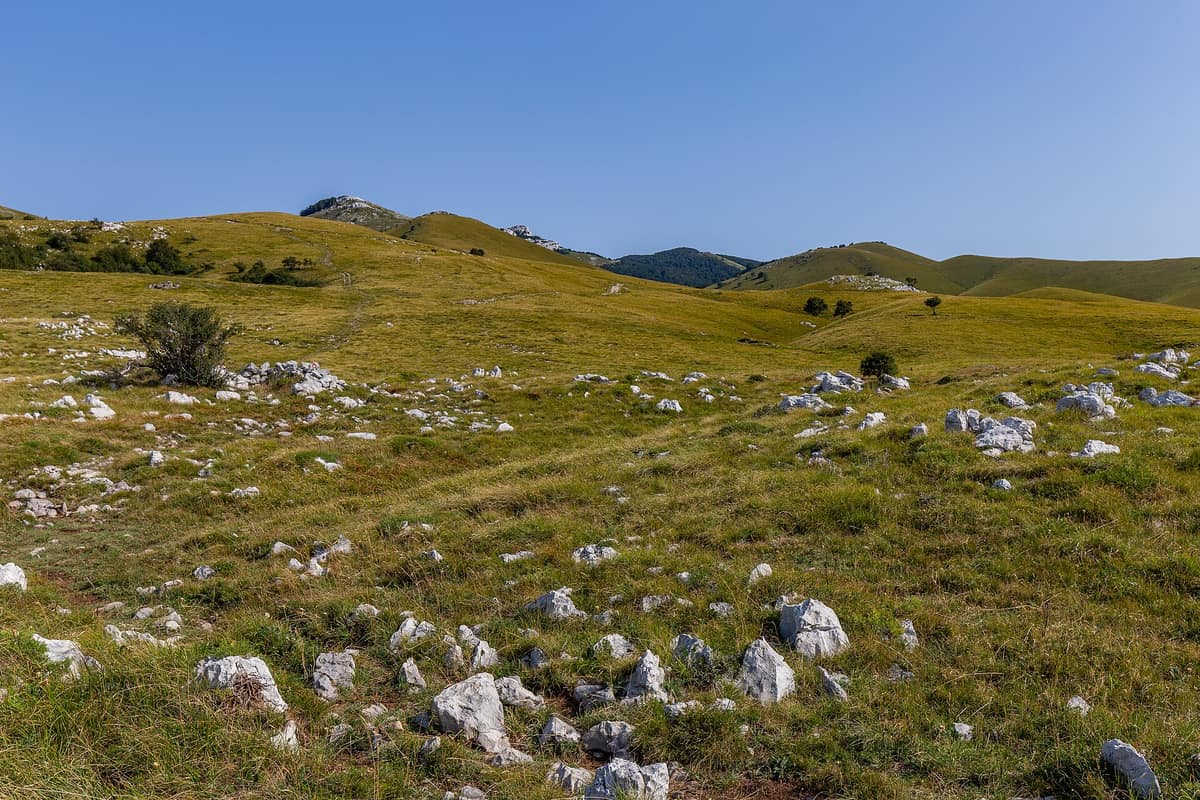
Risnjak National Park - Forest Complex
Nacionalni park Risnjak - Šumski kompleks
Gorski Kotar (Primorje-Gorski Kotar County) · Croatia
Photo: Michal Klajban · CC BY-SA 4.0 · Wikimedia Commons
Karst mountain massif blanketed by dense beech and silver fir forests, serving as a prime refuge for the Eurasian lynx.
Certain mountains divide water between two seas, and Risnjak is one of them. Rising in the northern Dinaric Alps, this massif marks the hydrological divide between the Adriatic and Black Sea basins. Its national park, located in Gorski Kotar some 15 km inland from the Adriatic, encompasses 63,5 km² across the core of the Risnjak-Snježnik range and the headwaters of the Kupa river. Forest reigns supreme: towering beech and silver fir over fractured limestone, watched over by the secretive cat that gave the mountain its name, as Risnjak likely derives from "ris", the Croatian word for lynx.
What makes it unique
A limestone mountain realm where Europe’s three apex carnivores—bear, wolf, and lynx—roam together and an emerald river takes birth.
The place
Nature
The landscape
The highest summit is Veliki Risnjak (1528 m) and the lowest elevation is the spring of the Kupa (313 m). Between them spreads a textbook karst topography dominated by limestone and dolomite: ponikve sinkholes, limestone pavements, collapsed chasms, and cavernous shafts. Because limestone is profoundly porous, surface streams are almost absent; groundwater bursts forth abruptly, as exemplified by the Kupa spring. Wellying at the park’s lowest point in an oval pool some 50 m wide, water surges through two subterranean conduits 86 and 57 m deep. The spring pool sits at 321 m and ranks among the most discharge-rich, expansive, and deepest karst springs in Croatia; it has enjoyed legal protection since 12 December 1963.
The climate is cool and moist montane: at the Risnjak mountain hut, mean annual temperature is 2,5 °C and annual precipitation reaches 3600 mm, among the highest in Croatia. Forests blanket 92 % of the park across 16 ecological communities ascending from the Kupa valley to the summits of Risnjak and Snježnik, dominated by mixed beech-fir stands. Rare flora graces the high crags, including edelweiss and black vanilla orchid. The vascular flora counts up to 1148 species and subspecies, featuring an exceptional diversity of native orchids.
Wildlife and seasons
The Eurasian lynx was extirpated in the nineteenth century and naturally recolonised Risnjak following reintroduction efforts in neighbouring Slovenia. Risnjak represents one of Croatia’s core survival zones, with its unfragmented mountain woodland ranking among the finest refuges for large mammals in Europe. Here dwell also the brown bear and the wolf, monitored in two stable packs—the Risnjak pack and the Snježnik pack. Two resident herds of chamois roam the crags year-round.
A total of 78 bird species breed in the park, almost all tied to mature forest, with 114 species recorded across the park and its buffer. The western capercaillie is critically endangered in Croatia, while peregrine falcon and Eurasian pygmy owlet are vulnerable. Entomologists have documented 89 butterfly species, 11 of which are threatened; the Kupa valley and Dimovac slopes harbour 69 species, earning the upper Kupa valley the moniker "Enchanted Valley of Butterflies". Underground, 42 cave invertebrate taxa have been recorded, 23 of them obligate troglobites.
Species
With a page in the atlas
Being mentioned in a source doesn't guarantee sightings: check with the people who manage the area.
Memory and protection
History and conservation
Risnjak received early protective recognition: in 1949 botanist Ivo Horvat first formally advocated safeguarding the area, and in 1997 the Croatian parliament expanded the park to its current borders, incorporating Snježnik and the Kupa headwaters. The protected area exceeds 4.600 ha, divided into strict and active conservation zones where natural processes proceed unimpeded.
Individual brown bear home ranges extend far beyond park boundaries, highlighting the ongoing challenge of landscape-scale connectivity for large carnivores.
Rewilding projects
Before you set off
Visiting
How to visit
Begin your journey on the Leska educational trail. The first nature trail established in a Croatian national park, it was inaugurated on 4 June 1993 and begins a short walk west of the park administration building in Crni Lug. It forms an accessible loop of 4.200 m with minimal elevation change, walkable year-round: awakening in spring, offering cool woodland shade in summer, ablaze with colour in autumn, and walkable through most of winter. Its 23 interpretive panels explain flora, fauna, and cultural heritage with English translations, detailing traditional architecture and large carnivore ecology; it can be explored independently or with a guide.
Two trails reach the source of the Kupa. From Razloge, it takes 35 minutes down (50 minutes return) over 1820 m and 229 m of descent, graded moderate, starting by the visitor centre. From Hrvatsko, the hike requires 1 h 30 min over 4850 m, graded easy, following the Ribička staza past Kupari hamlets. Two visitor centres serve the Kupa valley: the Gorski Kotar House of Knowledge in Razloge and the Birth House of the Kupa River in Gornji Kupari. The river trail can flood during heavy downpours and spring snowmelt.
To summit Veliki Risnjak (1528 m), five marked trails approach from various trailheads; spring, summer, and autumn are prime, while winter demands mountaineering equipment and experience. The Horvatova route begins near Bijela Vodica, following forest tracks through Bukovac and Smrekovac; it takes 2 h 40 min, climbs 838 m, and is moderately strenuous. The western approach from Vilje is the easiest ascent, gently climbing old forestry tracks to Medvjeđa Vrata (1289 m). Snježnik, at 1506 m, is the second summit, an hour and a half on foot from the Platak ski resort, renowned as Croatia’s finest ski-touring ridge.
For wildlife enthusiasts, the park provides an observation programme on the remote Lazac meadow, one of the few places in Europe where bear, wolf, and lynx share habitat. Starting at the main entrance, a park vehicle transports guests 30 km to the cabin, and a ranger returns them to Crni Lug the next morning. Booking is mandatory 7 days in advance; visitors must bring all food and drinking water. A guided chamois-watching excursion is also available.
Before you go
The Schlosser mountain hut nestled below the summit honours physician and botanist Josip Schlosser Klekovski; verify opening periods before relying on shelter. Dress warmly in layers, carry sufficient food and water, and stay on marked paths. Recommended hiking months span May to October.
Check access, rules and visiting conditions in the official information from the managing body before you set off.
Location
Where it is and how far it reaches
Boundary of Risnjak · © EEA, CDDA (CC-BY) The coordinate is estimated; it isn't a verified access point.
Transparency
Sources
The research data with its sources, and the official links for this place, are in the Spanish version of this page. See the Spanish version
Around it
Risnjak is encircled by vast forests: Snježnik Massif Croatia lies 1 km away, Snežnik Forest Massif / Veliki Snežnik 2 km, Kočevsko Forest Complex 3 km, Virgin Forest Krokar 5 km, Javorniki Forest Complex 9 km, and Postojna Cave - Planina Karst Field twenty-four kilometres away.
What else to explore nearby
Approximate straight-line distance between the edges of each area. It doesn't indicate access, routes or driving times.
- Krokar Primeval Forest
Southeast Slovenia (Borovška Gora Mountains / Kočevje Municipality / Kolpa River Basin)
About 5 km away
Primeval beech forest of Kočevsko, inscribed on the UNESCO World Heritage list, observed from the perimeter trail.
JFMAMJJASONDMay – October · Crowding very low
- Javorniki Forests and Karst Plateau
Inner Carniola (Postojna / Cerknica)
About 9 km away
Forested karst plateau without continuous human settlements adjoining the intermittent lake of Cerknica.
JFMAMJJASONDMay – October · Crowding very low
- Rajhenavski Rog Virgin Forest
Lower Carniola / Kočevsko (Kočevje / Semič)
About 28 km away
The strict forest reserve of Kočevsko set aside in 1892 by the Counts of Auersperg, featuring monumental silver firs soaring 50 m high (Queen of Rog).
JFMAMJJASONDMay – October · Crowding none
If you like this place, elsewhere in Europe
Distant places with uncommon wildlife and habitats in common. The most widespread species don't count. Sharing species doesn't imply a corridor or guaranteed presence.
- Northern Velebit National Park
Lika-Senj (Croatia)
In common: Eurasian pygmy owlet · Ural owl · Western capercaillie — old-growth forest, high mountain, karst and caves
Karst relief, ancient beech forests and mountain pastures in Northern Velebit.
JFMAMJJASONDMay – November · Crowding low
- Bucegi National Park - Western Slopes
Dâmbovița, Argeș, and Prahova Counties
In common: Ural owl · Western capercaillie · Eurasian lynx — old-growth forest, high mountain, karst and caves
Dramatic conglomerate cliffs rising toward the plateau of the Babele and Sphinx wind-sculpted rock formations.
JFMAMJJASONDJune – October · Crowding low
- Muránska Planina National Park - Primeval Forest Remnants
Banská Bystrica Region
In common: Ural owl · Western capercaillie · Eurasian lynx — high mountain, karst and caves
Karst plateau with limestone chasms, primeval beech woods, and meadows grazed by semi-feral mountain horses.
JFMAMJJASONDMay – October · Crowding very low
Entry #81 of the original atlas.