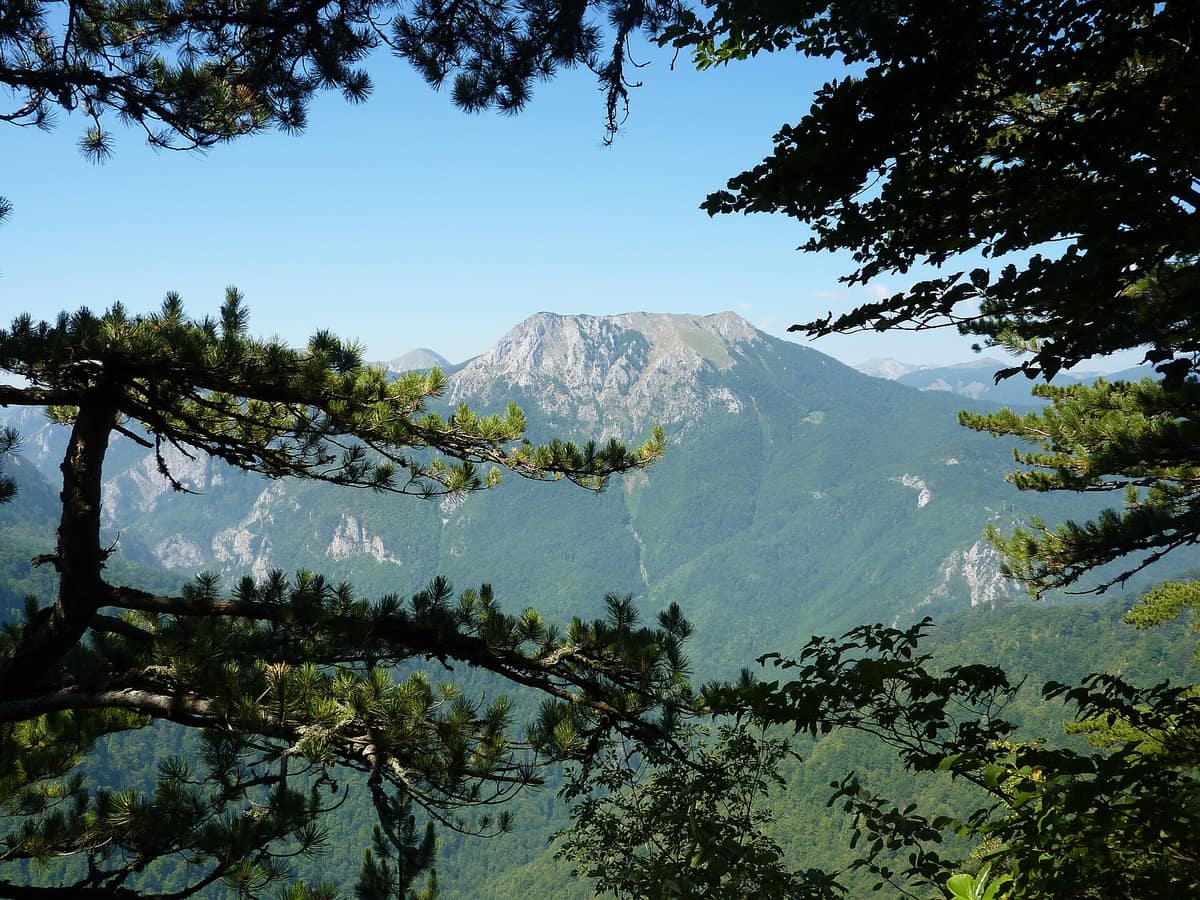
Perućica Primeval Forest - Sutjeska National Park
Prašuma Perućica - Nacionalni park Sutjeska
Republika Srpska (Foča / Maglić) · Bosnia and Herzegovina
Photo: Erwan Martin from Plouzané, France · CC BY 2.0 · Wikimedia Commons
The best-preserved beech and fir primeval forest in Southeastern Europe, with trees over 300 years old and the Skakavac waterfall.
Primeval forests are never silent. When a tree dies, another emerges, and the cycle continues uninterrupted without human intervention: birth, life, death, and renewal. This is Perućica, a primary forest of 1,434 hectares often referred to as 'the lungs of Europe', nestled in a mountain basin between Maglić, Volujak, and Sniježnica, within Sutjeska National Park in Republika Srpska. It is a strict nature reserve where nature follows its course untouched by human hands.
What makes it unique
A primary beech and fir forest that has remained excluded from forestry management for decades, featuring a waterfall of about 75 metres along its stream.
The place
Nature
The landscape
The reserve encompasses the basin of the Perućica stream, in a valley framed by mountains. The surrounding slopes and rock faces consist of limestone, whereas the central basin features acidic sandstone and schist. Higher up, ancient ice left its mark in the form of cirques, glacial valleys, and moraines. By contrast, the lower reaches of Perućica remained partially unglaciated. Running water shaped the rest, carving and deepening the Sutjeska Gorge, which structures the wider landscape. In this high-mountain terrain, the weather shifts rapidly across short distances.
Upon this terrain grows the forest. Between 1,000 and 1,600 metres of altitude, most of the reserve is cloaked in mature beech and fir stands, interspersed with occasional spruce, maple, elm, and ash. The upper sector shelters subalpine beech woodlands, occurring as pure stands or blended with sycamore maple, alongside subalpine spruce, dwarf pine formations, and alpine grasslands. In total, more than 170 tree and shrub species and over 1,000 herbaceous plants have been recorded.
Then there is the plummeting water: the Skakavac waterfall, formed by the Perućica stream right inside the forest. Dropping roughly 75 metres, it is among the highest cascades in the country.
Wildlife and seasons
Prominent mammals inhabiting Perućica include the brown bear, chamois, roe deer, wild boar, grey wolf, red fox, and European badger. Park managers also record less common fauna, such as the European wildcat, Eurasian lynx, and mole rat.
Woodpeckers represent another chapter altogether. Park authorities highlight nine species across the national park, particularly concentrated in the strict reserve of Perućica, explaining that they depend strictly on ancient, decaying, and standing dead trees—precisely what an unmanaged forest generates in abundance.
Guided tours operate from April through November.
Species
With a page in the atlas
Being mentioned in a source doesn't guarantee sightings: check with the people who manage the area.
Memory and protection
History and conservation
The state formally removed Perućica from ordinary commercial forestry in 1952, reserving it for scientific research and education. In 1954 the protected perimeter was expanded by 200 hectares. Sutjeska National Park was founded in 1962 and borders Durmitor National Park across the regional transboundary zone.
The surrounding area preserves stećci necropolises and traces of ancient Roman roads. The Sutjeska management plan for 2025–2035 underwent public consultation at the municipal offices in Gacko.
Before you set off
Visiting
How to visit
You visit Perućica on a guided hike departing from the Dragoš Sedlo viewpoint at the mountain pass and leading deep into the heart of the forest. The route covers around eight or nine kilometres across different forest sectors. The outing lasts four to five hours, with roughly three hours of walking at a moderate difficulty level. Along the path, scenic viewpoints perched at the forest edge look out over Perućica, the Skakavac waterfall, and the massifs of Maglić, Volujak, Zelengora, and Bioč.
The Sutjeska National Park Information Centre is the designated point to arrange entry to Perućica.
In Tjentište, the memorial complex includes the Battle Museum and the Sutjeska Battle Memorial House. The battle monument itself was erected in 1971.
Before you go
Access is strictly regulated: you may only travel through the reserve along designated paths and you must stay on them at all times. Entry permits and guides are arranged at the Park Information Centre.
Check access, rules and visiting conditions in the official information from the managing body before you set off.
Location
Where it is and how far it reaches
Boundary of Rezervat Prašuma Perućica · © OpenStreetMap contributors (ODbL) The coordinate is estimated; it isn't a verified access point.
Transparency
Sources
The research data with its sources, and the official links for this place, are in the Spanish version of this page. See the Spanish version
How it fits into the territory
Calculated from the Atlas boundaries. «Part of» is only stated with an official boundary; an estimated area only means that they overlap.
Part of Sutjeska National Park - Maglić Massif
Shares territory with
- Sutjeska National Park - Zelengora Mountains
Republika Srpska (Foča / Tjentište)
Their official boundaries overlap
The "Green Mountain", a range of forests and alpine meadows dotted by 8 glacial lakes of striking beauty.
JFMAMJJASONDJune – October · Crowding very low
Around it
Park prirode Piva directly adjoins Perućica, while two massifs of Durmitor lie around twenty kilometres away: Nacionalni park Durmitor - Masiv and Nacionalni park Durmitor - Kanjon Tare. Perućica is part of Nacionalni park Sutjeska - Zelengora, with Nacionalni park Sutjeska - Maglić nested within its domain.
Among related primeval forests, Codrul Secular Strâmbu-Băiuț shares silver fir, European beech, and Eurasian lynx; Prašuma Lom - Strogi rezervat prirode shares them as well. Bukovské vrchy pralesový komplex - NP Poloniny and Rezervația Codrul Secular Slătioara also share beech, lynx, and wolf.
If you like this place, elsewhere in Europe
Distant places with uncommon wildlife and habitats in common. The most widespread species don't count. Sharing species doesn't imply a corridor or guaranteed presence.
- Pelister National Park
Pelagonia (Bitola / Resen)
In common: Silver fir · Fagus sylvatica · Chamois — primary forest, high mountain
The oldest national park in North Macedonia (1948), established to preserve primeval Macedonian pine (molika) forests.
JFMAMJJASONDJune – October · Crowding very low
- Strâmbu-Băiuț Primeval Forest
Maramureș County
In common: Silver fir · Fagus sylvatica · Eurasian lynx — primary forest
Continuous virgin beech forest of the Northern Carpathians designated as a UNESCO World Heritage site.
JFMAMJJASONDMay – October · Crowding very low
- Badínsky Prales Primeval Forest
Banská Bystrica (Badín / Banská Bystrica)
In common: Silver fir · Fagus sylvatica · Eurasian lynx — primary forest
Virgin fir and beech forest over 400 years old protected since 1913, famous for receiving an official visit by Charles III of the United Kingdom for its ecological value.
JFMAMJJASONDMay – October · Crowding none
- Lom Primeval Forest Strict Nature Reserve
Republika Srpska (Petrovac / Klekovača)
In common: Silver fir · Fagus sylvatica · Eurasian lynx — primary forest, high mountain
Beech and fir reserve set upon the deep karstic terrain of Mount Klekovača.
JFMAMJJASONDJune – October · Crowding very low
Entry #42 of the original atlas.