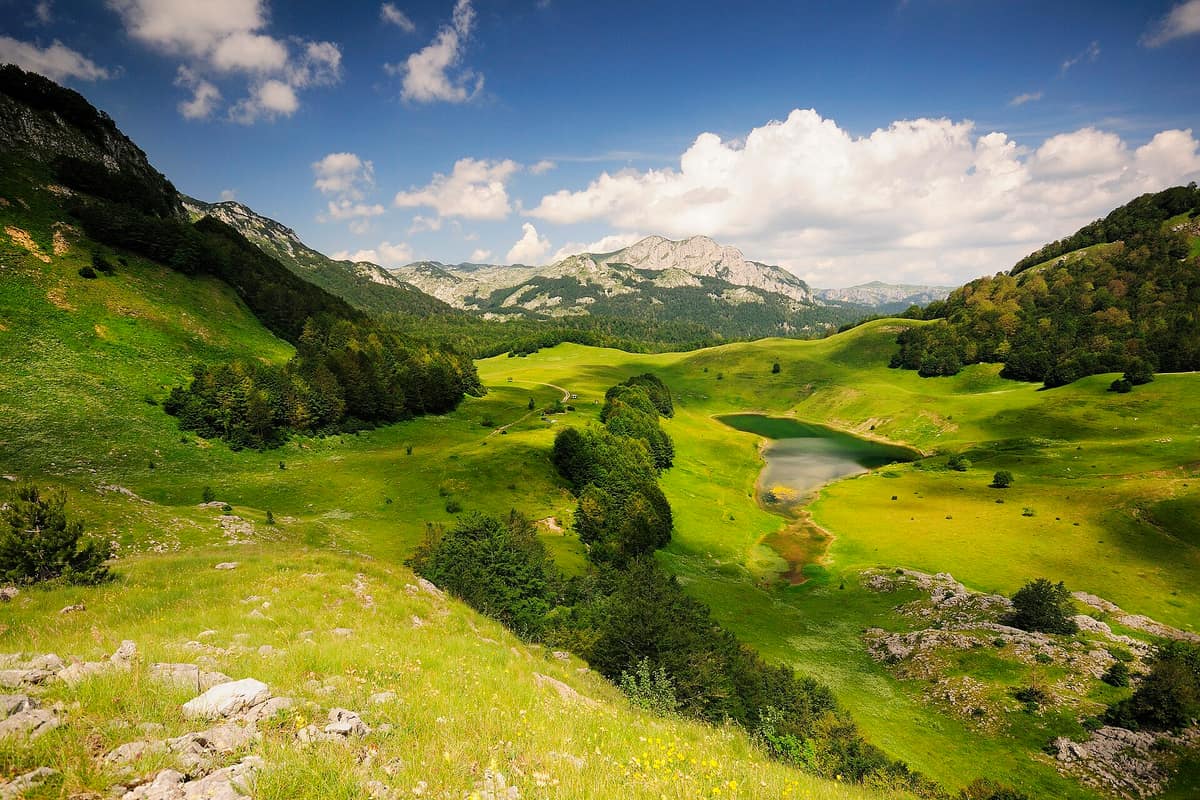
Sutjeska National Park - Zelengora Mountains
Nacionalni park Sutjeska - Zelengora
Republika Srpska (Foča / Tjentište) · Bosnia and Herzegovina
Photo: Petkovic Boris · CC BY-SA 4.0 · Wikimedia Commons
The "Green Mountain", a range of forests and alpine meadows dotted by 8 glacial lakes of striking beauty.
The Sutjeska River has carved a canyon some 1200 m deep. On one flank rise Maglić, Volujak and Bioč; on the opposite side spreads Zelengora, the "Green Mountain", undulating with rounded summits, blanketed by woodlands, lush meadows and glacial tarns. Located within Sutjeska National Park (Republika Srpska, between Foča and Tjentište), the park administration recommends it as an ideal setting for family recreation because its mountain trails are not particularly demanding.
What makes it unique
A gentle mountain of glacial lakes and pastures where shepherds have driven their livestock for centuries, opposite the rugged Sutjeska canyon.
The place
Nature
The landscape
Zelengora is the welcoming, gentle face of the national park. The park rangers themselves emphasize it: mild with softened ridges, the complete opposite of the razor-sharp crags of Maglić and Volujak. Its underlying geology blends limestone and dolomite capped by sandstone strata, which causes freshwater to bubble up in every direction: natural springs, mountain streams and glacial cirque tarns, fondly called the "eyes of the mountain". The best known are Kotlaničko, Orlovačko, Štirinsko, Borilovačko, Donje Bare, Gornje Bare, and the Black and White lakes. The headwaters of the Neretva River also originate within this massif.
Above a rolling plateau of mixed woods and pastures rise the principal peaks: Bregoč, at 2014 m, and Kozje strane, at 2013 m, facing each other across the highland like silent duellists. All around, the park highlights medicinal herbs, wild forest berries, woodlands, open grazing lands and clean springs. Each lake exhibits its own distinctive character: some entice you for a cold swim, others invite quiet contemplation.
Wildlife and seasons
Park authorities state that these ranges support the largest concentrations of large wildlife, frequently sighted during hikes; the official website describes Zelengora as home of the wolf. Across the national park territory visitors have recorded brown bear, chamois, wild boar, pine martens, wildcat, red fox and wild goat, particularly in the old-growth woodlands of Perućica. Furthermore, over 300 bird species populate the lake systems and wetland margins; species documented around Perućica include golden eagle, peregrine falcon and rock partridge. Chamois conservation here provides an exceptional success story: between 1963 and 1987, a total of 256 individuals were translocated from this park to 13 other mountain areas across Bosnia and Herzegovina and Croatia.
The pastoral calendar dictates the seasons. From May to September, thousands of sheep, goats and cattle cover the slopes of Zelengora, tended by traditional shepherds and mountain sheepdogs. For hiking, the park recommends touring the lake circuits between June and November.
Species
With a page in the atlas
Being mentioned in a source doesn't guarantee sightings: check with the people who manage the area.
Memory and protection
History and conservation
For centuries, transhumant pastoralists brought their flocks to these high pastures when summer drought dried out grazing land in the lowlands of Herzegovina and Bosnia. Encircling the high pastures remain the katuni, seasonal mountain hamlets of rustic timber huts. This pastoral heritage survives in local toponyms, medieval stećci tombstones, traditional cheese-making and customary seasonal livestock migrations.
The mountain has also witnessed dramatic conflict: it served as the theatre for fierce battles, and during World War II the Battle of the Sutjeska unfolded here between 15 May and 16 June 1943. Indeed, the national park was proclaimed in 1962 largely to commemorate those battlefield sacrifices rather than purely for ecological protection, making it the oldest national park in Bosnia and Herzegovina. The ancient primeval forest of Perućica, encompassed within the park, is inscribed on the UNESCO World Heritage tentative list.
Before you set off
Visiting
How to visit
Excursions depart from Tjentište in the Sutjeska valley. From the valley floor, off-road vehicles transfer hikers to Borovno brdo at 1720 m, the starting point for several routes.
The Four Lakes circuit is the most comprehensive trail. Linking Kotlaničko, Štirinsko, Borilovačko and Orlovačko, it is rated difficult and requires between five and six hours of walking. Štirinsko is the largest lake in Zelengora, with a medieval necropolis of carved stećci tombstones on its shore. Borilovačko is the only artificial lake in the chain.
Bregoč is more straightforward. The total distance is 8.5 km, reaching the summit in an hour and a half of climbing; the park classifies it as moderate to easy, with a descent down to Orlovačko. For those looking for a shorter day out, the Black and White lakes offer a hike of seven to eight hours in total with four to five hours of actual walking there and back; out of the White Lake juts a natural diving-board rock overlooking the water, and higher up at the Ljubin grob pass stands a partisan memorial monument from 1943.
Zelengora also caters to mountain biking along prepared and marked tracks, allows lakeside camping, and invites foraging for medicinal herbs, wild berries and forest mushrooms.
Before you go
The park remains accessible almost year-round, with winter restrictions. Perućica enjoys the strictest level of legal protection: entry is strictly prohibited unless pre-announced, officially authorised, and guided by park personnel. Consult park authorities regarding trail accessibility and winter conditions prior to departure.
Check access, rules and visiting conditions in the official information from the managing body before you set off.
Location
Where it is and how far it reaches
Boundary of Sutjeska · IUCN II · © EEA, CDDA (CC-BY) The coordinate is estimated; it isn't a verified access point.
Transparency
Sources
The research data with its sources, and the official links for this place, are in the Spanish version of this page. See the Spanish version
How it fits into the territory
Calculated from the Atlas boundaries. «Part of» is only stated with an official boundary; an estimated area only means that they overlap.
Shares territory with
- Sutjeska National Park - Maglić Massif
Foča (BA) / Plužine (ME)
Their official boundaries overlap
The highest summit in Bosnia and Herzegovina (Maglić 2.386 m) and the primeval forest reserve of Perućica.
JFMAMJJASONDJune – October · Crowding low
- Perućica Primeval Forest - Sutjeska National Park
Republika Srpska (Foča / Maglić)
Their official boundaries overlap
The best-preserved beech and fir primeval forest in Southeastern Europe, with trees over 300 years old and the Skakavac waterfall.
JFMAMJJASONDJune – October · Crowding very low
Around it
Prašuma Perućica lies within the national park itself. Just 1 km away begins Piva Nature Park, and around 20 km away rise the Durmitor massif and the Tara canyon.
Entry #310 of the original atlas.