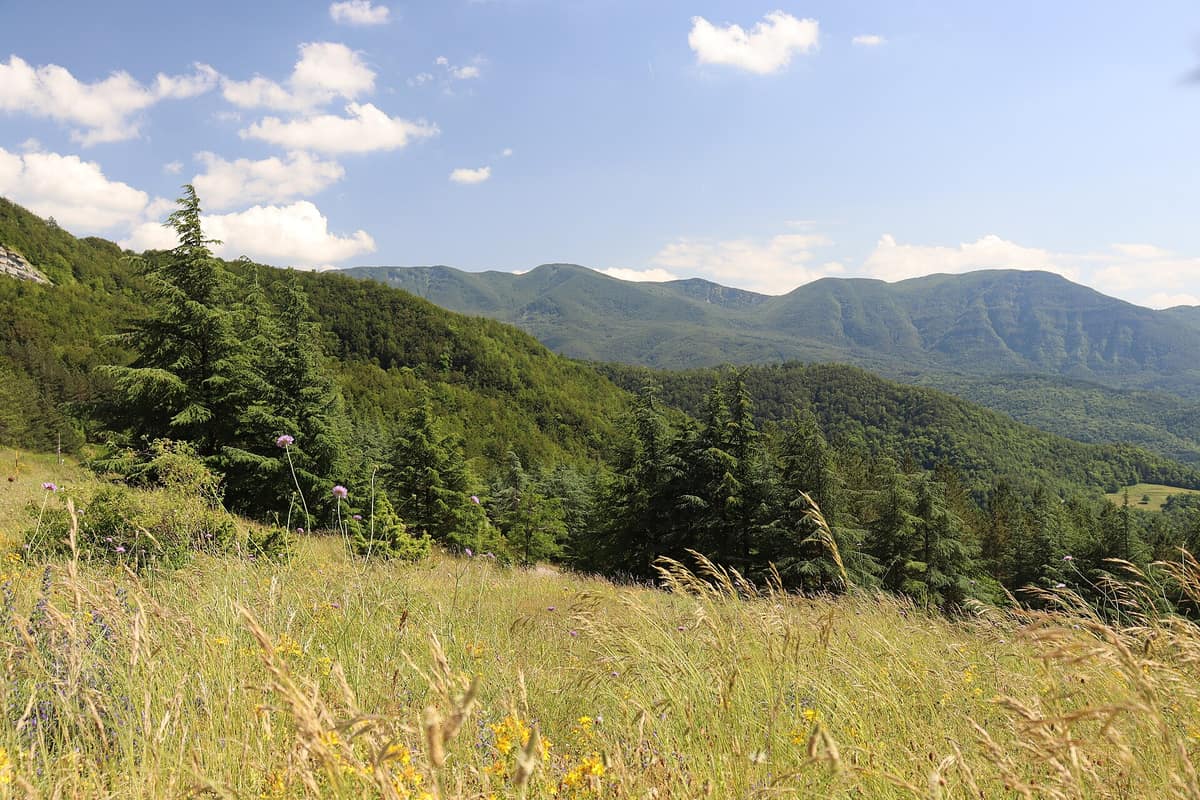
Foreste Casentinesi, Monte Falterona and Campigna National Park
Parco Nazionale delle Foreste Casentinesi, Monte Falterona e Campigna
Tuscany / Emilia-Romagna (Arezzo / Florence / Forlì-Cesena / Pratovecchio) · Italy
Photo: Vimy19 · CC BY-SA 4.0 · Wikimedia Commons
One of the oldest and best-preserved forest tracts in Europe, cradling the source of the Arno River on Monte Falterona.
In late September, as dusk falls over the forests of Ridracoli, a distant call echoes through the trees: the rutting roar of the red deer. It is one of the main reasons to visit the Foreste Casentinesi, Monte Falterona and Campigna National Park in autumn, when the green canopy turns shades of amber and russet. The park spans both slopes of the Tuscan-Romagnolo Apennines, between Emilia-Romagna and Tuscany, and 80 % of its territory is forest.
What makes it unique
Here you find beech trees over 500 years old and the first strict nature reserve protected by Italy.
The place
Nature
The landscape
The park straddles the ridge of the Apennines. Altitudes range from 400 to 1,658 metres: Monte Falco (1,658 m) and Monte Falterona (1,654 m), where the Arno rises, are the highest peaks. On the Romagna flank, the marly-arenaceous formation dominates, formed by deep marine sediments with thick sandstone strata from which all watercourses spring. There are no natural lakes, only the Ridracoli reservoir.
The geology reveals itself along a specific trail: the Acquacheta waterfall, tumbling more than 70 metres, famously cited by Dante in the Divine Comedy. It cascades over a rocky ledge of alternating sandstone and marl, starting at the Piana dei Romiti, the bed of an ancient lake formed when a landslide dammed the Fosso Acquacheta. It is one of around eighty geomorphological landmarks catalogued by the park.
Wildlife and seasons
Beech takes over from 900 or 1,000 metres upward, occasionally accompanied by silver fir favored by human management. The flora is exceptionally rich: 1,357 plant species, including 44 orchids, and 845 fungi, some new to science, discovered in Sasso Fratino. In that reserve the forest is left to its natural evolution, providing habitat for saproxylic invertebrates, fungi, and decomposers found nowhere else.
The grey wolf has its largest northern Apennine population here, about fifty individuals across nine possible packs. There are around 2,000 red deer in the park, almost 400 of them breeding stags. Among birds, 139 species have been recorded, 77 of which breed here. The black woodpecker, unique in the northern Apennines, has been recorded since the year 2000; and among daytime raptors, seven breed with certainty, including the golden eagle. Amphibians and reptiles total 25 species, among them an Apennine endemic, the yellow-bellied toad.
Autumn is the highlight season: the vibrant canopy in late October and the deer rut in late September.
Species
With a page in the atlas
Being mentioned in a source doesn't guarantee sightings: check with the people who manage the area.
Memory and protection
History and conservation
The Etruscans already worshipped their gods at Lago degli Idoli, at the foot of Falterona. Centuries later, monks took care of the forest: Saint Romuald at Camaldoli from 1012 and Saint Francis at La Verna in 1213. The timber of Campigna supplied masts for ships from Pisa and Livorno.
The park protects seven state nature reserves, three strict and four biogenetic. Sasso Fratino is Italy's first strict nature reserve (1959), and since 7 July 2017 it and the park's ancient beech woods have been a UNESCO World Heritage Site. Passo dei Mandrioli also holds Italy's first wilderness area, the Fosso del Capanno, created in 1988.
Before you set off
Visiting
How to visit
To begin, try the Sentieri Natura: nine easy nature trails featuring observation points and panels on geomorphology, flora, fauna, and local history. The Acquacheta trail covers nine kilometres with a 250-metre elevation gain. For longer treks, the Sentiero delle Foreste Sacre traverses more than 90 km in seven stages, from Lago di Ponte di Tredozio to La Verna.
There are several ways to experience the wildlife. In Ridracoli, an evening walk of about two hours and five kilometres lets you listen to the deer rut and learn how herds are monitored. In Moggiona, a wolf discovery trail features a reconstructed den and a small woodland clearing observatory. The park offers educational wolf howling sessions, limited to 24 participants and led exclusively by licensed guides in November, December, and January. Volunteers participate in the annual deer census, with volunteer shifts scheduled throughout the year.
Visitor centres showcase the region: Premilcuore highlights wildlife and water with an interactive museum for younger visitors; Londa, by the artificial lake, focuses on landscape transformations; the Camaldoli Information Point includes an ornithological museum. The Valbonella botanical gardens, three kilometres from Corniolo, and the Carlo Siemoni Museum and Arboretum in Badia Prataglia offer deep insight into the local flora.
Before you go
Check trail conditions before setting out: the park publishes updates and recommends checking whether routes are passable. Mushroom picking is regulated and only permitted on certain days of the week.
Check access, rules and visiting conditions in the official information from the managing body before you set off.
Location
Where it is and how far it reaches
Boundary of Parco nazionale delle Foreste Casentinesi, Monte Falterona e Campigna · IUCN II · © EEA, CDDA (CC-BY) The coordinate is estimated; it isn't a verified access point.
Transparency
Sources
The research data with its sources, and the official links for this place, are in the Spanish version of this page. See the Spanish version
How it fits into the territory
Calculated from the Atlas boundaries. «Part of» is only stated with an official boundary; an estimated area only means that they overlap.
Within this area · 1
- Sasso Fratino Strict Nature Reserve
Emilia-Romagna / Tuscany (Forlì-Cesena / Bagno di Romagna)
Inside its official boundary
The first Strict Nature Reserve established in Italy (1959), an intact primary beech forest over 500 years old untouched by logging.
JFMAMJJASONDMay – November · Crowding none
Around it
There are no neighbours published in the atlas, but it shares black woodpecker and wolf with the Reserva de Muniellos, with Badínsky Prales, with Aspromonte and with Sila.
If you like this place, elsewhere in Europe
Distant places with uncommon wildlife and habitats in common. The most widespread species don't count. Sharing species doesn't imply a corridor or guaranteed presence.
- Badínsky Prales Primeval Forest
Banská Bystrica (Badín / Banská Bystrica)
In common: Silver fir · Black woodpecker · Fagus sylvatica — primary forest, old-growth forest
Virgin fir and beech forest over 400 years old protected since 1913, famous for receiving an official visit by Charles III of the United Kingdom for its ecological value.
JFMAMJJASONDMay – October · Crowding none
- Strâmbu-Băiuț Primeval Forest
Maramureș County
In common: Silver fir · Black woodpecker · Fagus sylvatica — primary forest
Continuous virgin beech forest of the Northern Carpathians designated as a UNESCO World Heritage site.
JFMAMJJASONDMay – October · Crowding very low
- Irati Forest
Pyrénées-Atlantiques (FR) / Chartered Community of Navarre (ES)
In common: Silver fir · Black woodpecker · Fagus sylvatica — old-growth forest, high mountain
Pyrenean beech and silver fir forests, mountain torrents, and communal summer pastures spanning the Navarrese and French valleys of Irati.
JFMAMJJASONDMay – October · Crowding moderate
- Aigüestortes and Lake Saint Maurici National Park
Catalonia (Lleida)
In common: Silver fir · Black woodpecker · Fagus sylvatica — old-growth forest, high mountain
The only National Park in Catalonia, a glacial circus wonderland harboring over 200 tarns (estanys) beneath the iconic twin summits of Els Encantats.
JFMAMJJASONDJune – October · Crowding moderate
Entry #533 of the original atlas.