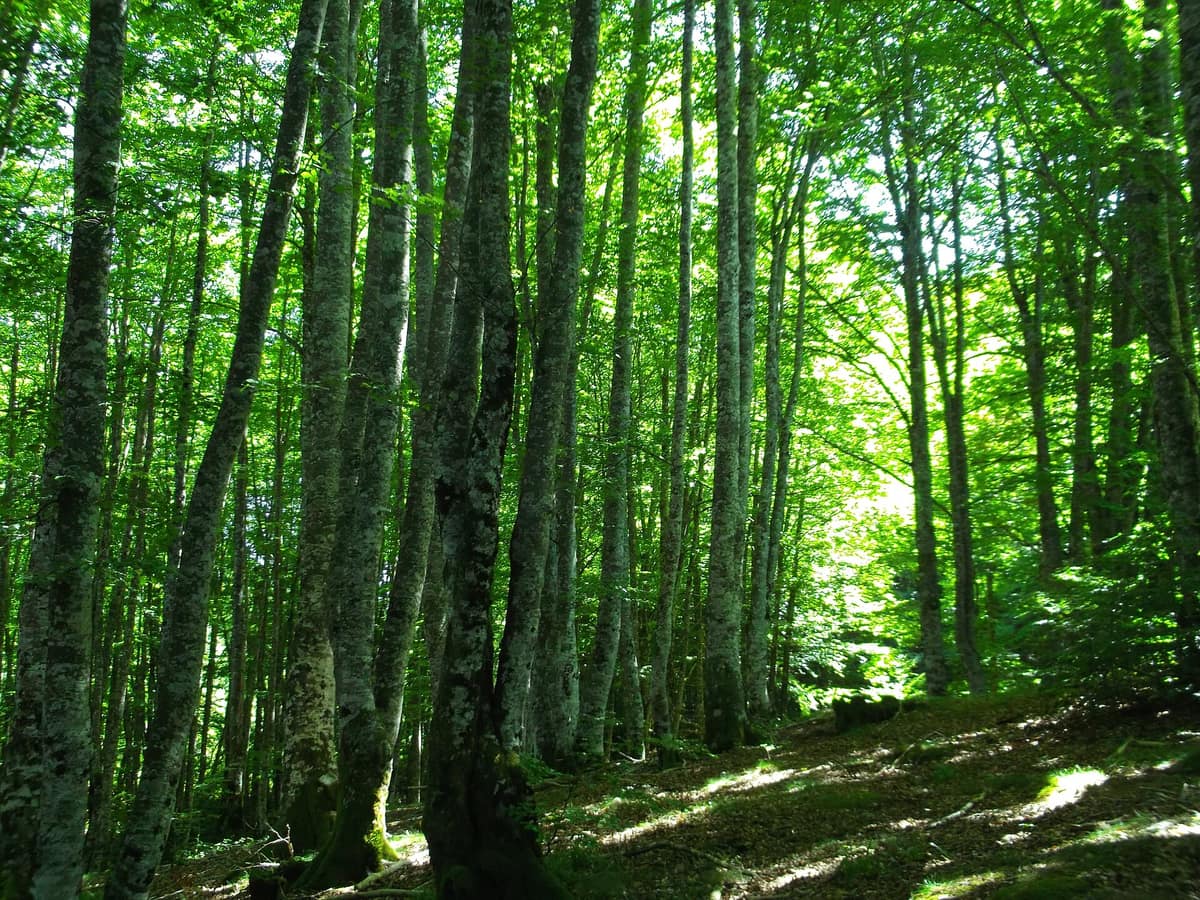
Irati Forest
Forêt d'Irati / Selva de Irati
Pyrénées-Atlantiques (FR) / Chartered Community of Navarre (ES) · France / Spain
Photo: Thaishs · CC BY-SA 4.0 · Wikimedia Commons
Pyrenean beech and silver fir forests, mountain torrents, and communal summer pastures spanning the Navarrese and French valleys of Irati.
Two nations, one undivided forest. The Selva de Irati straddles northern Navarre and the French valleys of Cize and Soule, knitted together by a vast blanket of European beech and silver fir rising and plunging across torrents, upland meadows, and limestone ridges. It is not a uniform plantation: natural woodland plots mingle with managed stands, strict nature reserves protect remnants of primeval old-growth, and surrounding valleys share communal pastures.
What makes it unique
A single woodland map unites natural beech-fir stands, the reserves of Lizardoia and Mendilatz, and communal pastures shared by historic treaties.
The place
Nature
The landscape
Begin with the canopy. European beech and silver fir co-dominate the slopes, but in shifting balances: mixed stands occupy lower ground, while fir assumes dominance on shady northern slopes and higher shoulders. Where moisture hangs thickest, birch, yew, and holly crowd the understorey. On warmer southern spurs downy oak forms stands, though diminished compared with historic extents.
To experience this from within, the Zabaleta trail climbs through beech and fir along the southern flank of Monte La Cuestión (Monte Zabaleta). The Spanish term "selva" captures this complexity: naturally regenerated stands coexist with sustainably managed communal woodlots. At Lizardoia, untouched primeval stands of fir and beech are preserved.
Beneath this unbroken canopy of foliage, the geology changes markedly. Marine limestone dominates the northern sector; Mendilatz features sharp karst fissures; toward Berrendi appear marls and calcareous clays, while Abodi reveals flysch formations. Arbanta exhibits schists and quartzites, with the Sierra de Abodi walling off the southern perimeter. Climate varies in parallel: oceanic Atlantic air delivers milder temperatures and heavier rainfall to the western valleys than to the east.
Wildlife and seasons
Irati is a forest best appreciated through its specialized micro-habitats. The critically endangered white-backed woodpecker finds a vital refuge here alongside the black woodpecker. Pure mountain streams harbour the secretive, endangered Pyrenean desman. These waters also support the Pyrenean frog, an endemic amphibian of the central and western Pyrenees reaching its westernmost global boundary here, alongside the Pyrenean brook salamander and fire salamander.
Mammals include roe deer, European badger, wild boar, edible dormouse, pine marten, Eurasian otter, and Miller's water shrew.
Autumn brings the reverberating rut of red deer. Avian calendars transcend the canopy: the high Pyrenean cols of Organbidexka, Ibañeta, and Lindux channel millions of migrating birds each autumn, with bramblings wintering across the Roncesvalles-Irati woods. The ornithological visitor centre at Chalets d’Iraty in Soule provides migration updates and identification exhibits.
Species
With a page in the atlas
Being mentioned in a source doesn't guarantee sightings: check with the people who manage the area.
Memory and protection
History and conservation
This ancient forest bears centuries of traditional human stewardship. The intensive era of logging occurred in the eighteenth century, supplying royal shipyards with naval timber as recounted on Errekaidorra's interpretive panels. Earlier occupation is attested by the Azpegi megalithic necropolis, the Roman watchtower of Urkulu, and the Royal Arms Factory of Orbaizeta. Mythological folklore still echoes through the beech trunks, where Basque tales celebrate lamias, witches, and Basajaun, the lord of the woods.
Today timber extraction follows strict selective felling aligned with nature conservation. Mountain pastures remain communal, governed by annual pastoral treaties (facerías) renewed between Navarrese and French valley councils. Ecological challenges persist: the Irabia reservoir fragments the upper Irati river, while tourist vehicular traffic creates local erosion.
Before you set off
Visiting
How to visit
The most popular trailhead is Casas de Irati, accessed via the Salazar valley. Before reaching Ochagavía, take the NA-2012 for about 23 kilometres to reach the visitor centre: ranger station, parking, picnic grounds, and mountain bike rentals with a repair stand. The other Salazar gateway is Virgen de las Nieves.
Two classic loop trails depart from here: Errekaidorra, a 10.04-kilometre easy circuit, and the Zabaleta Forest trail, measuring 8.74 kilometres with moderate climbing. Errekaidorra interprets the industrial archaeology of timber rafting for naval masts, oars, and charcoal. For a gentler stroll, the Pikatua Loop covers 1.2 kilometres with 15 metres of elevation change, its initial 400 metres paved for wheelchairs in dry conditions. For a waterside circuit, the trail around Irabia reservoir spans 9.5 kilometres.
From the Aezkoa valley, the main western gateways are Orbaizeta—where the Arrazola post is staffed by rangers in peak season and weekends—and Ochagavía, whose nature interpretation centre provides multilingual assistance in Spanish, Basque, French, and English. In Aribe, a seasonal office operates in summer, with local inquiries handled year-round by the Aezkoa Valley Board.
Trails are organized into four management sectors: Aezkoa, Salazar, Soule, and Cize, each equipped with designated information points.
Before you go
In winter, check snow clearance on the road to Casas de Irati: access can be closed by drifts. Mushroom foraging in Aezkoa and Salazar requires a personal daily permit carried during picking. Keep dogs under control to avoid disturbing woodland wildlife. Consult local access regulations and seasonal parking fees before visiting.
Check access, rules and visiting conditions in the official information from the managing body before you set off.
Location
Where it is and how far it reaches
Boundary of Roncesvalles-Selva de Irati · © EEA, CDDA (CC-BY) The coordinate is estimated; it isn't a verified access point.
Transparency
Sources
The research data with its sources, and the official links for this place, are in the Spanish version of this page. See the Spanish version
Around it
Just 15 kilometres across the French border lies the Pyrenees National Park (France). Further afield, other primeval beech-fir forests in the atlas include the Strict Nature Reserve of Sasso Fratino and the Strâmbu-Băiuț Primeval Forest, sharing silver fir, beech, and black woodpecker with Irati; the Lom Virgin Forest - Strict Nature Reserve sharing mountain fir and beech; and the Călimani National Park - Volcanic Forest Massif, which shares beech and western capercaillie.
If you like this place, elsewhere in Europe
Distant places with uncommon wildlife and habitats in common. The most widespread species don't count. Sharing species doesn't imply a corridor or guaranteed presence.
- Aigüestortes and Lake Saint Maurici National Park
Catalonia (Lleida)
In common: Silver fir · Fagus sylvatica · Black woodpecker — old-growth forest, high mountain
The only National Park in Catalonia, a glacial circus wonderland harboring over 200 tarns (estanys) beneath the iconic twin summits of Els Encantats.
JFMAMJJASONDJune – October · Crowding moderate
- Foreste Casentinesi, Monte Falterona and Campigna National Park
Tuscany / Emilia-Romagna (Arezzo / Florence / Forlì-Cesena / Pratovecchio)
In common: Silver fir · Fagus sylvatica · Black woodpecker — old-growth forest, high mountain
One of the oldest and best-preserved forest tracts in Europe, cradling the source of the Arno River on Monte Falterona.
JFMAMJJASONDMay – November · Crowding low
- Boubín Primeval Forest
South Bohemia (Vimperk / Šumava)
In common: White-backed woodpecker · Silver fir · Black woodpecker — high mountain
A virgin forest reserve designated in 1858 to rescue its 400-year-old firs and beeches from commercial exploitation.
JFMAMJJASONDMay – October · Crowding low
- Fuentes del Narcea, Degaña and Ibias Natural Park and Muniellos Reserve
Asturias (Cangas del Narcea / Degaña / San Antolín de Ibias)
In common: Fagus sylvatica · Black woodpecker · Western capercaillie — old-growth forest, high mountain
The largest sessile oak (Quercus petraea) forest in Spain and one of the best preserved in Europe (Muniellos).
JFMAMJJASONDMay – November · Crowding very low
Entry #136 of the original atlas.