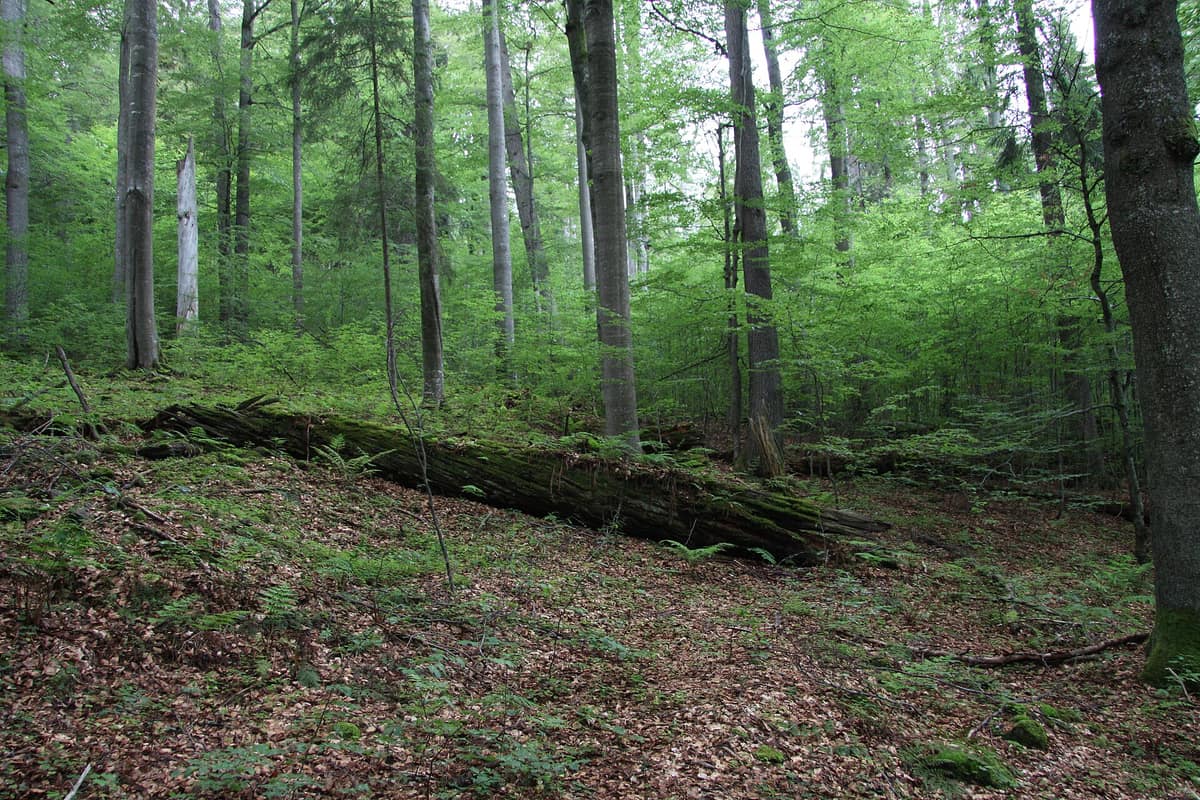
Boubín Primeval Forest
Boubínský Prales
South Bohemia (Vimperk / Šumava) · Czechia
Photo: Chmee2 · CC BY 3.0 · Wikimedia Commons
A virgin forest reserve designated in 1858 to rescue its 400-year-old firs and beeches from commercial exploitation.
Twelve thousand years ago, as the last ice sheets receded, this forest was already coming into being. Boubínský prales, the primeval forest of Mount Boubín, drapes the slopes of the 1,362 m peak in the Bohemian Forest, and was set aside as a nature reserve in 1858: the third oldest in the Czech lands. It shelters beeches, spruces, and silver firs reaching 400 years of age, a fenced core where no axe has struck a trunk in more than a century and a half, and a miniature artificial lake built for timber rafting.
What makes it unique
A woodland protected since 1858, whose untouched core is left entirely to sprout, fall, and renew on its own.
The place
Nature
The landscape
Boubín is multifaceted. It is a massif of gneiss, mica schist, and coarse-grained granite where bedrock rarely surfaces except on high ridges and the summit tor. Everywhere else is cloaked in dense woodland that changes with elevation: rich herb-layer beechwoods in the lower zone, acidic mountain beech-fir forests further up, and climax spruce woodland at the top. Within the fenced core of 46.67 ha, natural regeneration is vigorous, particularly in beech: up to 15,460 saplings per hectare compared with 250-300 mature canopy trees. The forest regenerates entirely without human aid.
The iconic giant of the wood was the King of Spruces, a monumental Norway spruce of 440 years, 57 m in height and 160 cm in trunk diameter, which crashed down in a snowstorm on 4 December 1970. Fallen trunks remain exactly where they fall, except where they present an immediate hazard to visitor trails.
Wildlife and seasons
What you encounter in Boubín depends on the vertical layer you examine. In the understorey grow protected wildflowers including Cicerbita alpina, herb Paris, and Lycopodium annotinum; recent surveys have refound rare orchids like Epipogium aphyllum and Corallorhiza trifida, alongside the grape-fern Botrychium multifidum, once presumed locally extinct. The reserve is extraordinarily rich in fungi, with Pseudorhizina sphaerospora known in the Czech Republic from only three localities. Across the summit ridges, 311 invertebrate species have been catalogued.
High in the canopy, wildlife is heard far more often than seen. Protected birds include the white-backed woodpecker, hazel grouse, and Ural owl; nesting nocturnal raptors include the boreal owl and Eurasian pygmy owl; while hole-nesting specialists feature the black woodpecker and three-toed woodpecker.
The mammalian history holds an ecological lesson. In the prolonged absence of apex predators, wild ungulates multiplied and heavily overbrowsed young saplings, hitting silver fir and sycamore hardest. During the 80s of the twentieth century the Eurasian lynx was reintroduced, successfully breeding throughout the region ever since.
Species
With a page in the atlas
Being mentioned in a source doesn't guarantee sightings: check with the people who manage the area.
Memory and protection
History and conservation
Forester Josef John, head of the Schwarzenberg forestry estate in Vimperk, was the driving visionary behind its protection. From 1847 onwards he surveyed the remaining pristine stands and marked out eight research plots. A severe gale in 1870 followed by salvage-logging fears over spruce bark beetle led to sweeping clearcuts, sparing only some 47 ha of intact old-growth core. That this wood survived was also a matter of circumstance: the glassworks at Kubova Huť required fuelwood, but timber was abundant closer to hand, leaving these rugged upper slopes unharvested. Two historic smugglers' trails carrying salt, gunpowder, livestock, and grain once crossed the ridge, and nearby between 1789 and 1822 the Schwarzenberg floating canal was engineered to raft timber towards Prague and Vienna. The small reservoir, dammed in 1836, served the same log-driving purpose.
The subsequent chapter is that of a wilderness loved almost to destruction. By 1958, over one hundred thousand annual visitors trod the trail to the lake and the King of Spruces. Consequently, the core zone was fenced off in 1963 and has been entirely closed to public entry since 1979. In 2007 Cyclone Kyrill, and a year later Storm Emma, inflicted heavy blowdown across the summit ridges.
Before you set off
Visiting
How to visit
Access is from Kubova Huť or Zátoň. Zátoň has a railway halt, Zátoň – Boubín, and green waymarks lead to the trailhead car park beneath Boubín and the Idina Pila visitor information point. From there a path reaches Boubín lake, starting point for an educational nature trail of nearly four kilometres with eight interpretive stops covering forest flora, veteran trees, birds, and animals across Šumava.
From Kubova Huť, blue waymarks climb past the Basum meadows to the summit of Mount Boubín, crowned by a wooden lookout tower: 21 m high with 109 steps, offering panoramic vistas across the eastern Bohemian Forest. Another blue trail leads to John’s Stone, honouring the forester who championed the reserve. The gravel trail leading up to the lake dam is accessible for wheelchairs and all-terrain pushchairs.
Before you go
On 14 April 2022 the circular educational trail encircling the core was closed due to the imminent hazard of falling snag trees following the 2019 bark beetle outbreak, and access along the Knížecí cesta road remains barred; the accessible path reaches only as far as the lake dam. The fenced core is strictly off-limits. The reserve draws some one hundred thousand visitors each year, so expect company along open summit stretches.
Check access, rules and visiting conditions in the official information from the managing body before you set off.
Location
Where it is and how far it reaches
Boundary of Boubínský prales · IUCN Ia · © EEA, CDDA (CC-BY) The coordinate is estimated; it isn't a verified access point.
Transparency
Sources
The research data with its sources, and the official links for this place, are in the Spanish version of this page. See the Spanish version
Around it
The Šumava National Park lies some 5 km away, and the Bavarian Forest National Park about 15 km: together they form the great cross-border mountain wilderness of the Bohemian Forest. The Jizera Mountains Beech Forest National Nature Reserve shares primeval mountain woodland and pygmy owls with Boubín, as does the Białowieża National Park - Strict Reserve.
What else to explore nearby
Approximate straight-line distance between the edges of each area. It doesn't indicate access, routes or driving times.
- Šumava National Park
South Bohemian and Plzeň Regions
About 5 km away
The "Green Roof of Europe", an immense mountain massif of raised peat bogs, glacial tarns, and montane beechwoods.
JFMAMJJASONDMay – October · Crowding low
- Bavarian Forest National Park
Bavaria (Lower Bavaria / Grafenau)
About 15 km away
Germany's first National Park (1970), forming alongside Šumava the largest unbroken forest tract in Central Europe.
JFMAMJJASONDMay – October · Crowding low
If you like this place, elsewhere in Europe
Distant places with uncommon wildlife and habitats in common. The most widespread species don't count. Sharing species doesn't imply a corridor or guaranteed presence.
- Northern Velebit National Park
Lika-Senj (Croatia)
In common: Eurasian pygmy owlet · Three-toed woodpecker · White-backed woodpecker — high mountain
Karst relief, ancient beech forests and mountain pastures in Northern Velebit.
JFMAMJJASONDMay – November · Crowding low
- Rodna Mountains National Park
Bistrița-Năsăud and Maramureș Counties (Pietrosu Rodnei)
In common: Eurasian pygmy owlet · White-backed woodpecker · Ural owl — high mountain
The highest glacial mountains in the Eastern Carpathians hosting the Pietrosu Rodnei scientific reserve.
JFMAMJJASONDJune – October · Crowding low
Entry #144 of the original atlas.