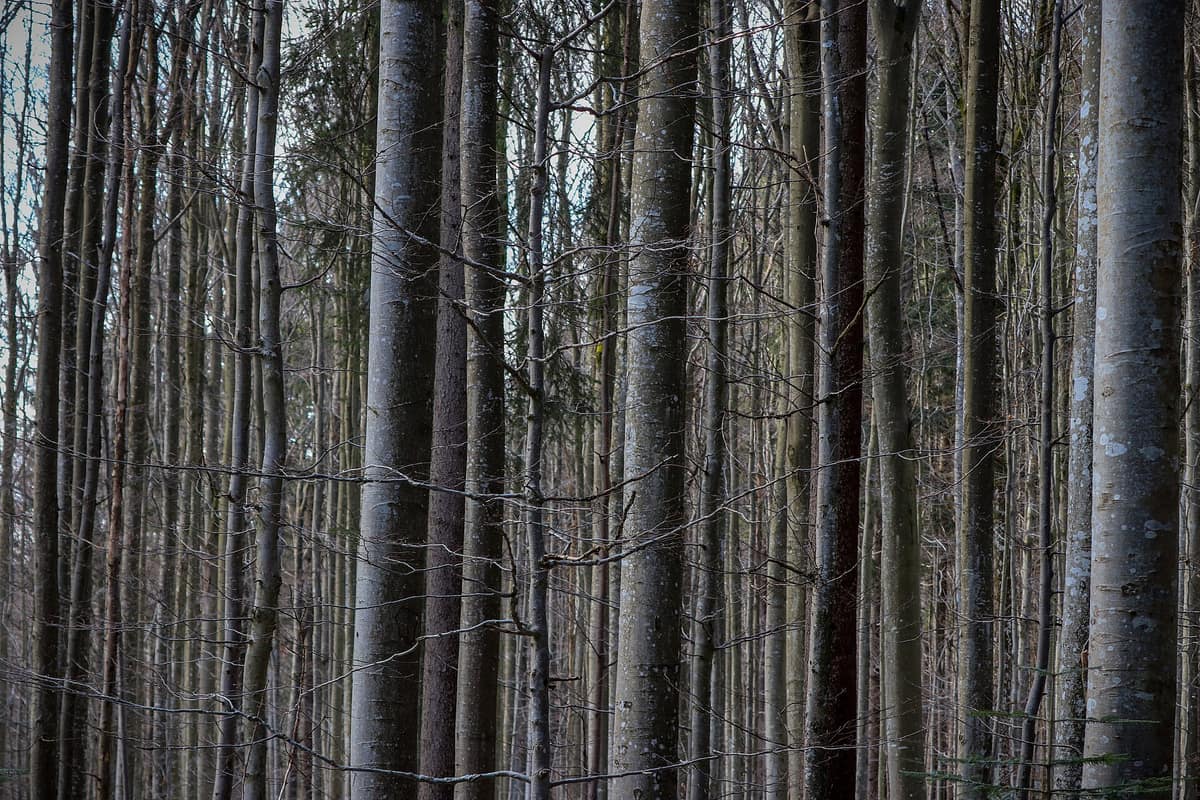
Bavarian Forest National Park
Nationalpark Bayerischer Wald
Bavaria (Lower Bavaria / Grafenau) · Germany
Photo: JakobRei · CC BY-SA 4.0 · Wikimedia Commons
Germany's first National Park (1970), forming alongside Šumava the largest unbroken forest tract in Central Europe.
On 1 August 1983 a violent storm felled roughly 70.000 m³ of timber, and Bavarian minister Hans Eisenmann made a decision that would transform the concept of forests in Germany: no salvage logging. Let a «primeval forest grow for our children and grandchildren», he declared. Bavarian Forest National Park, Germany’s very first national park inaugurated on 7 October 1970, stretches along the Czech border between Bayerisch Eisenstein and Mauth, guided ever since by a simple philosophy: let nature be nature. Conjoined with neighbouring Šumava, it constitutes Central Europe’s largest contiguous protected forest wilderness.
What makes it unique
Yesterday's timber plantation is tomorrow's primeval wilderness.
The place
Nature
The landscape
The bedrock consists of paragneiss and granite, and during the Ice Ages the crests were smothered in ice. Today forest blankets 98 % of the surface, punctuated by open raised bogs, the Filze, and high-altitude pastures, the Schachten. The most prominent peaks are Großer Rachel (1453 m), Lusen (1373 m), and Großer Falkenstein (1315 m), while the solitary natural glacial lake is Rachelsee.
Altitude separates three distinct forest zones. On mountain summits above 1200 m grows montane spruce taiga; across warmer slopes extends mixed mountain forest of spruce, fir, beech, and sycamore; and along damp frosty hollows where nocturnal cold air settles pools valley spruce. On the summits mean annual temperatures linger between two and five degrees, annual precipitation ranges from 830 to 2280 mm, and snow cover persists for seven to eight months.
What meets the eye is not what once stood here. Between 1910 and 1950, almost every surviving relic of montane primeval forest was logged. In the nineties, millions of spruces across Lusen succumbed to the spruce bark beetle, and since then the woodland has been regenerating entirely under its own momentum. Precious remnants such as Mittelsteighütte can be visited today.
Wildlife and seasons
Lynx, otter, capercaillie, and Ural owl have reclaimed their home here. The Eurasian lynx vanished in the nineteenth century due to ruthless persecution, alongside bear and wolf, returning thanks to a Czech reintroduction project in the 1980 decade. The wolf is once again an established resident, joined by European wildcat, Eurasian otter, and Eurasian beaver.
The quintessential bird of the Bavarian Forest is the western capercaillie, whose courtship displays occur in late winter. Its population rebounded thanks to strict conservation measures, above all the imperative to remain on waymarked paths. The Ural owl returned following a successful reintroduction initiative and now nests predominantly in decaying veteran trees. Other avian specialties include red-breasted flycatcher, ring ouzel, and three-toed woodpecker.
Then come the smaller creatures. Over 1.600 beetle species have been documented, including 16 primeval forest relict species such as Tragosoma depsarium, which held out in refugia like Mittelsteighütte or Rachelseewand and are expanding again. Deadwood provides nourishment and habitat for hundreds of insects, fungi, and birds, and windthrown trunks remain exactly where they fall.
Species
With a page in the atlas
Being mentioned in a source doesn't guarantee sightings: check with the people who manage the area.
Memory and protection
History and conservation
In the thirteenth century glassmakers settled in these valleys, and settlements like Riedlhütte, Neuschönau, and Weidhütte arose around forest glass foundries. Intensive commercial logging followed. The national park was enlarged on 1 August 1997 with the Falkenstein-Rachel sector and on 23 June 2022 with an area northeast of Finsterau, reaching roughly 24.945 ha. Strict natural zones, entirely free from human intervention, encompass 75,37 % of the park area.
Before you set off
Visiting
How to visit
Begin at one of the two visitor centres. The Lusen centre near Neuschönau features the Hans-Eisenmann-Haus, large open-air animal, plant, and geological enclosures, and a tree-top walk. The Falkenstein centre near Ludwigsthal houses the Haus zur Wildnis, an animal enclosure, and a Stone Age cave. In the spacious enclosures of Neuschönau and Ludwigsthal you can observe past and present forest denizens. Additional information points operate in Bayerisch Eisenstein, Zwiesel, Frauenau, Spiegelau, Mauth, and Freyung, and the park organises guided ranger walks throughout the year.
The trail network encompasses around 350 km of marked footpaths: circular trails are signified by an animal silhouette on a yellow background, while linear routes carry a plant icon on a white background. Long-distance routes Goldsteig and E6 cross the park. Popular themed nature trails include the Seelensteig beneath the Rachel, the Windwurf-Erlebnispfad at Falkenstein, the Schachten und Filze loop near Frauenau, and the primeval grove Hans-Watzlik-Hain. A classic viewpoint crowns the Rachel chapel overlooking Rachelsee. In certain sections, such as Mittelsteighütte, you encounter old-growth relics, while boardwalks traverse fragile mires and riparian woodlands. More than 200 km of cycling routes and some 80 km of cross-country ski trails are maintained. In winter a network of groomed winter walking tracks is kept clear in lower elevations, and snowshoeing is widespread.
Before you go
In sensitive habitats, particularly mountain crests and peat mires, you must stick strictly to designated trails to shield endangered species from disturbance. Cycling is restricted to marked tracks, vehicles must use official car parks, and smoking, open campfires, and free-running dogs are prohibited. Dead standing trees and branches can shed without warning, and visitors must leave the woods during high winds; trail use is strictly at your own risk. The park welcomes around 1,3 million visitors annually.
Check access, rules and visiting conditions in the official information from the managing body before you set off.
Location
Where it is and how far it reaches
Boundary of Bayerischer Wald · IUCN II · © EEA, CDDA (CC-BY) The coordinate is estimated; it isn't a verified access point.
Transparency
Sources
The research data with its sources, and the official links for this place, are in the Spanish version of this page. See the Spanish version
Around it
The Šumava National Park is just 1 km away, extending the exact same continuous forest massif across the Czech border. Roughly 15 km away lies the Boubín Primeval Forest, a famed old-growth forest reserve.
What else to explore nearby
Approximate straight-line distance between the edges of each area. It doesn't indicate access, routes or driving times.
- Šumava National Park
South Bohemian and Plzeň Regions
About 1 km away
The "Green Roof of Europe", an immense mountain massif of raised peat bogs, glacial tarns, and montane beechwoods.
JFMAMJJASONDMay – October · Crowding low
- Boubín Primeval Forest
South Bohemia (Vimperk / Šumava)
About 15 km away
A virgin forest reserve designated in 1858 to rescue its 400-year-old firs and beeches from commercial exploitation.
JFMAMJJASONDMay – October · Crowding low
Entry #108 of the original atlas.