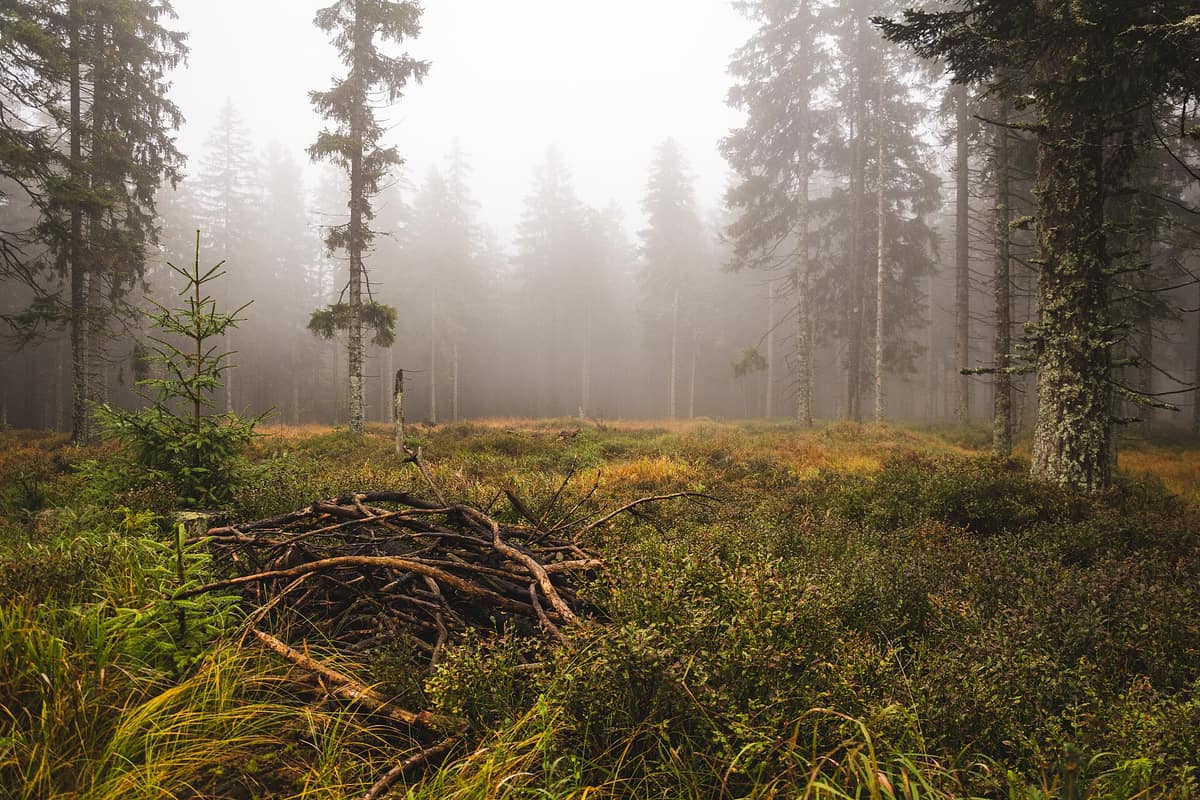
Šumava National Park
Národní park Šumava
South Bohemian and Plzeň Regions · Czechia
Photo: Martin Vorel · CC0 · Wikimedia Commons
The "Green Roof of Europe", an immense mountain massif of raised peat bogs, glacial tarns, and montane beechwoods.
Here the waters determine which ocean to seek. The European continental divide between the North Sea and the Black Sea threads directly through Šumava National Park, where the Vltava river is born. Spanning 685 km², it is the largest national park in Czechia and is celebrated as the Green Roof of Europe because it forms one of the most extensive continuous forest tracts in Central Europe. You traverse it amid spruce taiga, boardwalked raised peat bogs, glacial tarns, and an ancient stillness with a historical reason: for decades it was a deserted Iron Curtain border zone.
What makes it unique
An immense wilderness left to natural processes, harbouring raised bogs and glacial lakes at its core and the sole viable capercaillie population in Czechia.
The place
Nature
The landscape
The Bohemian Forest represents Central Europe’s largest forested massif, though it differs from ancient woodlands: secondary Norway spruce plantations predominate today, which suffer from gale blowdowns and bark beetle outbreaks under harsh climatic extremes. Nestled among them remain wild plateaus with raised bogs, glacial cirque tarns, and primeval forest remnants like Boubín.
The bedrock comprises granite, gneiss, and mica-schist, outcropping along ridges. The park ranges from 600 m in the Otava valley to 1378 m atop Plechý, the highest mountain on the Czech side of Šumava. Precipitation is heavy: Březník ranks among the rainiest locations in Czechia, recording 1552 mm of mean annual rainfall. This moisture sustains the vast mire systems. The Vltava rises as Černý potok on the slope of Černá hora, transforming into the Warm Vltava near Borová Lada.
Three glacial tarns—Plešné, Prášilské, and Laka—lie within the park. The largest bog lake in Šumava is situated in Chalupská slať near Borová Lada.
Wildlife and seasons
The raised bogs support specialized flora: sundews feeding on insects, peat mosses, and cottongrasses. Four regional endemics occur, including Aconitum plicatum and Phyteuma nigrum.
Among birds, the undisputed king is the western capercaillie: its Šumava stronghold represents the only viable population in Czechia and remains acutely sensitive to human disturbance. It shares the forest with black grouse, hazel grouse, three-toed woodpecker, corn crake, Ural owl, Eurasian pygmy owlet, boreal owl, black stork, and white-tailed eagle. Up to three eagle species can be observed across the park and its buffer.
Mammalian history has come full circle. The last native brown bear in Šumava was shot in 1856. Conversely, the Eurasian lynx was successfully reintroduced during the 80s of the twentieth century and represents the park’s most iconic predator today. The Eurasian beaver recolonised permanently around 2007, and Šumava’s pristine waterways form one of Czechia’s premier bastions for the Eurasian otter.
Species
With a page in the atlas
Being mentioned in a source doesn't guarantee sightings: check with the people who manage the area.
Memory and protection
History and conservation
The current forest is inextricably linked to twentieth-century history. Following the Second World War, almost all German-speaking inhabitants were expelled and the borderlands became an uninhabited militarised exclusion zone. Centuries earlier, abundant timber and quartz sand had fostered celebrated forest glassworks at Hůrka, Prášily, and Filipova Huť, while gold deposits around Kašperské Hory were mined from Celtic antiquity through the nineteenth and twentieth centuries. A silver fir aged 559 years, the second oldest tree in the park, grew beside Lake Plešné.
In 1963 a large Protected Landscape Area was declared in the Bohemian Forest, in 1990 the region achieved UNESCO Biosphere Reserve status, and on 20 March 1991 the most pristine core was proclaimed a national park. The peatlands were designated as a Ramsar site in 1990. Zone I, spanning 8.807 ha or 13 % of the park, is strictly dedicated to natural wilderness processes without human interference. Formerly ditched bogs were comprehensively re-wetted between 2018 and 2024 through the Life for MIRES programme.
Before you set off
Visiting
How to visit
In summer visitors converge around glacial lakes, the peat bogs of Modrava, Kvilda, and Borová Lada, the Vltava spring, Poledník, and Povydří; in winter, Modrava and Kvilda become premier cross-country skiing centres.
Three nature walks illustrate distinct ecosystems. Tříjezerní slať is a classic raised bog at 1066 m, some 2,5 km from Modrava; covering 19 ha, it is accessible via a wooden boardwalk. Chalupská slať lies 1 km from Borová Lada, reached from a car park via an asphalt track and boardwalk. Povydří is a famed riverside trail following the rushing Vydra river amid giant granite boulders and giant’s kettles. For a longer hike, the park suggests an 8,6 km circuit visiting glacial tarns Černé and Čertovo.
Poledník, rising to 1315 m, features an observation tower adapted from a Cold War radar station; opened in 1998, it provides sweeping vistas across central Šumava and the Bavarian Forest. At Kvilda, a wildlife trail passes large enclosures for red deer and lynx with elevated viewing hides, accompanied by interpretive panels explaining wild animal tracks, native flora, and forestry. To explore bedrock geology, the park maintains two exhibitions: an open-air display at Rokyta and an indoor centre in Stožec.
Before you go
Within the first conservation zone, hiking is permitted solely along waymarked tourist trails; the sensitive mire reserves of Modravské slatě and Mrtvý luh are closed to the public.
Check access, rules and visiting conditions in the official information from the managing body before you set off.
Location
Where it is and how far it reaches
Boundary of Šumava · IUCN II · © EEA, CDDA (CC-BY) The coordinate is estimated; it isn't a verified access point.
Transparency
Sources
The research data with its sources, and the official links for this place, are in the Spanish version of this page. See the Spanish version
Around it
Immediately bordering the park, just 1 km away, lies the Bavarian Forest National Park, preserving the contiguous transboundary forest tract in Germany. Roughly 5 km away rises the Boubín Primeval Forest, the celebrated old-growth forest reserve. Further afield, Soomaa National Park and Žemaitija National Park share mature woodlands and peat bogs with Šumava, with Soomaa sharing moose, beaver, and lynx, and Žemaitija sharing moose, beaver, and wolf.
What else to explore nearby
Approximate straight-line distance between the edges of each area. It doesn't indicate access, routes or driving times.
- Bavarian Forest National Park
Bavaria (Lower Bavaria / Grafenau)
About 1 km away
Germany's first National Park (1970), forming alongside Šumava the largest unbroken forest tract in Central Europe.
JFMAMJJASONDMay – October · Crowding low
- Boubín Primeval Forest
South Bohemia (Vimperk / Šumava)
About 5 km away
A virgin forest reserve designated in 1858 to rescue its 400-year-old firs and beeches from commercial exploitation.
JFMAMJJASONDMay – October · Crowding low
If you like this place, elsewhere in Europe
Distant places with uncommon wildlife and habitats in common. The most widespread species don't count. Sharing species doesn't imply a corridor or guaranteed presence.
- Retezat National Park
Hunedoara County (Hațeg)
In common: Pinguicula vulgaris · Western capercaillie · European wildcat — old-growth forest, high mountain
The realm of the granitic and glacial Retezat, with over 80 crystal tarns and the Gemenele scientific reserve.
JFMAMJJASONDJune – October · Crowding low
- Romincka Forest Landscape Park
Warmian-Masurian Voivodeship (Gołdap)
In common: Drosera anglica · Moose · Eurasian lynx — old-growth forest
The 'Polish Taiga', a boreal spruce forest across steep moraine ridges famed for the Stańczyki viaducts.
JFMAMJJASONDMay – October · Crowding very low
Entry #109 of the original atlas.