Romincka Forest Landscape Park
Park Krajobrazowy Puszczy Rominckiej
Warmian-Masurian Voivodeship (Gołdap) · Poland
Photo: Wulfstan · CC BY-SA 3.0 · Wikimedia Commons
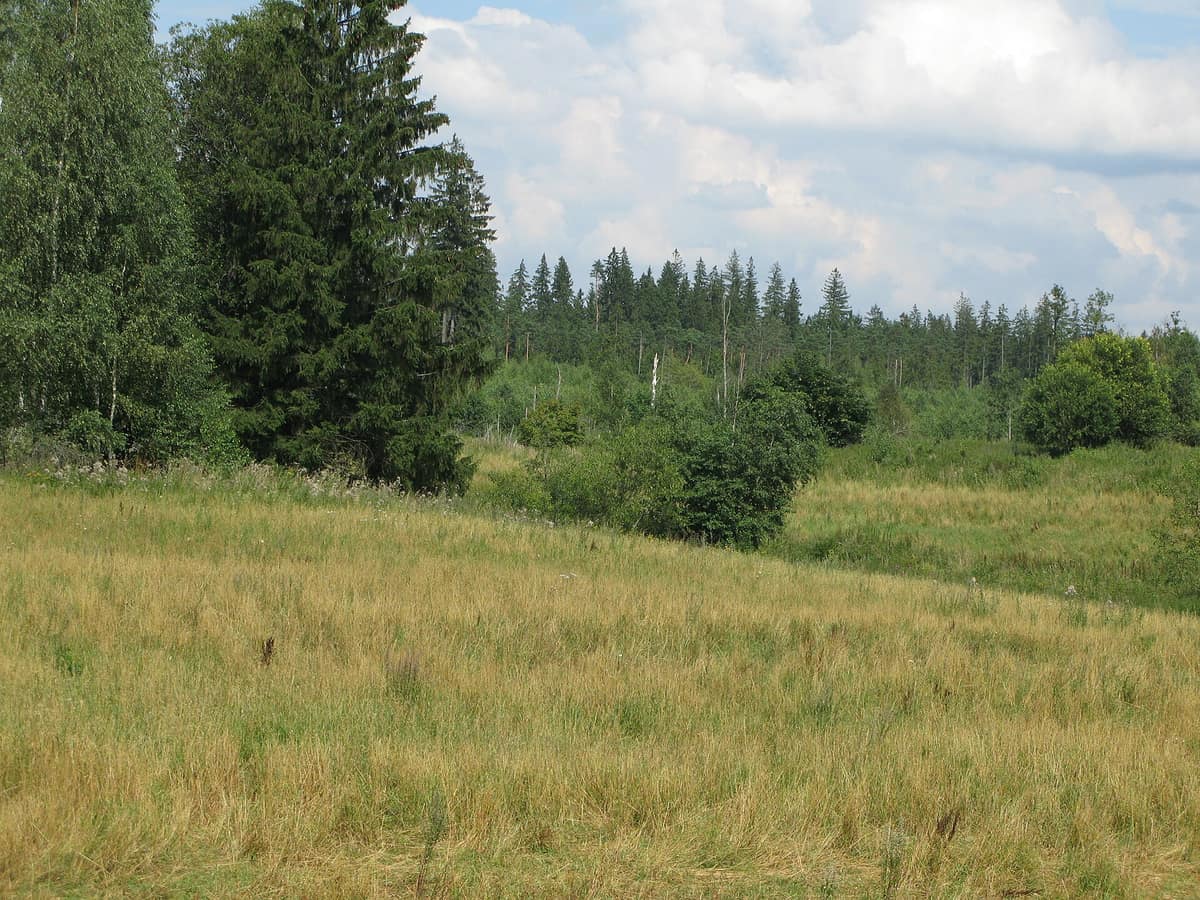
The 'Polish Taiga', a boreal spruce forest across steep moraine ridges famed for the Stańczyki viaducts.
In the far north-eastern corner of Poland, where the northern perimeter of the park coincides with the Russian border, the forest takes on a distinctive character: dark, humid, carpeted in deep moss, and reminiscent in places of true boreal taiga. This is the Park Krajobrazowy Puszczy Rominckiej, established on 14 January 1998 and spanning 146.20 km², of which 80 % is dense woodland.
It is a landscape defined by dramatic relief and water. Moraine hills, kettle lakes, and a river slicing through the forest in a steep ravine make it one of the most distinctly northern environments anywhere in the Polish lowlands.
What makes it unique
It is the closest equivalent to true taiga found in Poland, spanned by colossal twin railway viaducts resembling Roman aqueducts.
The place
Nature
The landscape
Everything was sculpted by glacial ice. The relief was shaped by the Pomeranian phase of the last Baltic glaciation and displays great variety: morainic ridges, almost entirely forested, reaching up to 280 m, with elevation drops exceeding 140 m. Between them lie hollows and meltwater channels now occupied by peat bogs, lakes, and winding streams. Kettle lakes occupy glacial depressions that never filled in after stranded blocks of dead ice melted away.
The most dramatic feature is the valley of the Błędzianka, a gorge-like ravine with steep slopes scarred by erosion gullies and inclines of up to 60°. The Błędzianka flows along the bed of a deep glacial trench, fed by tributaries including the Bludzia and the Żytkiejmska Struga.
The signature tree of this forest is the Norway spruce, typical of boreal taiga. Waterlogged valleys shelter alder and ash woods harbouring protected ostrich fern (Matteuccia struthiopteris), while peat bogs host botanical rarities: Scheuchzeria palustris, Rhynchospora alba, Empetrum nigrum, Goodyera repens, and cloudberry (Rubus chamaemorus). Meandering brooks and numerous pools created by beaver dams complete the mosaic.
Wildlife and seasons
The park's mammal population includes European beaver, elk, red deer, roe deer, wild boar, wolf, Eurasian lynx, and Eurasian otter; the state forestry administration considers the forest a vital refuge for wolf, lynx, otter, and beaver. Avian highlights include grey-headed woodpecker, white-backed woodpecker, lesser spotted eagle, European honey buzzard, osprey, common crane, black stork, and black kite.
The Bludzia and Żytkiejmska Struga rivers support water crowfoot (Batrachium), an aquatic plant rare in north-eastern Poland, alongside protected fish species such as European bitterling (różanka), bullhead (głowacz białopłetwy), spined loach (koza), and stone loach (śliz). Peat bogs also harbour dwarf birch, cloudberry, long-leaved sundew, and marsh violet.
May to October is the finest season to visit. Spring and summer bring the frog and toad chorus along the Rechot educational trail, a wooden boardwalk stretching for about two hundred metres alongside Lake Ostrówek explaining amphibian ecology.
Species
With a page in the atlas
Being mentioned in a source doesn't guarantee sightings: check with the people who manage the area.
Memory and protection
History and conservation
From the fifteenth century onward, the forest belonged to the Teutonic Knights and later to the dukes and kings of Prussia, serving as a royal hunting ground that preserved its core wilderness. From Kaiser Wilhelm II's hunts survive several memorial stones, eight of them within the Polish portion of the Puszcza. At Stańczyki, the two towering concrete viaducts stand some 36 m high and constitute a major regional landmark. At Golubie, an abandoned village between Stańczyki and Pobłędzie, a 4 km historical and nature trail illustrates how wilderness has reclaimed former homesteads.
Current legal protection relies on six nature reserves, notably Dziki Kąt, conserving a primeval boreal spruce-pine forest, and Czerwona Struga, safeguarding ostrich ferns in an alder carr; in the peripheral buffer zone, Uroczysko Kramnik protects glacial relict flora including cloudberry. The Natura 2000 Puszcza Romincka special area of conservation encompasses 14,754.34 hectares.
Before you set off
Visiting
How to visit
The Gołdap forest inspectorate maintains eight nature and educational paths plus one historical route. For a first impression, shorter circuits are ideal: Czworolist, the oldest, forms a 1.4 km loop starting and ending at Jurkiszki, with parking beside the track; Niezapominajka, starting from Żytkiejmy, measures some 700 m with 14 interpretive boards; Na tropie covers 2.3 km, highlighting tracks left by wild boar, beaver, and deer.
A 1.8 km trail near Galwiecie uses panels to describe birdlife across different habitats and is well suited to walking or cycling. Between Żytkiejmy and Bludzie runs a 9 km nature trail recommended for cycling. For longer hikes: a 10 km circular trail departs from the car park below the Stańczyki bridges; another 15 km route connects Dubeninki to the bridges along rural and forest paths, occasionally sandy, passing an observation tower. The Szlak Wilhelma provides a shorter four-kilometre loop and a longer thirteen-kilometre route along forest tracks.
Adjacent to the Gołdap forest district office, an educational classroom features an exhibition dedicated to the forest ecosystem.
Before you go
The landscape park operates under an active protection plan, implementing targeted conservation measures without closing the land to public recreation. Wear footwear suitable for sandy forest tracks, and consult the managing authority's website before setting out.
Check access, rules and visiting conditions in the official information from the managing body before you set off.
Location
Where it is and how far it reaches
Boundary of Park Krajobrazowy Puszczy Rominckiej · IUCN V · © EEA, CDDA (CC-BY) The coordinate is estimated; it isn't a verified access point.
Transparency
Sources
The research data with its sources, and the official links for this place, are in the Spanish version of this page. See the Spanish version
Around it
Eighteen kilometres away lies the Borecka Forest - Natura 2000 Area, the other great forest tract of the region, home to free-ranging European bison. Further away, Biebrza National Park and Soomaa National Park share with Romincka elk, Eurasian lynx, and wolves.
What else to explore nearby
Approximate straight-line distance between the edges of each area. It doesn't indicate access, routes or driving times.
- Borecka Forest - Natura 2000 Area
Warmian-Masurian Voivodeship (Kruklanki)
About 18 km away
Diverse Masurian old-growth woodland harbouring a significant reintroduced free-ranging European bison population.
JFMAMJJASONDMay – October · Crowding very low
If you like this place, elsewhere in Europe
Distant places with uncommon wildlife and habitats in common. The most widespread species don't count. Sharing species doesn't imply a corridor or guaranteed presence.
- Šumava National Park
South Bohemian and Plzeň Regions
In common: Drosera anglica · Moose · Eurasian lynx — old-growth forest
The "Green Roof of Europe", an immense mountain massif of raised peat bogs, glacial tarns, and montane beechwoods.
JFMAMJJASONDMay – October · Crowding low
- Sarek National Park - Europe's Last Great Wilderness
Swedish Lapland / Norrbotten (Jokkmokk / Kvikkjokk / Ritsem)
In common: Empetrum nigrum · Moose · Eurasian lynx
Peaks, glaciers, and the Ráhpavuobme valley in Sarek National Park, part of the Laponia World Heritage site.
JFMAMJJASONDJuly – September · Crowding very low
Entry #104 of the original atlas.