Sarek National Park - Europe's Last Great Wilderness
Sarek National Park
Swedish Lapland / Norrbotten (Jokkmokk / Kvikkjokk / Ritsem) · Sweden
Photo: Bjornvaktaren · CC BY-SA 4.0 · Wikimedia Commons
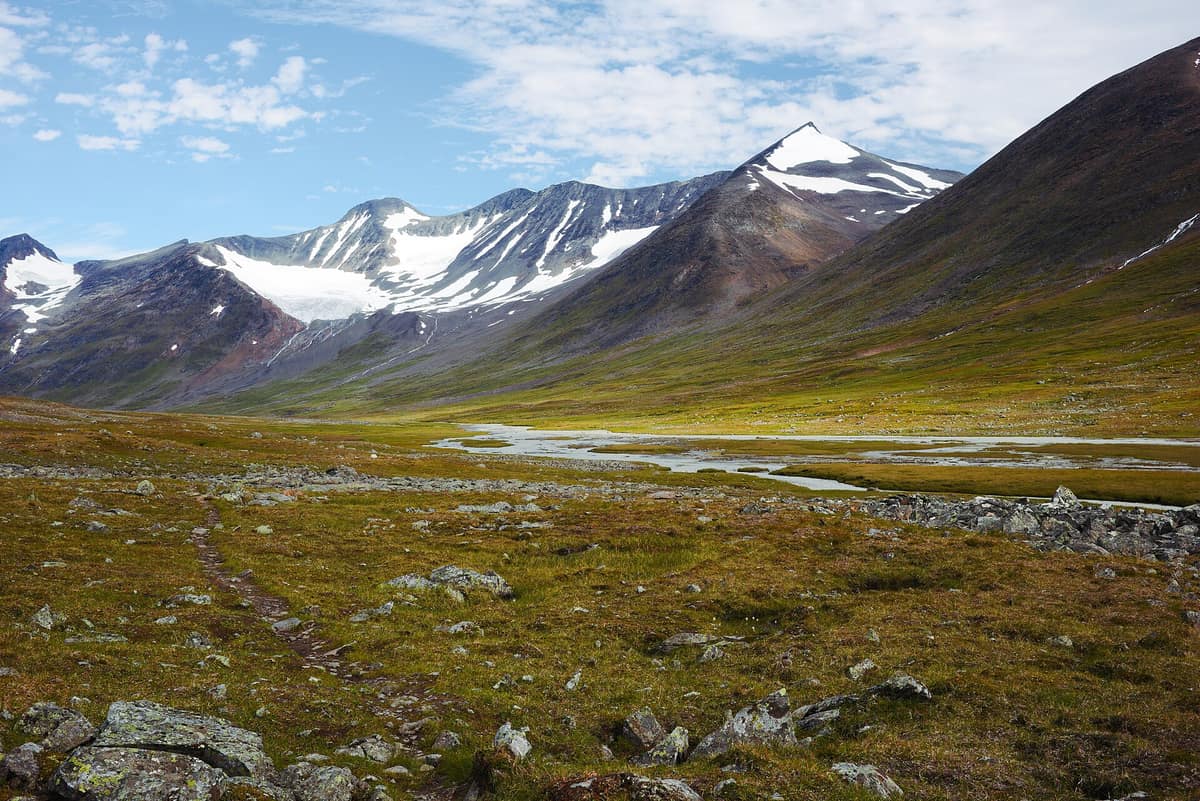
Peaks, glaciers, and the Ráhpavuobme valley in Sarek National Park, part of the Laponia World Heritage site.
There are no roads in Sarek, and that fact explains nearly everything. Anyone who wishes to enter must be able to hike or ski, carry everything they need, and manage with whatever nature presents. In exchange, you enter an alpine wilderness in its pristine state: six of Sweden's highest summits, nearly a hundred glaciers, torrential streams, coniferous forests, wetlands, and true alpine tundra. It has been a national park since 1909, situated in Swedish Lapland within Norrbotten County, and since 1996 it forms part of the Laponian World Heritage area.
What makes it unique
Nearly a hundred glaciers feed a single river, the Ráhpaädno, which sculpts the most famous delta in the northern mountains.
The place
Nature
The landscape
Everything you see has been sculpted by glacial ice. The valleys of Sarek carry gentle U-shaped profiles carved out by massive ice sheets during past glaciations, while the summits left standing remain jagged and formidable thanks largely to amphibolite bedrock. In several places, magmatic dykes that forced their way through metasediments crop out with their chilled margins still distinct.
Meltwater descends from the glaciers into the Ráhpaädno, the lifeblood of the national park, where the river creates the inland delta of Ráhpavuobme, or Rapadalen. Here the sinuous mountain world shifts character entirely: valleys fill with ancient birchwoods, braided deltas, and alpine heaths, while scots pine with scattered norway spruce dominate the lower slopes. In summer, the lush meadows of Ráhpavuobme are likened by park rangers to a subarctic jungle: northern monkshood, melancholy thistle, and wood cranesbill flourish alongside globeflowers and alpine sow-thistle. The understorey is carpeted with Vaccinium myrtillus and Empetrum nigrum. Higher up, clinging to glacier edges and perennial snowbeds, blooms the glacier buttercup.
The mountain peaks produce their own microclimate: up there, temperatures frequently dip below freezing even during midsummer.
Wildlife and seasons
The Rapadalen delta shelters some of the largest moose in Sweden, while the surrounding birchwoods and the lakes of Rittak and Laitaure host the Eurasian lynx. The wolverine commands the alpine tundra, descending to coniferous woodlands in deep winter. The red fox is gradually pushing into higher elevations, where it competes directly with the Arctic fox.
Semi-domesticated reindeer define the brief summer. When warmth returns, herds seek high snowfields and glacier flanks to escape biting insects. If you encounter reindeer, sit down quietly until they move on or walk a wide circuit around grazing groups to avoid distressing them.
The bluethroat fills the mountain birchwoods with song in summer, while in early spring flocks of snow buntings return to forage along the edges of melting snowpatches.
The year splits into two distinct visiting windows: July to September for self-supported trekking, and March to April for ski expeditions.
Species
With a page in the atlas
Being mentioned in a source doesn't guarantee sightings: check with the people who manage the area.
Memory and protection
History and conservation
The Sámi have lived here and followed the seasonal migrations of reindeer herds since time immemorial. At Skierffe and Nammásj, sacred offering sites mark places where human life and ancestral spiritual realms met.
Across Laponia, major conservation decisions require consensus among Sámi communities and state authorities. The Natura management guidelines for Sarek ensure that natural processes and ecological succession continue to unfold entirely unhindered.
Before you set off
Visiting
How to visit
The southern gateway is Kvikkjokk, or Huhttán, reached by public bus from Jokkmokk. From Ritsem in the north, you take a boat across Lake Áhkkájávrre and then hike between half a day and a full day to reach the park boundary.
The Kungsleden trail passes through Aktse. From there you can scramble up the iconic cliff of Skierffe or continue into the roadless interior. Another classic ascent leads up Bårddetjåhkkå: along the approach stands the historic Hamberg Observatory, completed in 1911, while the summit looks out across every peak of the Bårddemassivet and the Bårddejiegŋa glacier, the largest in Sarek. At Álggavárre, a historic chapel and remnants of seventeenth-century silver mining endure.
To understand this vast landscape before setting out, the Naturum Laponia visitor centre sits on the Viedásnjárgga peninsula at Stora Sjöfallet. Its exhibits explain the alpine massifs, old-growth forests, and peatlands, tracing the seasonal cycles and illuminating the deep cultural primacy of reindeer for the Sámi people. It provides guided walks, binocular loans, and barrier-free single-storey architecture.
Before you go
There are no marked trails, footbridges, or wilderness cabins within Sarek: it is an expedition realm exclusively for fully self-sufficient backcountry travellers on foot or skis. A few torrents feature seasonal summer bridges: the crossing at Skárjá is removed each autumn by helicopter and reassembled after high spring meltwater, typically in late June. Operating drones anywhere across the Laponia World Heritage site requires advance permission from the Norrbotten County Administrative Board.
Check access, rules and visiting conditions in the official information from the managing body before you set off.
Location
Where it is and how far it reaches
Boundary of Sarek · IUCN II · © EEA, CDDA (CC-BY) The coordinate is estimated; it isn't a verified access point.
Transparency
Sources
The research data with its sources, and the official links for this place, are in the Spanish version of this page. See the Spanish version
Around it
Sarek directly borders two national parks in the atlas: Padjelanta National Park, at 1 km, and Stora Sjöfallet National Park / Stuor Muorkke, at 2 km. Further away it shares wolverine and moose with Urho Kekkonen National Park, Abisko National Park, and Femundsmarka National Park; sharing Arctic fox and alpine tundra habitats with Abisko as well. Pallas-Yllästunturi National Park converges on high-mountain terrain, Vaccinium myrtillus, Arctic fox, and brown bear.
What else to explore nearby
Approximate straight-line distance between the edges of each area. It doesn't indicate access, routes or driving times.
- Padjelanta National Park
Swedish Lapland / Norrbotten (Jokkmokk / Kvikkjokk)
About 1 km away
Sweden's largest national park (198.000 ha), featuring vast alpine lakes Vastenjaure and Virihaure and ancestral Sami grazing lands.
JFMAMJJASONDJuly – September · Crowding very low
If you like this place, elsewhere in Europe
Distant places with uncommon wildlife and habitats in common. The most widespread species don't count. Sharing species doesn't imply a corridor or guaranteed presence.
- Urho Kekkonen National Park
Finnish Lapland (Saariselkä / Inari / Sodankylä)
In common: Xestia borealis · Wolverine · Moose — high mountain
Finland’s second largest national park (2.550 km²), rounded arctic tundra fell-tops (tunturi), and wild trekking under the shadow of Sokosti (718 m).
JFMAMJJASONDJune – April · Crowding low
- Vindelfjällen Nature Reserve
Västerbotten (Ammarnäs / Tärnaby)
In common: Arctic fox · Wolverine · Moose — high mountain, river corridor
One of the largest nature reserves in Europe: high-alpine massifs, birch valleys, and the free-flowing Vindel River running wild to the Baltic.
JFMAMJJASONDMarch – April · June – September · Crowding very low
- Romincka Forest Landscape Park
Warmian-Masurian Voivodeship (Gołdap)
In common: Empetrum nigrum · Moose · Eurasian lynx
The 'Polish Taiga', a boreal spruce forest across steep moraine ridges famed for the Stańczyki viaducts.
JFMAMJJASONDMay – October · Crowding very low
- Abisko National Park
Swedish Lapland / Norrbotten (Kiruna / Abisko)
In common: Arctic fox · Wolverine · Moose — high mountain, gorge and canyon
The grand canyon of the Abiskojåkka emptying into Lake Torneträsk and the iconic mountain pass of Lapporten (The Gate of Lapland).
JFMAMJJASONDJune – September · December – April · Crowding moderate
Entry #574 of the original atlas.