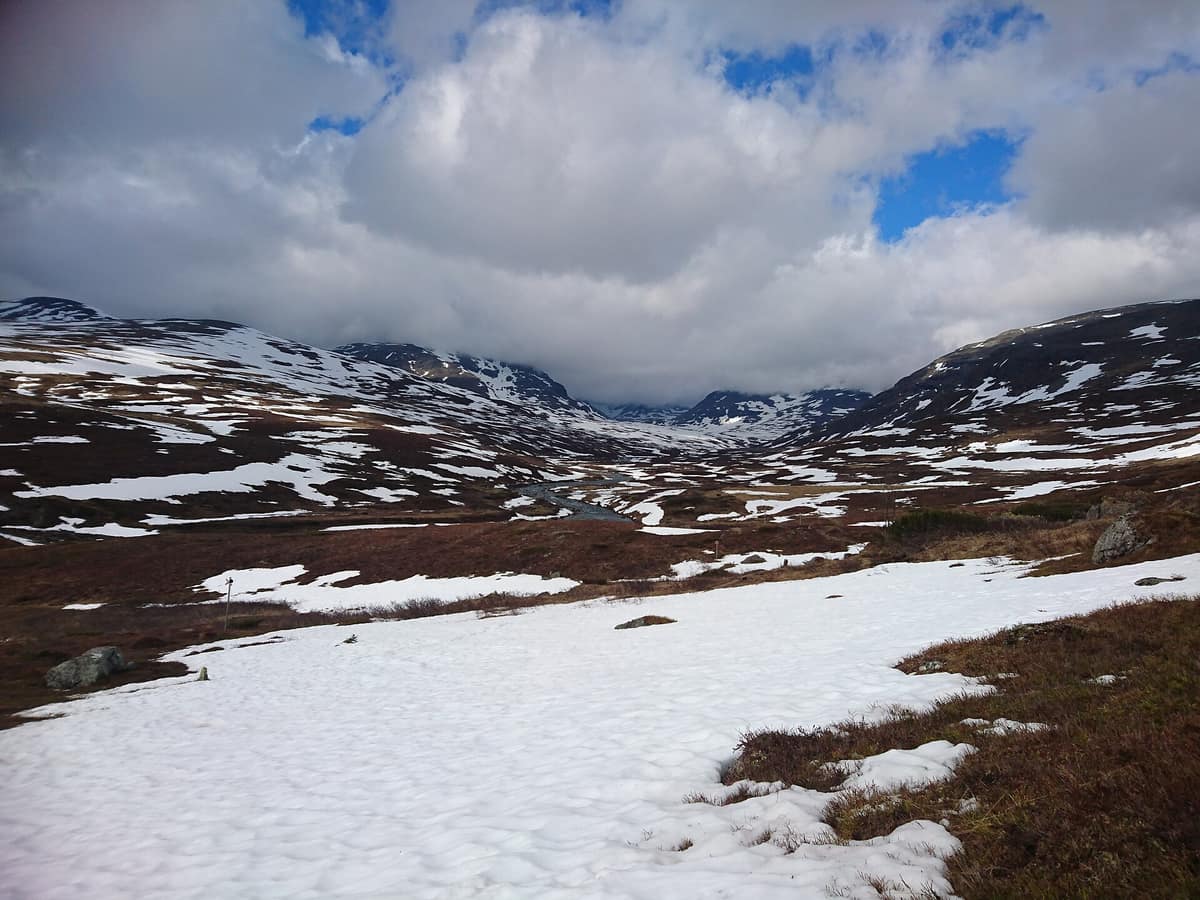
Vindelfjällen Nature Reserve
Vindelfjällens naturreservat
Västerbotten (Ammarnäs / Tärnaby) · Sweden
Photo: Emilia · CC BY-SA 4.0 · Wikimedia Commons
One of the largest nature reserves in Europe: high-alpine massifs, birch valleys, and the free-flowing Vindel River running wild to the Baltic.
In Vindelfjällen an entire country could find room. It is the largest nature reserve in Sweden and one of the most expansive protected wildernesses in Europe, holding glacier-crowned alpine peaks, montane birch woodlands that stretch to the horizon, vast peat mires, and primeval taiga forests that have never known the axe. Across the municipalities of Sorsele and Storuman in Swedish Lapland, the mountains open into the glacial valleys of the Ume River catchment, traversed by the undammed, free-flowing Vindel River, which runs without a single hydroelectric dam to the sea.
What makes it unique
An entire Scandinavian mountain chain operating as it always has: from glaciers to taiga, with an undammed wild river and the arctic fox as its emblem.
The place
Nature
The landscape
These are the Scandinavian Scandes, of Caledonian origin, formed by the continental collision of Laurentia and Baltica between 420 and 400 million years ago. Glaciers later smoothed and carved the topography into monumental U-shaped troughs, such as Syterskalet, which bisects Norra Storfjället—the high-alpine heart of the reserve. Its symmetrical parabolic profile is often compared to Lapporten. Flanking it rise Artfjället, Ammarfjället, and Björkfjället, cradling the river valleys of the Vindel and its tributaries.
Due to its sheer scale, climate varies markedly across the reserve. Ammarnäs sits in a rain shadow, receiving less than 600 mm of annual precipitation, whereas Hemavan west of Norra Storfjället records roughly 750 mm.
The spatial metrics reflect the astounding diversity: roughly 500 km² of primeval coniferous taiga, over 1600 km² of subalpine birch woodland (the largest protected birch forest in Sweden), nearly 1600 km² of alpine tundra heath, and nearly 300 km² of peat mire. Birch woods begin where conifers peter out, ascending to the tree line around 800 m. At Lake Tärnasjön, one of the two largest waterbodies, the southern third forms a labyrinthine archipelago of wooded islets and shallow channels.
Artfjället, rich in limestone, is celebrated for its botanical wealth: its name translates as "mountain of many species", harboring no fewer than 11 species of wild orchids. The rarest plant in Vindelfjällen, Gymnadenia runei, blooms with deep purple florets right at the tree line on barren schist slopes. Between Artfjället and Övre Ältsvattnet, genuine karst topography develops, featuring sinkholes, subterranean streams, and some of the largest cave passages in Sweden.
Wildlife and seasons
The emblematic symbol of the reserve is the arctic fox, critically endangered in Scandinavia. Its breeding success is tied intimately to small rodents: it litters almost exclusively during peak lemming years, which occur roughly once every four years.
The reindeer roaming these fells are domesticated: belonging to indigenous Sámi communities, they range in semi-liberty, with tallies exceeding 20.000 animals across the mountain plateau. In the broad forested valleys roams the moose, the wolverine maintains an established population, and brown bear, while historically abundant along the Vindel, persists in reduced numbers. The Tärnaån River was among the earliest sites in Sweden where the beaver was reintroduced in 1924, following its total extirpation in 1871.
For avifauna, wetlands offer prime habitats. The Marsivagge valley serves as a breeding ground for around 120 bird species. The adjoining fell heaths support European golden plover and Eurasian dotterel, while black-throated diver and osprey nest on pristine lakes. In the birch woods of Tjulträsk, breeding density reaches between 400 and 500 pairs per km², half of them willow warblers. Higher up, golden eagle, snowy owl, gyrfalcon, and peregrine falcon hunt over the windswept tundra.
Each season unfolds a different wilderness. Between mid-April and late June, female reindeer calve on Artfjället. Along the Kungsleden trail, deep snow lingers well into summer, with foot travel rarely practicable before Midsummer at the earliest.
Species
With a page in the atlas
Being mentioned in a source doesn't guarantee sightings: check with the people who manage the area.
Memory and protection
History and conservation
The earliest human hunters arrived roughly 9000 years ago as the continental ice receded, leaving pitfall systems along reindeer migration bottlenecks. Sámi traditions attribute stone foundations near these traps to the Stallo, legendary giants; archaeological research identifies them as the earliest known Sámi settlements. In the nineteenth century, seasonal traders known as norgefarare traversed the Vindel valley between Ammarnäs and Norway carrying loads close to 50 kg. The remote timber church Viktoriakyrkan was constructed in 1938 without road access, built entirely with local hand-hewn logs.
The Vindel River is one of Sweden's four designated "National Rivers", legally protected against dams and regulation; conservation battles in the mid-twentieth century prevented hydroelectric damming. The nature reserve was established in 1974 and significantly expanded on 25 January 1988 with the old-growth forests of Kirjesålandet, Matsorliden, and Giertsbäcksdalen. It is also designated within Natura 2000.
Before you set off
Visiting
How to visit
Because the reserve is colossal, approaches are numerous, but the standard gateways are Hemavan and Ammarnäs. Both villages feature a Naturum visitor centre: interpreting fauna, flora, geology, and cultural history, offering exhibits, guided excursions, and trail counsel. They open in spring and summer, so verify opening schedules beforehand. The Hemavan Naturum sits at the common trailhead of the Kungsleden, Drottningleden, and Lapplandsleden, adjoining the Mountain Botanical Garden, one of the highest in Sweden and among the most northerly in the world.
The most famous trek is the Kungsleden between Ammarnäs and Hemavan: served by five STF mountain huts staffed by wardens, offering provisions and saunas. The stage from Viterskalsstugan to Hemavan is straightforward. The Drottningleden spans nine kilometres between Laisaliden and Hemavan, offering panoramic views of Norwegian peaks and glaciers. The Vindelvaggileden traces the upper Vindelälven valley toward the Norwegian frontier, mainly through subalpine birch.
The remote forests of Matsorliden, Kirjesålandet, and Giertsbäcksdalen lack marked trails entirely, demanding true wilderness navigation experience.
Before you go
From mid-April to late June, reindeer calve on Artfjället; the management requests that hikers choose alternative areas during this sensitive period. The Marsivagge valley bird sanctuary is strictly closed to entry from 15 May to 1 August. Disturbing wildlife or reindeer herding and driving motorized vehicles off designated routes are strictly banned. In the later-added primeval forest zones, approaching within 100 metres of raptor eyries, dens, or burrows is prohibited. Check the operational status of trails, bridges, and huts before departure.
Check access, rules and visiting conditions in the official information from the managing body before you set off.
Location
Where it is and how far it reaches
Boundary of Vindelfjällen · © EEA, CDDA (CC-BY) The coordinate is estimated; it isn't a verified access point.
Transparency
Sources
The research data with its sources, and the official links for this place, are in the Spanish version of this page. See the Spanish version
Around it
Vindelfjällen has no adjacent entries in the atlas, but shares high-alpine habitats and arctic fauna with other northern reserves. It is linked to Pallas-Yllästunturi National Park by rock ptarmigan, golden plover, arctic fox, and mires; to Saltfjellet-Svartisen National Park by rock ptarmigan, wolverine, reindeer, and wild rivers; to Reinheimen National Park by golden plover, wolverine, and wild reindeer; and to Urho Kekkonen National Park by wolverine, reindeer, golden eagle, alpine fells, and peatlands.
If you like this place, elsewhere in Europe
Distant places with uncommon wildlife and habitats in common. The most widespread species don't count. Sharing species doesn't imply a corridor or guaranteed presence.
- Pallas-Yllästunturi National Park
Finnish Lapland (Enontekiö / Kittilä / Kolari / Muonio)
In common: Rubus chamaemorus · Charadrius morinellus · European golden plover — high mountain, wetland
Finland's most visited national park (1.020 km²), a chain of tundra fell hills (tunturi) hosting the cleanest air measuring station on Earth (Sammaltunturi).
JFMAMJJASONDJune – September · December – April · Crowding moderate
- Varanger Peninsula National Park
Finnmark (Vadsø / Vardø / Berlevåg / Båtsfjord)
In common: Lemmus lemmus · Snowy owl · Charadrius morinellus — wetland
Low-elevation Arctic tundra fronting the Barents Sea on Europe’s far northeastern edge, renowned for winter sea-duck roosts of Steller’s and king eiders.
JFMAMJJASONDMay – September · Crowding very low
- Cairngorms National Park
Scotland (Aviemore / Braemar / Speyside)
In common: Charadrius morinellus · Rock ptarmigan · Osprey — high mountain, river corridor, wetland, old-growth forest
Britain's largest national park: subarctic plateau, remnants of the ancient Caledonian pine forest, and capercaillie.
JFMAMJJASONDMay – September · Crowding low
- Sarek National Park - Europe's Last Great Wilderness
Swedish Lapland / Norrbotten (Jokkmokk / Kvikkjokk / Ritsem)
In common: Arctic fox · Wolverine · Moose — high mountain, river corridor
Peaks, glaciers, and the Ráhpavuobme valley in Sarek National Park, part of the Laponia World Heritage site.
JFMAMJJASONDJuly – September · Crowding very low
Entry #1045 of the original atlas.