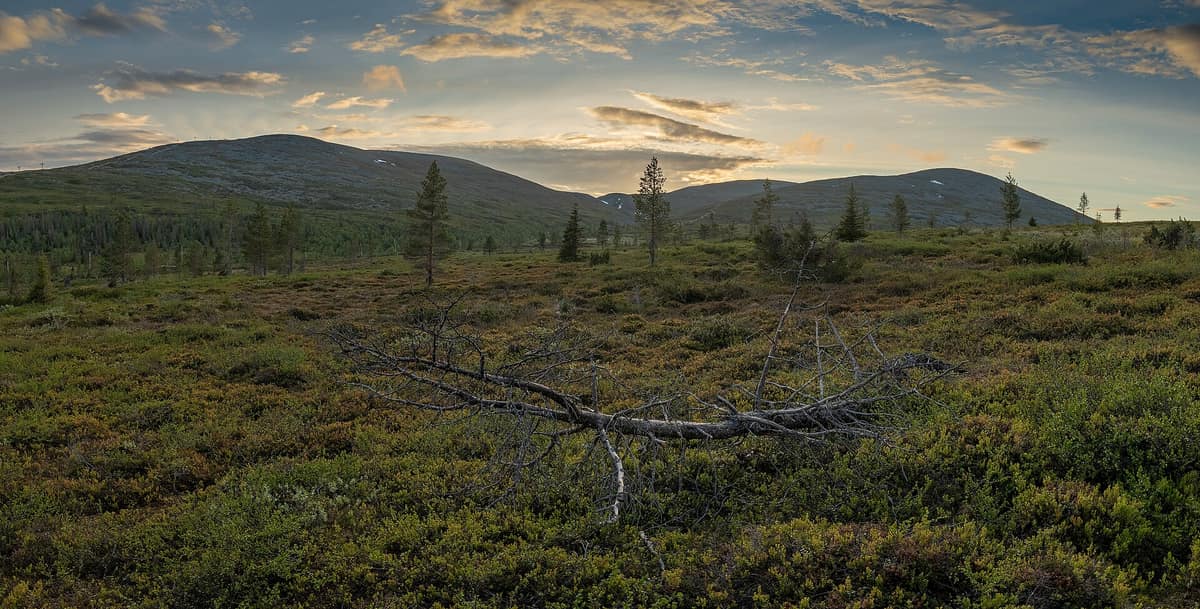
Pallas-Yllästunturi National Park
Finnish Lapland (Enontekiö / Kittilä / Kolari / Muonio) · Finland
Photo: Ximonic (Simo Räsänen) · CC BY-SA 3.0 · Wikimedia Commons
Finland's most visited national park (1.020 km²), a chain of tundra fell hills (tunturi) hosting the cleanest air measuring station on Earth (Sammaltunturi).
A chain of rounded, treeless fells stretches across western Lapland. These are no young alpine crags: they are the eroded remnants of an ancient folded mountain range worn down to its bedrock roots by deep time. This is Pallas-Yllästunturi, Finland's third-largest national park, spanning 1.020 km² across Enontekiö, Kittilä, Kolari, and Muonio.
What makes it unique
On a single trek you walk across the crests of an ancient eroded mountain range beneath air ranked among the purest on the planet.
The place
Nature
The landscape
The key word is kero, which in Finnish describes the rounded, treeless summit of a fell. The highest peak in the park is Taivaskero in the Pallastunturi fells at 809 meters; beside it rise Pyhäkero, Lumikero, Laukukero, and Palkaskero. Between them the landscape shifts abruptly: aapa mires, heath forests, pristine old-growth woods, open fell tops, and herb-rich gullies.
Scots pine, Norway spruce, and mountain birch dominate the timberline. Higher up, where trees cannot survive, dwarf birch, alpine bearberry, and crowberry take over. Lower down, in humid old-growth forests, wood cranesbill, dwarf cornel, and numerous rare mosses and fungi thrive. In the peatlands bloom Labrador tea and cotton grass, while lime-rich pockets shelter delicate wild orchids.
The air merits special distinction. At the Sammaltunturi atmospheric station, researchers record—according to the WHO—some of the cleanest air on the globe.
Wildlife and seasons
Northern and southern avifauna meet here. High-latitude birds include the rock ptarmigan, willow grouse, and Eurasian dotterel; spruce forests shelter the blackbird and wood warbler. In deep woodlands look for tits, Siberian jays, and pine grosbeaks; along mountain streams the white-throated dipper dives into rushing water even in the depths of winter. When voles are plentiful, owls and raptors surge. Fell birds can be observed from trails and rest stops in Fell Lapland, including the European golden plover, snow bunting, and long-tailed jaeger.
Large mammals include the caribou and moose. In summer reindeer linger on windy fells and open peatlands, frequently crossing hiking paths. The brown bear and Eurasian lynx maintain resident populations in the park; mountain hare, red fox, least weasel, Norwegian lemming, and red squirrel are also widespread.
The annual cycle is one of sharp contrasts. Winter brings polar night throughout December and January, temperatures plunging to minus 30 degrees, and blazing northern lights on clear nights; the snowpack peaks in March and April at over one meter deep. Summer arrives in mid-June, bathed in midnight sun through June and July. By mid-September the vibrant autumn ruska sets the hills aflame for two to three weeks, and the first permanent snows typically fall after mid-October. Meanwhile, you can forage for bilberries on fell slopes and cloudberries in sloping mires.
Species
With a page in the atlas
Being mentioned in a source doesn't guarantee sightings: check with the people who manage the area.
Memory and protection
History and conservation
The area has been inhabited since the Stone Age, primarily by the Sami, across a culturally fascinating borderland. Today the reindeer-herding cooperatives of Alakylä, Kyrö, Muonio, and Näkkälä use the park for grazing and reindeer breeding. Many local place-names are of Sami origin: kaltio, kero, lompolo, mella, vuoma, and vuontis are loanwords from that legacy.
The idea of establishing national parks emerged in 1910, with botanist Kaarlo Linkola playing a central role in advocating for the Pallastunturi fells. Pallas-Ounastunturi became one of Finland's first two national parks when founded in 1938. By the nineteen-thirties Pallas was already a celebrated tourist destination, and the trail from Pallas to Hetta was marked out in 1934. In 1952 Finland's Olympic flame was lit atop Taivaskero. In 2005 the park merged with the Ylläs-Aakenus reserve to create the current national park, doubling its previous expanse. It holds the European Charter for Sustainable Tourism awarded by the EUROPARC Federation.
Before you set off
Visiting
How to visit
The park features 340 km of marked summer hiking trails and over 500 km of cross-country ski tracks. The classic traverse is Hetta–Pallas, a 55 km trail that is Finland's oldest marked trekking route: it follows open fell plateaus, plunges into steep ravines, and summits several iconic peaks. Along the way stand wilderness and rental huts; the huts at Hannukuru lie 28 km from Hetta and 27 km from Pallas. It can also be undertaken on skis in winter, though it demands backcountry experience and meticulous planning.
For day trips, popular shorter options include Pyhäkero, Taivaskeron kierros, Pirunkurun ponnistus, Varkaankurun polku, Kesänkijärven kierros, and Tuomikurun kierros. In the Ylläs sector you can snowshoe up Kukastunturi or walk to the Tuomikuru lean-to shelter. In the Pallas sector, by contrast, there are no marked snowshoe routes, as prevailing winds hard-pack the snow across the exposed fell tops.
The park operates three visitor centers: Kellokas in Yllästunturi, Pallastunturi, and Fell Lapland in Hetta. Their exhibits, including Meän elämää and Vuovjjuš-Kulkijat, interpret regional ecology and heritage, the latter celebrating Sami culture and fell wilderness.
Before you go
Winter travel requires cold-weather gear, map, compass, and navigation skills: blizzards can obliterate tracks and reduce visibility to zero within minutes. Stick to marked trails in sensitive tundra zones to prevent trampling erosion. Campfires are permitted only at designated fire pits using provided firewood.
Check access, rules and visiting conditions in the official information from the managing body before you set off.
Location
Where it is and how far it reaches
Boundary of Pallas-Yllästunturin kansallispuisto · IUCN II · © EEA, CDDA (CC-BY) The coordinate is estimated; it isn't a verified access point.
Transparency
Sources
The research data with its sources, and the official links for this place, are in the Spanish version of this page. See the Spanish version
Around it
To the west and south, other northern sanctuaries preserve Arctic fellscapes. Vindelfjällen Nature Reserve and Sarek National Park protect vast contiguous expanses of Scandinavian tundra, sheltering reindeer, rock ptarmigan, and alpine wildlife.
If you like this place, elsewhere in Europe
Distant places with uncommon wildlife and habitats in common. The most widespread species don't count. Sharing species doesn't imply a corridor or guaranteed presence.
- Vindelfjällen Nature Reserve
Västerbotten (Ammarnäs / Tärnaby)
In common: Rubus chamaemorus · Charadrius morinellus · European golden plover — high mountain, wetland
One of the largest nature reserves in Europe: high-alpine massifs, birch valleys, and the free-flowing Vindel River running wild to the Baltic.
JFMAMJJASONDMarch – April · June – September · Crowding very low
- Varanger Peninsula National Park
Finnmark (Vadsø / Vardø / Berlevåg / Båtsfjord)
In common: Charadrius morinellus · European golden plover · Arctic fox — wetland
Low-elevation Arctic tundra fronting the Barents Sea on Europe’s far northeastern edge, renowned for winter sea-duck roosts of Steller’s and king eiders.
JFMAMJJASONDMay – September · Crowding very low
- Sarek National Park - Europe's Last Great Wilderness
Swedish Lapland / Norrbotten (Jokkmokk / Kvikkjokk / Ritsem)
In common: Vaccinium myrtillus · Arctic fox · Brown bear — high mountain
Peaks, glaciers, and the Ráhpavuobme valley in Sarek National Park, part of the Laponia World Heritage site.
JFMAMJJASONDJuly – September · Crowding very low
- Cairngorms National Park
Scotland (Aviemore / Braemar / Speyside)
In common: Charadrius morinellus · Rock ptarmigan — high mountain, primary forest, wetland
Britain's largest national park: subarctic plateau, remnants of the ancient Caledonian pine forest, and capercaillie.
JFMAMJJASONDMay – September · Crowding low
Entry #595 of the original atlas.