Abisko National Park
Swedish Lapland / Norrbotten (Kiruna / Abisko) · Sweden
Photo: Ulfnilss · CC BY-SA 4.0 · Wikimedia Commons
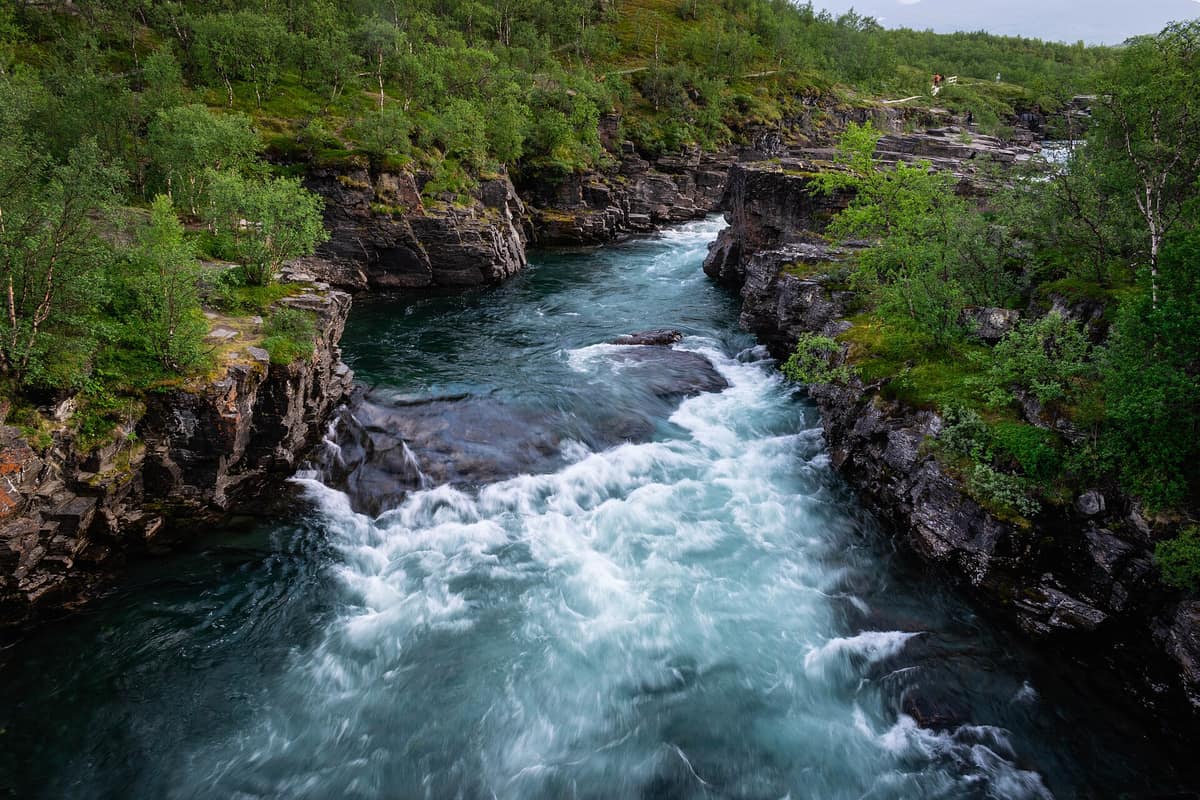
The grand canyon of the Abiskojåkka emptying into Lake Torneträsk and the iconic mountain pass of Lapporten (The Gate of Lapland).
In Abisko it hardly ever rains. It is the place with the lowest precipitation in all of Sweden, about 300 mm a year, and one of the sunniest, because the western peaks intercept Atlantic moisture, leaving little more than scraps for the valley. Beneath this bright sky lies a mountain birch valley flanked by soaring massifs, with Lake Torneträsk in the background and the Abiskojåkka rushing through a canyon between them.
It is one of Sweden's nine original national parks, the earliest established in Europe, created in 1909. It spans 7.700 hectares encompassing birch forest, open heathland, lush meadows, and bare alpine fell, serving as the official northern gateway to the Kungsleden.
What makes it unique
Here, in the mountain rain shadow, thrives Sweden’s only population of the protected mountain slipper orchid (lappfela).
The place
Nature
The landscape
To understand Abisko, look at the vertical walls of the Abiskojåkka canyon: like a slice of cake, they reveal the geological anatomy of the entire mountain. These rocks were uplifted from the ancient lapetus Ocean and thrust eastward as vast thrust sheets when the Caledonian range formed 400 million years ago. The resulting bedrock is exceptionally rich in lime, which explains the unique alpine flora: numerous rare species that grow nowhere else along the chain.
Subalpine birch woodland covers 3.900 of the 7.700 hectares, climbing to 650 metres on northern slopes and up to 800 on southern aspects; above lies the bare alpine tundra, covering 2.800 hectares. Amidst the birch stands where the Kårsajåkka joins the Abiskojåkka remains an ancient pine stand that should biologically not exist so high or so far north: a living relic of a warmer postglacial epoch when Scots pine was far more widespread.
The climate also chronicles recent change. Over recent decades Abisko has warmed noticeably: lowland permafrost is thawing and the birch tree line has advanced roughly 50 metres uphill. In the fifties, severe caterpillar outbreaks of the autumnal moth stripped birch foliage across vast areas, leaving stands sparse and littered with standing deadwood.
Wildlife and seasons
This is a botanist's dream. Along the rim of the canyon sprawl dwarf rhododendron heaths (lapsk alpros), while rocky ledges shelter polarblära, fjällarnika, and tufted saxifrage. Mount Njullá is celebrated as the "flower mountain" for its astonishing variety of blooms; midsummer, when alpine wildflowers and subarctic birds peak together, is the ideal time to ascend.
Birds animate the birch woods and windswept tundra. Among the birches, common redpolls, bramblings, and bluethroats mingle with dunnocks, willow warblers, and European robins; on the stony alpine fell you may spot snow buntings, rock ptarmigans, and Eurasian dotterels. The most common raptor is the merlin, with the golden eagle patrolling higher crags. Large carnivores are scarce: Arctic fox, wolverine, and Eurasian lynx roam through only occasionally, whereas moose are widespread and their tracks everywhere.
The year shows three distinct faces. Midsummer brings midnight sun for over eight weeks around the solstice, with swollen meltwater streams early in the season. Early autumn turns the birch forest into fiery gold with crisp air and no mosquitoes. Winter brings midday twilight for four weeks alongside optimal northern lights: lack of light pollution and frequent clear skies make Abisko a premier global aurora destination. By December, black ice on Torneträsk invites Nordic skaters, followed by winter snowshoeing and ski touring.
Species
With a page in the atlas
Being mentioned in a source doesn't guarantee sightings: check with the people who manage the area.
Memory and protection
History and conservation
The STF opened its first tourist station in Abisko in 1902 alongside the Iron Ore Railway line. The scientific research station was rebuilt at its present site in 1912 after a fire in 1910 and opened in 1913.
Before you set off
Visiting
How to visit
Most visitors arrive by rail. The station, named Abisko Turist, lies inside the park, about 800 metres from the naturum visitor centre and the STF mountain station. The park is situated roughly 100 kilometres west of Kiruna in northern Sweden.
The naturum features permanent exhibitions on local flora, fauna, geology, and cultural history. Staff provide information on nearby Vadvetjåkka and lead guided walks in summer. Around the naturum are nine discovery points.
For a first excursion, the Abiskojåkka canyon is a spectacular, easily accessible gorge right beside the naturum that served as a founding reason for the park. A trail along the shores of Torneträsk runs about 1,2 kilometres each way, where you can watch yellow wagtails and bluethroats. For longer journeys, the 440 km Kungsleden trails southward along the Scandinavian mountains, starting right by the tourist station. Accessible paths lead to canyon overlooks and park landmarks with rest areas.
Before you go
The Abiskojåkka river delta is closed to public access from 1 May to 31 July to protect ground-nesting birds. Pitching tents outside designated camping grounds, uprooting plants, disturbing the soil, and disrupting grazing reindeer or herding activities are strictly prohibited. Organized groups of more than 35 participants may require prior authorization from the County Administrative Board of Norrbotten.
Between early May and early June, and during October, tourist services pause and several facilities close to allow nature to rest. The E10 road and the railway line run through the park.
Check access, rules and visiting conditions in the official information from the managing body before you set off.
Location
Where it is and how far it reaches
Boundary of Abisko · IUCN II · © EEA, CDDA (CC-BY) The coordinate is estimated; it isn't a verified access point.
Transparency
Sources
The research data with its sources, and the official links for this place, are in the Spanish version of this page. See the Spanish version
Around it
Abisko shares species and habitats with distant arctic parks. Sarek gathers Arctic fox, wolverine, and moose amidst high peaks and canyons. Børgefjell shares Arctic fox and wolverine with high alpine wilderness, tarns, and old-growth taiga. The Vindelfjällen Nature Reserve also shelters Arctic fox and wolverine with alpine plateaus and mature forests, while Femundsmarka combines wolverine and moose with wilderness lakes and ancient pines.
If you like this place, elsewhere in Europe
Distant places with uncommon wildlife and habitats in common. The most widespread species don't count. Sharing species doesn't imply a corridor or guaranteed presence.
- Sarek National Park - Europe's Last Great Wilderness
Swedish Lapland / Norrbotten (Jokkmokk / Kvikkjokk / Ritsem)
In common: Arctic fox · Wolverine · Moose — high mountain, gorge and canyon
Peaks, glaciers, and the Ráhpavuobme valley in Sarek National Park, part of the Laponia World Heritage site.
JFMAMJJASONDJuly – September · Crowding very low
- Vindelfjällen Nature Reserve
Västerbotten (Ammarnäs / Tärnaby)
In common: Arctic fox · Wolverine · Moose — high mountain, old-growth forest
One of the largest nature reserves in Europe: high-alpine massifs, birch valleys, and the free-flowing Vindel River running wild to the Baltic.
JFMAMJJASONDMarch – April · June – September · Crowding very low
- Børgefjell National Park
Trøndelag / Nordland (Hattfjelldal / Røyrvik)
In common: Arctic fox · Wolverine — high mountain, lake, old-growth forest
One of Scandinavia's purest trail-less wilderness sanctuaries, a core breeding haven for the Arctic fox (Vulpes lagopus).
JFMAMJJASONDJuly – September · Crowding none
- Femundsmarka National Park
Trøndelag and Innlandet Counties (Border with Sweden)
In common: Wolverine · Moose — lake, old-growth forest
A vast Arctic-alpine wilderness of boulder fields, ancient Scots pine forest, and an intricate labyrinth of canoeing lakes.
JFMAMJJASONDFebruary – March · July – September · Crowding very low
Entry #589 of the original atlas.