Femundsmarka National Park
Femundsmarka nasjonalpark
Trøndelag and Innlandet Counties (Border with Sweden) · Norway
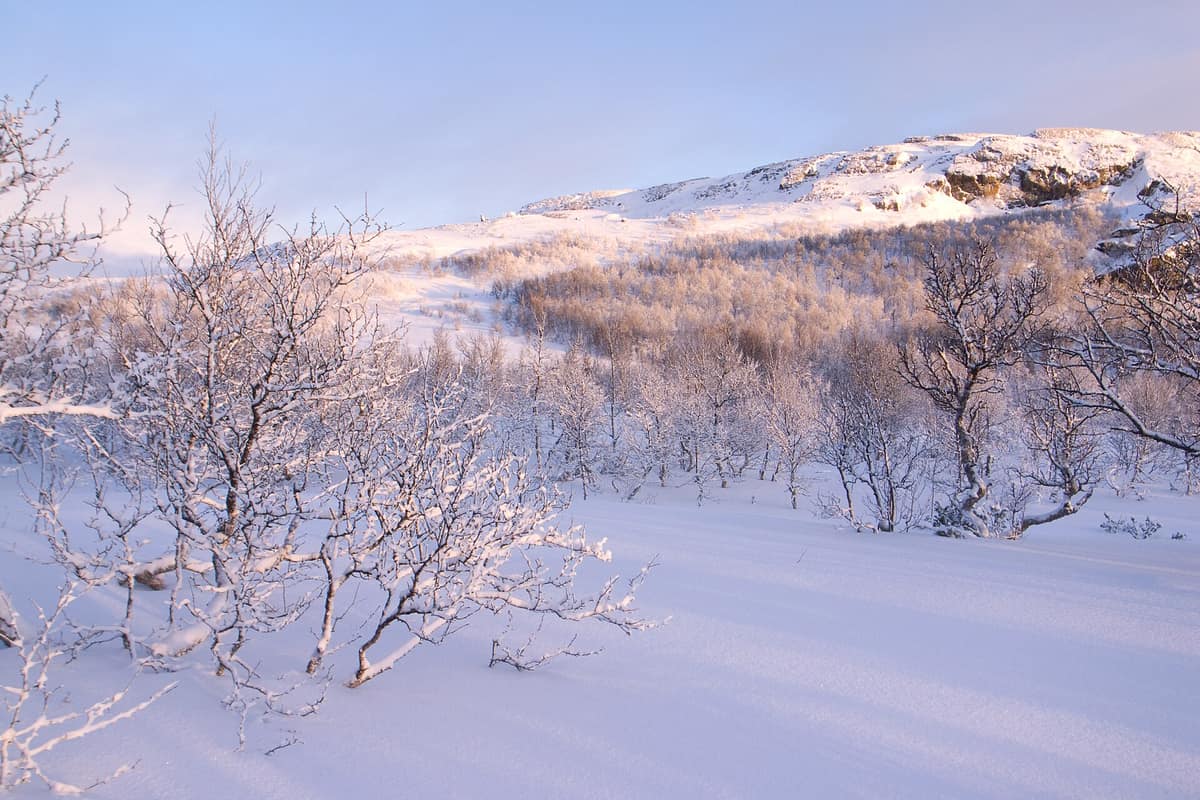
Photo: Aslak Raanes · CC BY 2.0 · Wikimedia Commons
A vast Arctic-alpine wilderness of boulder fields, ancient Scots pine forest, and an intricate labyrinth of canoeing lakes.
Ten thousand years after the glaciers retreated, Femundsmarka still appears newly sculpted by the ice. Boulders everywhere, a jumble of block fields, tarns tucked into every hollow, and ancient pines that died on their feet standing silvery like natural monoliths. It is a terrain of broad ridges and sweeping horizons between Lake Femunden and the Swedish frontier, in the municipalities of Røros and Engerdal, forming together with adjacent Swedish reserves one of the largest unbroken wilderness areas in southern Scandinavia.
What makes it unique
In Femundsmarka every tree is protected, including standing deadwood pines, ensuring that dead timber remains an integral pulse of life.
The place
Nature
The landscape
Glaciation shaped every feature. During the last glacial maximum the ice sheet reached between 2000 and 3000 m in thickness around Lake Femunden, making this one of the final areas to melt out. Ten thousand years ago it finally receded, leaving a primeval landscape draped in a chaotic sea of boulders that has remained virtually untouched ever since.
From the water, distinct features emerge. Narrow morainic ridges snake out across lakes to form capes, skerries, and islands: these are Rogen moraines, eponymous for this specific glacial landform. While Femundsmarka consists largely of gentle fell slopes and open lichen woodland, rocky peaks punctuate the skyline: Storviglen at 1561 m is the highest in the north, matched in the south by Stor-Svuku at 1421 m and Elgåhogna at 1460 m.
Among the block fields thrives resilient life: carpets of reindeer lichen, hardy mountain wildflowers, and dwarf shrubs. Wolf lichen (Letharia vulpina), brilliant sulfur-yellow, encrusts dead veteran pines; it is an endangered Red List lichen, and the park protects one of Norway's premier populations. It takes its name from its historical use: laden with toxic vulpic acid, it was once mixed with tallow and glass shards to poison wolves and foxes.
Wildlife and seasons
Standing dead pines support rich communities of wood-boring beetles, hole-nesting birds, and rare lichens. Along the watercourses Eurasian beavers fell birches and build lodges. In quiet forests elk browse the undergrowth while pine martens hunt voles. Eurasian otters leave telltale slides on snowy riverbanks. In the deep backcountry along the Swedish border, brown bear and wolverine roam, and in the northern fells a small relict herd of muskoxen persists, descendants of animals that wandered from Dovre in the seventies.
In spring the gyrfalcon patrols for willow ptarmigan, snow buntings migrate northward, and black-throated loons yodel across misty lakes. Eastern taiga species reach their western fringe here: bar-tailed godwit and Siberian tit are prized sightings. Late in winter, ospreys journey back from sub-Saharan wintering quarters to nest in flat-topped pines over fish-rich shallows.
Traditional Sámi reindeer herding operates across the entire park: year-round in the south and in winter throughout the north. The reindeer are especially sensitive to human disturbance from Midsummer through 15 July during calf-marking. Keep your distance.
Species
With a page in the atlas
Being mentioned in a source doesn't guarantee sightings: check with the people who manage the area.
Memory and protection
History and conservation
Femundsmarka is among Norway's earliest national parks, saved from catastrophic hydroelectric damming through protracted public campaigns. Designated in 1971 and expanded in 2003, it today spans 573 km².
Human history runs deep across the landscape. The Sámi have herded reindeer across these fells for centuries, leaving turf hut foundations, storage pits, and traditional corrals. South Sámi herding districts (sijte) remain active: Saanti sijte and Gåebrien sijte pasture herds in the north, while Svahken sijte grazes the south. Historic charcoal hearths and timber chutes dot the border country, reminders of charcoal burning for the copper smelters of Røros. At Sylen on the Swedish border, isolated roadless farms remain inhabited, surrounded by the park.
Before you set off
Visiting
How to visit
Femundsmarka is navigated on foot, by canoe, or aboard the lake boat. Two main gateways exist: Elgå to the south and Synnervika to the north. From both docks operates the historic wooden passenger vessel Fæmund II, delivering hikers to wilderness landings along Lake Femunden throughout the summer. Elgå hosts the Femundsmarka and Gutulia National Park Visitor Centre, featuring exhibitions on South Sámi reindeer herding, geology, and wildlife; outside, a nature trail leads down to the pier. The centre loans out lightweight twig-burning stoves free of charge to leave no trace.
For hiking, innumerable kilometres of marked trails span the fells, alongside wild game tracks. Three representative peaks reward climbers: Elgåhogna, a 5.2 km marked trail from Dalset with 700 m of elevation gain opening broad panoramas over Lake Femunden; Stor-Svuku, a 5.7 km steady ascent from Svukuriset mountain hut with views toward Rondane and Sweden; and Storviglen from Ljøsnåvollen, an adventurous 7 km ascent partly over unmarked terrain. For long-distance walkers, the historic Malmveien connects Røros to Femundsmarka in three stages of roughly 15 km per day.
By canoe or packraft, calm lakes connect via portages into an unbroken waterway leading into Sweden. The Langtjønna canoe route runs from Synnervika toward Nordvika over roughly eight kilometres; the wild Røa river offers quiet paddling between Lake Rogen and Lake Roasten before plunging over rapids toward Lake Femunden.
Before you go
From 15 April to 15 September open campfires are strictly prohibited, except where fire danger is demonstrably absent; burn only fallen dead twigs, as all trees, dead or alive, are legally protected. Dogs must be kept on leads from 1 April to 20 August. Check park alerts prior to departure for seasonal sensitive zones.
Check access, rules and visiting conditions in the official information from the managing body before you set off.
Location
Where it is and how far it reaches
Boundary of Femundsmarka · IUCN II · © EEA, CDDA (CC-BY) The coordinate is estimated; it isn't a verified access point.
Transparency
Sources
The research data with its sources, and the official links for this place, are in the Spanish version of this page. See the Spanish version
Around it
Roughly five kilometres away lies Gutulia National Park, Norway's smallest national park. Farther north, Sarek National Park, Urho Kekkonen National Park, and Abisko National Park share wolverine and elk in grand boreal wilderness.
What else to explore nearby
Approximate straight-line distance between the edges of each area. It doesn't indicate access, routes or driving times.
- Gutulia National Park
Innlandet (Engerdal / Femundsmarka)
About 5 km away
Norway's smallest National Park (23 km²), protecting an untouched primeval forest of Scots pine and centuries-old spruces.
JFMAMJJASONDJune – September · Crowding very low
If you like this place, elsewhere in Europe
Distant places with uncommon wildlife and habitats in common. The most widespread species don't count. Sharing species doesn't imply a corridor or guaranteed presence.
- Vindelfjällen Nature Reserve
Västerbotten (Ammarnäs / Tärnaby)
In common: Wolverine · Osprey · Moose — old-growth forest
One of the largest nature reserves in Europe: high-alpine massifs, birch valleys, and the free-flowing Vindel River running wild to the Baltic.
JFMAMJJASONDMarch – April · June – September · Crowding very low
- Sarek National Park - Europe's Last Great Wilderness
Swedish Lapland / Norrbotten (Jokkmokk / Kvikkjokk / Ritsem)
In common: Wolverine · Moose · Brown bear — glacial landscape
Peaks, glaciers, and the Ráhpavuobme valley in Sarek National Park, part of the Laponia World Heritage site.
JFMAMJJASONDJuly – September · Crowding very low
- Urho Kekkonen National Park
Finnish Lapland (Saariselkä / Inari / Sodankylä)
In common: Wolverine · Moose · Brown bear
Finland’s second largest national park (2.550 km²), rounded arctic tundra fell-tops (tunturi), and wild trekking under the shadow of Sokosti (718 m).
JFMAMJJASONDJune – April · Crowding low
- Hossa National Park
Finland (Suomussalmi — Kainuu)
In common: Wolverine · Brown bear · Grey wolf — old-growth forest, lake
Clear lakes and rivers woven between glacial esker ridges and taiga pine forests, featuring rock art on the shores of Lake Somerjärvi.
JFMAMJJASONDFebruary – March · June – September · Crowding very low
Entry #569 of the original atlas.