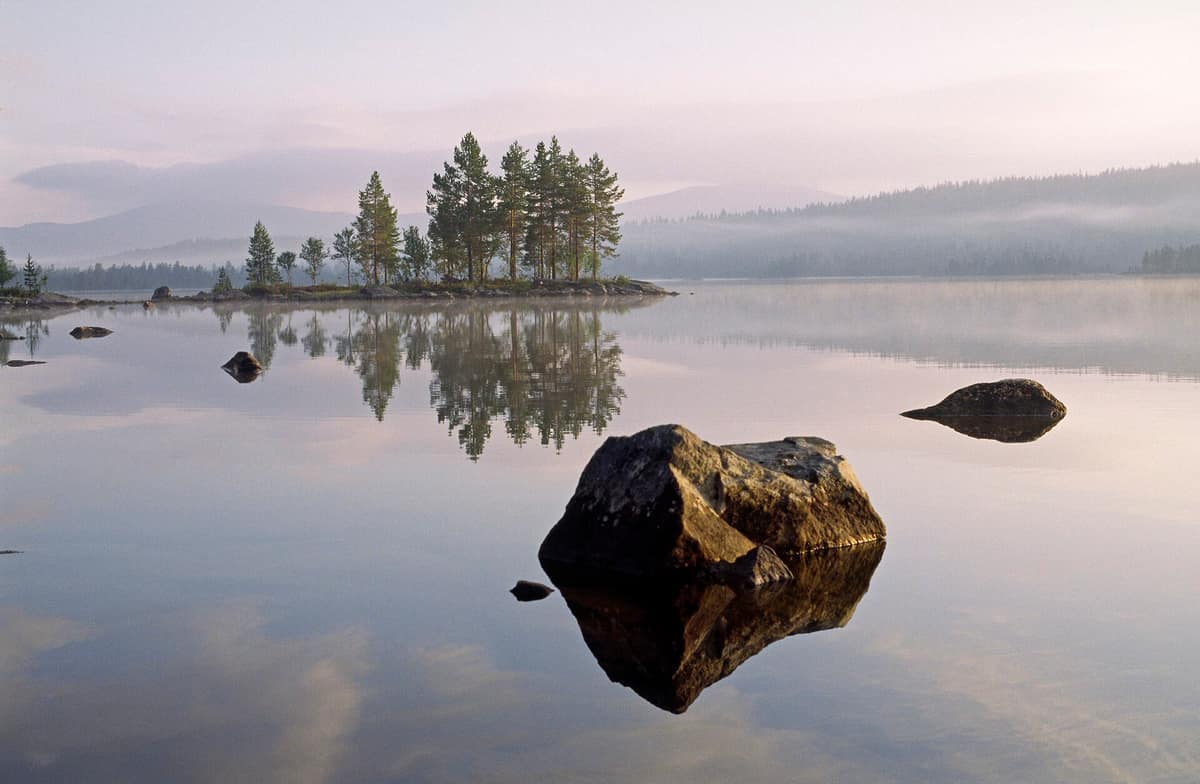
Gutulia National Park
Innlandet (Engerdal / Femundsmarka) · Norway
Photo: Peter Möllenkamp · CC BY-SA 3.0 · Wikimedia Commons
Norway's smallest National Park (23 km²), protecting an untouched primeval forest of Scots pine and centuries-old spruces.
Gutulia is Norway's smallest national park, and its compact scale means an entire wilderness is concentrated in very little space. Spanning just over 22 km² of spruces and Scots pines that have stood for centuries, fallen trunks teem internally with insects, fungi, and lichens, while tucked in one corner lies an unexpected cultural contrast: historic seter meadows dotted with timber cabins where livestock were brought to graze every summer for two centuries. It lies between Drevsjø and Elgå, east of Lake Femunden, touching the Swedish border.
What makes it unique
In a park of 22 km² you pass from primeval forest to an alpine seter meadow with historic log cabins.
The place
Nature
The landscape
This is a quintessential high-elevation taiga forest of eastern Norway: rising from 615 to 949 m, centered on Mount Gutulivola with Lake Gutulisjøen spreading to the west. The bedrock is predominantly nutrient-poor sandstone, so whatever grows here does so slowly and tenaciously. The flanks of Gutulivola support open pine woodland, yielding in lower basins to dense spruce forests cluttered with standing dead snags and fallen logs. Almost the entire park has never experienced commercial logging.
That distinction matters profoundly. Ancient forests provide far more ecological niches than managed commercial timberlands, and here they harbor numerous threatened species of fungi, lichens, plants, and fauna. Beardless and beard lichens drape from weathered branches; on the ground, decaying wood hums with hidden activity. Distinctive species include the Siberian jay, Eurasian three-toed woodpecker, wolf lichen, and bracket polypores. Every single tree in the park, living or dead, standing or fallen, enjoys total legal protection, with deadwood sheltering rare invertebrates and lichens.
Wildfire has also set its seal on this landscape: Gutulia has weathered natural forest fires repeatedly through the centuries, creating habitats vital to fire-adapted ecology.
Wildlife and seasons
One does not come here expecting great herds, but to listen in silence. The black woodpecker and inquisitive Siberian jay are the residents easiest to detect. Among common songbirds are the brambling, tree pipit, and willow warbler. Across the woodland wander most characteristic boreal creatures: moose, roe deer, red fox, pine marten, American mink, Eurasian beaver, and Eurasian otter. Brown bears make occasional appearances, while in summer the whistling wings of the common goldeneye echo over Lake Gutulisjøen and fortunate visitors may spot an osprey. Around one hundred bird species have been recorded, including willow ptarmigan and western capercaillie.
Wild reindeer disappeared from the district around 1880, but domestic reindeer belonging to the Southern Sami still roam these slopes: the entire area constitutes summer grazing pastures for the Svahken sitje, Norway's southernmost Sami reindeer-herding district. In spring, during calving, wildlife is exceedingly sensitive to human disturbance.
Species
With a page in the atlas
Being mentioned in a source doesn't guarantee sightings: check with the people who manage the area.
Memory and protection
History and conservation
The name derives from guttu, «path», and li, «forested slope»: historic traders navigated the frozen rivers and lakes with horse and sleigh toward the winter market in Røros. Later, beginning in the mid-eighteenth century, farming families from Lillebo and Sorken brought dairy cattle here every summer until 1949. Between 1975 and 1983, the 16 historic log cabins were restored using traditional log-building techniques.
The earliest conservation proposals for Gutulia, prompted by its ancient pine stands, date to 1916. The national park was officially established on 20 December 1968 encompassing around 18 km²; in 2004 it was expanded to protect its current 22,563 km². Following the expansion of tiny Ormtjernkampen into Langsua in 2011, Gutulia became Norway's smallest national park. Since 1990 its ecosystem has been monitored under the Terrestrisk naturovervåking national programme, tracking long-range transboundary air pollutants.
Before you set off
Visiting
How to visit
You can drive directly to the park trailhead beside Lake Gutulisjøen, which features parking, information boards, benches, and designated campfire sites. The historic Stallen barn houses an exhibition about the park. From there, a marked nature trail leads 3 km to Gutulisetra, the traditional mountain dairy meadow: roughly 45 minutes on foot.
At Gutulisetra begins more immersive exploring. An interpretive loop of 1,5 km with more than 20 stations highlights the giant spruce Storgrana, wolf lichens, wildlife traces, and pastoral history. At the upper hamlet of Oppåvollen, a small exhibit recounts seasonal seter life over 200 years, with an on-site summer host answering visitor queries. If you want panoramic views, Mount Jyltingsvola at 874 m lies just 3,8 km from Gutulisetra: its summit commands sweeping vistas across Femundsmarka to the north, Sweden to the east, and Mount Sølen to the west. The ascent starts from the bridge over the River Gutua, climbing steadily through ancient forest to the tundra crest.
Beyond these paths, the park maintains no manicured trails, allowing you to wander across untouched primeval forest on foot or touring skis wherever you please. In Elgå, the joint visitor centre for Femundsmarka and Gutulia features exhibitions on local heritage, Sami reindeer husbandry, and wildlife.
Before you go
Between 15 April and 15 September open campfires are prohibited, except in designated spots where fire spread is impossible; designated camping sites with firewood and dry toilets are situated along the southeastern shore of Lake Gutulisjøen. All timber, standing or dead, is legally protected. Dogs must be kept on a leash from 1 April to 20 August. Check ahead for summer dairy schedules, as facilities and guided tours vary from year to year.
Check access, rules and visiting conditions in the official information from the managing body before you set off.
Location
Where it is and how far it reaches
Boundary of Gutulia · IUCN II · © EEA, CDDA (CC-BY) The coordinate is estimated; it isn't a verified access point.
Transparency
Sources
The research data with its sources, and the official links for this place, are in the Spanish version of this page. See the Spanish version
Around it
About five kilometres away lies Femundsmarka National Park, with which it shares the visitor centre at Elgå. Further north, Urho Kekkonen National Park, Hamra National Park, and Muddus / Muttos National Park share with Gutulia three-toed woodpeckers and moose roaming old-growth boreal forest.
What else to explore nearby
Approximate straight-line distance between the edges of each area. It doesn't indicate access, routes or driving times.
- Femundsmarka National Park
Trøndelag and Innlandet Counties (Border with Sweden)
About 5 km away
A vast Arctic-alpine wilderness of boulder fields, ancient Scots pine forest, and an intricate labyrinth of canoeing lakes.
JFMAMJJASONDFebruary – March · July – September · Crowding very low
If you like this place, elsewhere in Europe
Distant places with uncommon wildlife and habitats in common. The most widespread species don't count. Sharing species doesn't imply a corridor or guaranteed presence.
- Urho Kekkonen National Park
Finnish Lapland (Saariselkä / Inari / Sodankylä)
In common: Perisoreus infaustus · Three-toed woodpecker · Moose — primary forest, wetland
Finland’s second largest national park (2.550 km²), rounded arctic tundra fell-tops (tunturi), and wild trekking under the shadow of Sokosti (718 m).
JFMAMJJASONDJune – April · Crowding low
- Skuleskogen National Park (High Coast of Sweden)
Västernorrland (Höga Kusten / Örnsköldsvik / Kramfors)
In common: Perisoreus infaustus · Three-toed woodpecker · Moose — old-growth forest
The heart of Sweden's High Coast (Höga Kusten), the site of the world's greatest post-glacial isostatic rebound (286 m of land uplift after the ice), featuring the Slåttdalssvackan canyon.
JFMAMJJASONDMay – October · Crowding low
- Hamra National Park
Gävleborg (Ljusdal / Fågelsjö)
In common: Three-toed woodpecker · Moose · Brown bear — primary forest, old-growth forest, wetland
An island of 400-year-old primeval coniferous forest with untouched bogs in the Orsa Finnmark region.
JFMAMJJASONDMay – October · Crowding very low
- Stabbursdalen National Park
Finnmark (Porsanger / Lakselv)
In common: Perisoreus infaustus · Moose · Brown bear — primary forest
Shelters the northernmost Scots pine forest (Pinus sylvestris) on Earth (Stabbursnes), tucked at 70° N along the shores of Porsangerfjorden.
JFMAMJJASONDJune – September · Crowding very low
Entry #587 of the original atlas.