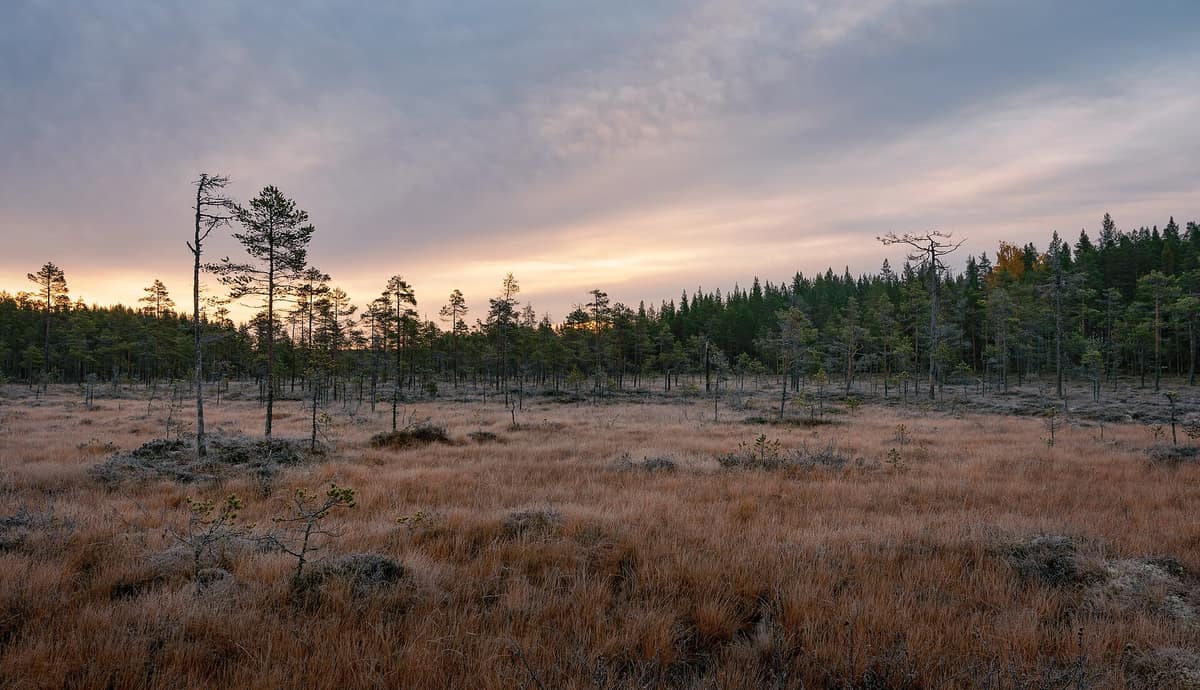
Hamra National Park
Gävleborg (Ljusdal / Fågelsjö) · Sweden
Photo: Kateryna Baiduzha · CC BY 4.0 · Wikimedia Commons
An island of 400-year-old primeval coniferous forest with untouched bogs in the Orsa Finnmark region.
It spans just over a thousand hectares, and almost half is an unbroken mire. Hamra is an intimate park best explored at a slow pace: an old-growth coniferous forest with pines exceeding 400 years old, a meandering stream never cleared for log-driving, and an open peatland crossed via two-plank boardwalks. It lies within the Orsa Finnmark region of Gävleborg County.
Established in 1909 with barely 28 hectares, the park was expanded in 2011, gaining three new gateways and marked trails. Its core mission is protecting what remains hidden from afar: ancient woodland, intact wetlands, and naturally flowing waterways.
What makes it unique
Nearly half the park is a continuous expanse of mire untouched by roads or ditches, and the stream draining it flows as freely as ever.
The place
Nature
The landscape
The original core is a moraine knoll cloaked in forest of 19.5 hectares, framed by mires and, to the north, Lake Svansjön. Around it, nearly half the enlarged park forms a single wetland matrix of bogs, brooks, tarns, and swamp forests. All of this drains through the Svartån, whose meandering valley, surrounded by old-growth forest, was never cleared for timber-floating before meeting the Voxnan River.
The Svartån takes its name from water darkened by peat humus, appearing almost black above red riverbed stones. A ten-minute stroll from the Svartå entrance leads to a bridge over its largest rock pool, scoured by meltwater during the last Ice Age. It is one of very few streams in the region preserved without modification for timber transport.
In the park Norway spruce dominates, its boughs festooned with old man's beard, an indicator lichen of ancient forests.
Wildlife and seasons
Hamra does not boast endless species tallies; the striking exception is insects, with 450 beetle species documented in the virgin forest. What it excels at are classic mire spectacles.
In April, the viewing tower at the Myr entrance offers vistas of black grouse displaying in their spring lek, while arriving common cranes echo their calls across the peatland. Down along the Svartån, polished riverside rock ledges invite a quiet rest to watch for Eurasian otter and white-throated dipper in the eddies. Overhead, pines make up close to 90 % of the forest canopy, with many giants exceeding 300 years of age.
Species
With a page in the atlas
Being mentioned in a source doesn't guarantee sightings: check with the people who manage the area.
Memory and protection
History and conservation
Following its 2011 expansion, the national park absorbed the former nature reserves of Långsvedjan, Svartågrenen, and Svartåvallen.
Before you set off
Visiting
How to visit
The three entrances are Main (North), Myr (Central), and Svartå (South), each equipped with dry toilets, fire rings, and picnic benches. The main entrance is reached from the E45 highway via an eastward turning at Fågelsjö, followed by about 5 signposted kilometres; a gravel road connects it to Svartå via Myr.
Trails cater to different desires. The virgin forest loop, Urskogsslingan, departs from the main entrance and takes about an hour; at 2.5 km a shortcut allows a briefer walk. Its first 500 metres to the Svansjön viewing platform feature a wide wooden boardwalk fully accessible for wheelchairs and strollers, offering insights into the lake's history and wildlife.
The open mire circuit takes an hour on two-plank boardwalks across damp peat; from the Myr entrance lookout starts Långa myrslingan (3 kilometres), while from the main entrance starts Lilla myrslingan (2.5 km). Långa myrslingan traverses the heartland of black grouse, cranes, and vibrant sphagnum carpets.
The greatest traverse is Hamraleden, crossing the entire national park in roughly six hours, recommended starting from the Svartå entrance. Sections require boulder-scrambling and river wading, demanding sturdy boots, including an unbridged crossing of the Svartån.
Before you go
Camping is prohibited in the original core area, as is damaging or removing plants, mosses, lichens, and dead or living trees. Outside the historic core, you may camp for up to two consecutive nights in one spot, out of sight of park entrances and trails. Foraging berries, edible mushrooms, and flowers for personal use is permitted. Off-trail, beware of quaking bogs: floating moss carpets can give way underfoot into deep water. Landing aircraft requires permission from the Gävleborg County Administrative Board.
Check access, rules and visiting conditions in the official information from the managing body before you set off.
Location
Where it is and how far it reaches
Boundary of 2000933 Hamra · IUCN II · © EEA, CDDA (CC-BY) The coordinate is estimated; it isn't a verified access point.
Transparency
Sources
The research data with its sources, and the official links for this place, are in the Spanish version of this page. See the Spanish version
Around it
Hamra shares ecological affinities with distant protected areas. Gutulia National Park, Muddus / Muttos National Park, and Urho Kekkonen National Park all feature moose, brown bear, Eurasian three-toed woodpecker, and old-growth boreal forest mosaic. The Białowieża Strict Reserve similarly shares primeval woodland, bear, and three-toed woodpecker.
If you like this place, elsewhere in Europe
Distant places with uncommon wildlife and habitats in common. The most widespread species don't count. Sharing species doesn't imply a corridor or guaranteed presence.
- Gutulia National Park
Innlandet (Engerdal / Femundsmarka)
In common: Three-toed woodpecker · Moose · Brown bear — primary forest, wetland, old-growth forest
Norway's smallest National Park (23 km²), protecting an untouched primeval forest of Scots pine and centuries-old spruces.
JFMAMJJASONDJune – September · Crowding very low
- Muddus / Muttos National Park
Swedish Lapland / Norrbotten (Gällivare / Jokkmokk)
In common: Three-toed woodpecker · Moose · Brown bear — primary forest, wetland, old-growth forest
The pristine realm of boreal taiga and untouched peatlands in Laponia (UNESCO World Heritage), famous for pines over 700 years old that survived historical forest fires.
JFMAMJJASONDJune – September · Crowding very low
- Urho Kekkonen National Park
Finnish Lapland (Saariselkä / Inari / Sodankylä)
In common: Three-toed woodpecker · Moose · Brown bear — primary forest, wetland
Finland’s second largest national park (2.550 km²), rounded arctic tundra fell-tops (tunturi), and wild trekking under the shadow of Sokosti (718 m).
JFMAMJJASONDJune – April · Crowding low
- Skuleskogen National Park (High Coast of Sweden)
Västernorrland (Höga Kusten / Örnsköldsvik / Kramfors)
In common: Three-toed woodpecker · Moose · Brown bear — old-growth forest
The heart of Sweden's High Coast (Höga Kusten), the site of the world's greatest post-glacial isostatic rebound (286 m of land uplift after the ice), featuring the Slåttdalssvackan canyon.
JFMAMJJASONDMay – October · Crowding low
Entry #590 of the original atlas.