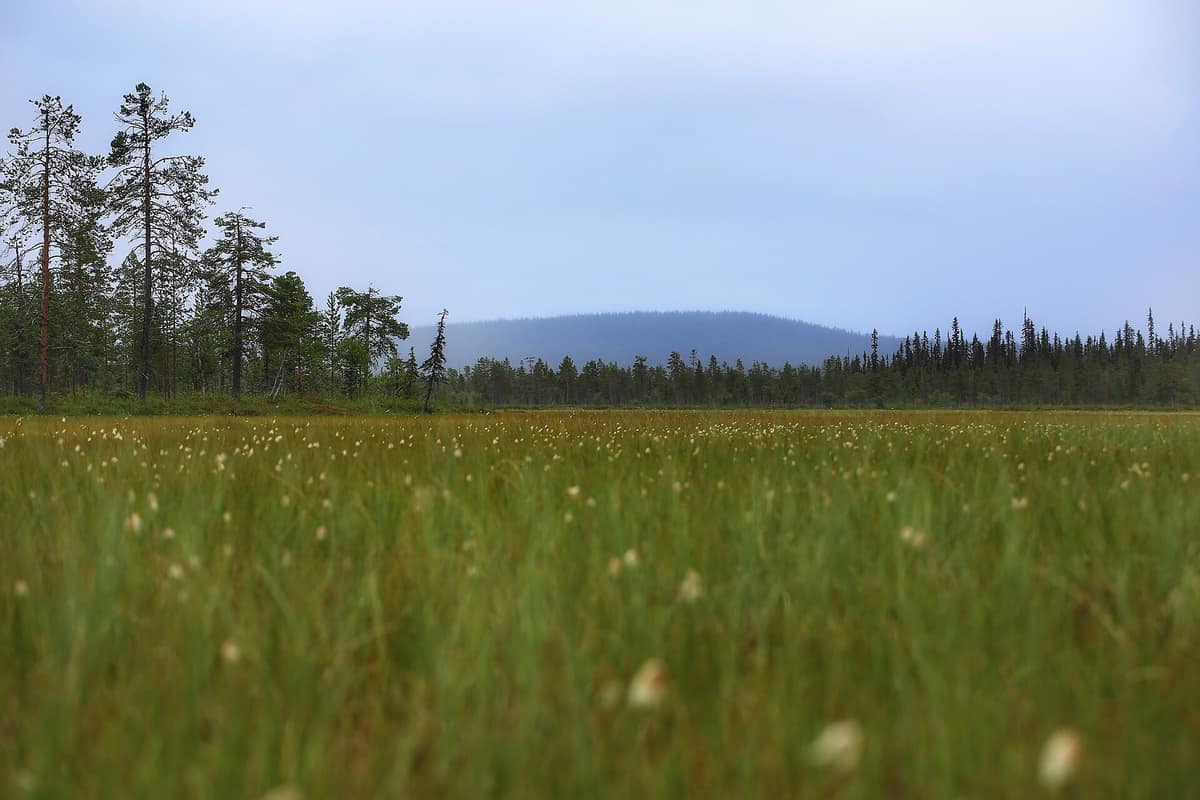
Muddus / Muttos National Park
Muddus National Park
Swedish Lapland / Norrbotten (Gällivare / Jokkmokk) · Sweden
Photo: Jojoo64 · CC BY-SA 4.0 · Wikimedia Commons
The pristine realm of boreal taiga and untouched peatlands in Laponia (UNESCO World Heritage), famous for pines over 700 years old that survived historical forest fires.
Nearly half of Muddus is mire. Keep that in mind when you look at the map: this national park in Swedish Lapland, lying east of the high mountain chain between Jokkmokk and Gällivare, is not a sequence of alpine summits but a wilderness mosaic of still water, coniferous woodland, and open heath, studded with old-growth pine forests and sudden deep gorges. The Sámi call it Muttos. It has been a national park since 1942, and today forms an integral component of the Laponia World Heritage site.
What makes it unique
An ancient forest of giant pines, criss-crossed by immense mires, cascading waterfalls, and deep ravines.
The place
Nature
The landscape
The foundation is Precambrian granite. Over this bedrock, glacial ice sculpted everything else. As the continental ice sheet receded, violent torrents of meltwater gouged the Måskosgårsså canyon, a steep-sided, dry chasm that opens abruptly in the middle of the woods. Sinuous esker ridges, formed along the tail of retreating glaciers, still snake across the Muttos landscape.
This forest is far from uniform. Stunted pine woods grow on nutrient-poor sandy soils, while wetter spruce mire forests prove considerably more productive. In these damp spruce stands, understorey flora flourishes: here grow the calypso orchid (norna) and ghost orchid (skogsfru), the latter a rare inhabitant of ancient spruce groves that can remain dormant underground for years without flowering. The open mires shelter another botanical rarity, the yellow marsh saxifrage (myrbräcka).
To the south, the Muttosälven River drains into the Stora Luleälv. In the park's heart, the Muddusfallet or Muttosagahtjaldak waterfall plunges 42 metres over a sheer rock shelf.
Wildlife and seasons
The expansive open mires provide your best opportunity to spot moose and reindeer: you are far more likely to observe them out on the open bogs than hidden within dense timber. Nesting waterbirds on the mires include whooper swans, bean geese, and northern pintails.
The ancient taiga harbours its own treasures. The European pine marten and western capercaillie maintain strongholds here that are unusually robust for Lapland. Regularly observed mammals include stoats, weasels, and the Eurasian otter. Among birds of prey and owls, northern goshawks, hen harriers, short-eared owls (jorduggla), and great grey owls (lappuggla) appear consistently.
Inspect the older pine trunks as you hike: distinct rectangular scars tell of historical bark-harvesting by Sámi people, who gathered the nutrient-rich inner bark for food and storage.
Fire ecology has its own living exhibit here. The last major wildfire struck in 2006; from the Skájdde trailhead, a walk of a couple of kilometres brings you into the burn zone, where you can watch the slow natural regeneration of the boreal forest. The prime visiting season runs from June to September; in winter, Nordic skiers travel between wilderness huts.
Species
With a page in the atlas
Being mentioned in a source doesn't guarantee sightings: check with the people who manage the area.
Memory and protection
History and conservation
In the mid-nineteenth century settlers cleared virgin ground to establish a homestead near Lake Muddusjaure. The settlers persevered for a little over fifty years in this demanding subarctic climate before the homestead was finally abandoned in 1909. Sámi reindeer herders, for their part, historically fitted bells to their animals; without bells, locating reindeer within the dense taiga would have been impossible.
Key conservation decisions in the Laponia World Heritage area are reached through consensus. The Natura management plan for Muddus focuses on preserving undisturbed habitats for breeding, resting, and foraging birds, preventing human disturbances from degrading wilderness conditions.
Before you set off
Visiting
How to visit
The main park entrance is Skájdde, accessible from Jokkmokk along the E45 highway. Facilities there include interpretive panels, campfire pits, compost toilets, boardwalks, and ramps, forming an accessible modern gateway. The waterfall lies seven kilometres from the trailhead. Alternative eastern access points are at Sárggavárre and Urtimjaur (Urdávrre), just off the Messaure road.
There are two primary trail loops. The shorter Muttosleden trail leads past the waterfall and the sheer Måskosgårsså canyon. The longer circuit, Muttosbálges or Muddusleden, connects the waterfall with Muttosluoppal, Manson, Nammavárre, and Måskosgårsså. From the observation tower at Muttosluoppal you look out over lakes, peatlands stretching for kilometres, and distant mountain peaks. The trail by Manson passes a small red wilderness cabin through pine heaths and primeval woods marked by thousands of years of human passage.
The regional visitor centre is Naturum Laponia at Viedásnjárgga inside Stora Sjöfallet. It illuminates the mountains, forests, wetlands, and seasonal cycles of Laponia, highlighting the central role of reindeer in Sámi culture. It provides guided walks, binocular rentals, and fully accessible exhibitions.
Before you go
Intentionally disturbing grazing reindeer or interfering with the work of Sámi herders is strictly prohibited, as is leaving litter. The access road to Skájdde may be temporarily closed during spring and early summer thaw when the roadbed softens. Always consult Laponia management notices before visiting. The Naturum operates on a spring and summer schedule through September.
Check access, rules and visiting conditions in the official information from the managing body before you set off.
Location
Where it is and how far it reaches
Boundary of Muddus · IUCN II · © EEA, CDDA (CC-BY) The coordinate is estimated; it isn't a verified access point.
Transparency
Sources
The research data with its sources, and the official links for this place, are in the Spanish version of this page. See the Spanish version
Around it
Muddus shares Laponia World Heritage status with Sarek, Stora Sjöfallet, and Padjelanta, but shared heritage does not mean contiguity, and the park has no immediate neighbours within the atlas. It does, however, share close ecological parallels: Gutulia National Park, Hamra National Park, and Urho Kekkonen National Park all feature three-toed woodpecker, moose, brown bear, primary taiga, and intact mires. Białowieża National Park - Strict Reserve shares the three-toed woodpecker, brown bear, and primeval woodland ecosystem.
If you like this place, elsewhere in Europe
Distant places with uncommon wildlife and habitats in common. The most widespread species don't count. Sharing species doesn't imply a corridor or guaranteed presence.
- Gutulia National Park
Innlandet (Engerdal / Femundsmarka)
In common: Three-toed woodpecker · Moose · Brown bear — primary forest, wetland, old-growth forest
Norway's smallest National Park (23 km²), protecting an untouched primeval forest of Scots pine and centuries-old spruces.
JFMAMJJASONDJune – September · Crowding very low
- Hamra National Park
Gävleborg (Ljusdal / Fågelsjö)
In common: Three-toed woodpecker · Moose · Brown bear — primary forest, wetland, old-growth forest
An island of 400-year-old primeval coniferous forest with untouched bogs in the Orsa Finnmark region.
JFMAMJJASONDMay – October · Crowding very low
- Urho Kekkonen National Park
Finnish Lapland (Saariselkä / Inari / Sodankylä)
In common: Three-toed woodpecker · Moose · Brown bear — primary forest, wetland
Finland’s second largest national park (2.550 km²), rounded arctic tundra fell-tops (tunturi), and wild trekking under the shadow of Sokosti (718 m).
JFMAMJJASONDJune – April · Crowding low
- Skuleskogen National Park (High Coast of Sweden)
Västernorrland (Höga Kusten / Örnsköldsvik / Kramfors)
In common: Three-toed woodpecker · Moose · Brown bear — old-growth forest
The heart of Sweden's High Coast (Höga Kusten), the site of the world's greatest post-glacial isostatic rebound (286 m of land uplift after the ice), featuring the Slåttdalssvackan canyon.
JFMAMJJASONDMay – October · Crowding low
Entry #576 of the original atlas.