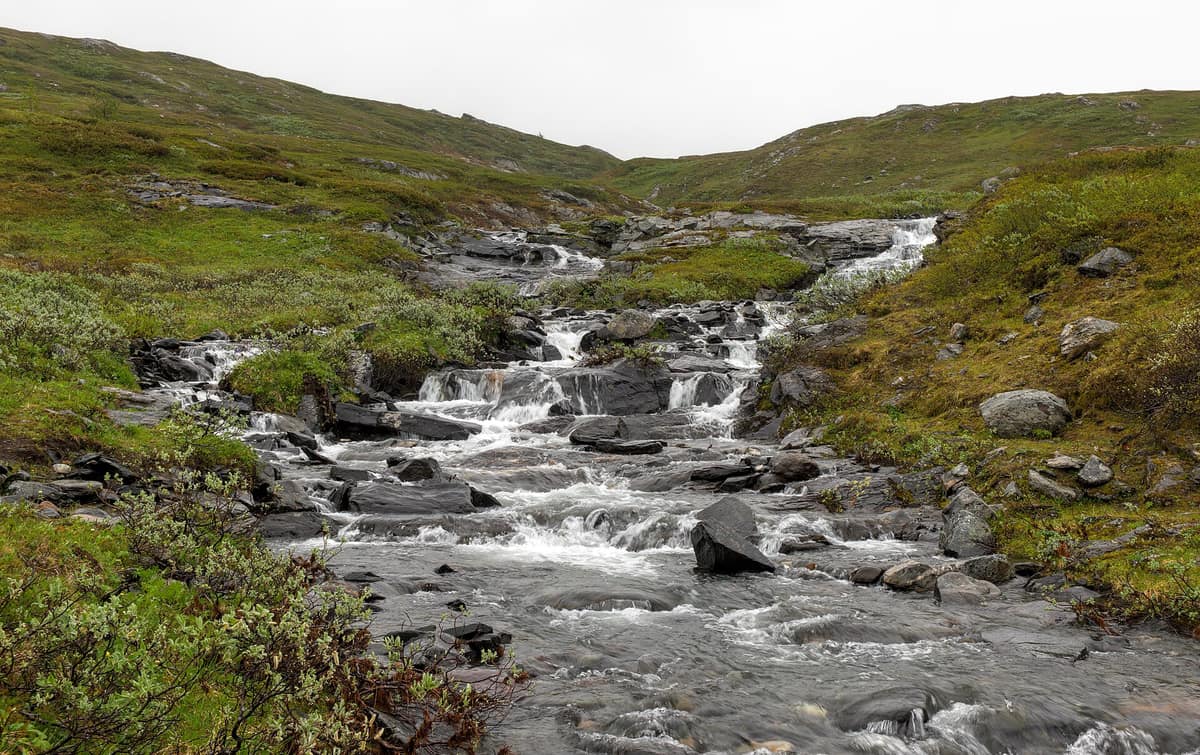
Padjelanta National Park
Swedish Lapland / Norrbotten (Jokkmokk / Kvikkjokk) · Sweden
Photo: Trougnouf (Benoit Brummer) · CC BY 4.0 · Wikimedia Commons
Sweden's largest national park (198.000 ha), featuring vast alpine lakes Vastenjaure and Virihaure and ancestral Sami grazing lands.
Padjelanta translates to "the higher land", and the name says it all. Instead of sharp peaks piercing the sky, you find a vast rolling plateau of gentle hills surrounding two unusually large lakes, Vastenjávrre and Virihávrre, nearly all lying above the treeline. It is Sweden's largest national park and forms part of the Laponian Area World Heritage site.
It is also a destination demanding ample time: located in roadless wilderness in the mountains of Jokkmokk, it is traversed by the Padjelantaleden, a summer trail of some 160 kilometres running between Kvikkjokk and Ritsem.
What makes it unique
Its limestone plateau holds a record for lower plants of the Swedish mountains and Sweden's most remote point from civilization.
The place
Nature
The landscape
The landscape is open and gently undulating, characterized by soft hills and few high summits, in contrast to alpine Sarek bordering it to the east. Almost the entire park lies above the tree limit: mountain birch forms only a modest forest of 1.400 hectares in the northeastern corner. All else is heathland, wetland, tundra, and lakes.
The flora is the supreme attraction. The limestone substrate, abundant precipitation, and late-melting snow foster vegetation rare elsewhere in the Swedish fells, and this exceptional botanical wealth prompted the park's designation in 1962. More than 400 species of lower plants have been catalogued—a record in the Swedish mountains—while Potentilla robbinsiana and Arenaria humifusa grow nowhere else in Sweden. A 2023 survey recorded ten lichens new to the country and 98 new to the Lule lappmark region.
Wildlife and seasons
Mammals are scarce and mostly maintain modest populations: primarily lemmings and caribou, along with the predators sustained by them—the wolverine and the Arctic fox, both permanent residents. During lemming peak years, one might even sight the snowy owl, an uncommon visitor to Padjelanta.
Birdlife tells a vastly different story: the avifauna is exceptionally diverse. Across the moorlands, European golden plovers, meadow pipits, and northern wheatears are hallmarks, accompanied by rock ptarmigans, Eurasian dotterels, and whimbrels. Lakes host teeming waterfowl such as long-tailed ducks and common teals, beside waders like red-necked phalaropes, ruffs, and wood sandpipers. Scattered throughout the expanse hunt gyrfalcons, golden eagles, white-tailed eagles, rough-legged buzzards, and long-tailed jaegers.
The seasonal rhythm is governed by flowers and reindeer. The floral bloom encircling Lake Virihávrre is among the most lavish in the Scandinavian mountains. Reindeer cows calve across the plains flanking the lakes in late May, and the first three weeks of July mark the peak period of reindeer herding: hikers are best advised to avoid the route when possible. Reindeer graze here throughout the summer; the ideal period to trek the route is from July to September.
Species
With a page in the atlas
Being mentioned in a source doesn't guarantee sightings: check with the people who manage the area.
Memory and protection
History and conservation
The area has witnessed habitation since the Stone Age, as attested by numerous hunting pit systems, while various petroglyph panels document an enduring Sami heritage. Everywhere across the terrain linger remnants of past life: hearths, turf hut foundations, and pit traps.
Today, three Sami reindeer-herding communities—Duorbun, Jåhkågasska, and Sirges—graze their herds here in summertime, based at traditional summer settlements in Stáloluokta, Árasluokta, and Sállohávrre. Many verdant meadows were historic reindeer milking enclosures, hosting plant communities extraordinarily rich in species. In the Tarra valley lies Basseuksa, the "sacred gateway", one of Sweden's most revered Sami sacred sites; out of cultural respect, visitors should refrain from approaching too closely.
Before you set off
Visiting
How to visit
Three primary access points exist. From the south, Kvikkjokk serves as the finest trailhead, located roughly 120 km from Jokkmokk. From the north, you take a boat across Lake Áhkkájávrre from Ritsem, followed by a half-day trek to the park boundary. To commence in the interior, regular helicopter flights connect both Kvikkjokk and Ritsem with Stáloluokta.
The Padjelantaleden is a summer path equipped with bridges and boardwalks, offering wilderness cabins every 10 to 20 kilometres. Daily stages span between six and 23 kilometres. Near Stáloluokta, a rewarding day hike ascends Unna Dijdder past the kyrkkåta chapel, winding through mountain avens and wild orchids to summits revealing Norwegian massifs to the west, Sulidälbmá to the south, and Sarek to the east. Jiegŋáffo, the park's highest summit, is famed among botanists for rare blooms and attracts reindeer on warmer days to its snowfields and glacier.
Between Gisuris and Låddejåhkå two trails diverge: the newer route following the Vuojatädno, and the older route traversing Mount Njierek with commanding panoramas over the great lakes and Sarek's jagged peaks. From Stáloluokta, you can also follow the Nordkalottleden southward to Stáddajåhkå and mount gentle terraces up to Stáddátjåhkkå amid expanses of mountain avens.
Before you go
Bringing dogs is strictly prohibited during summer and autumn. Dry composting toilets are provided at cabin sites along the trail, and river and stream water is generally clean and potable. The Padjelantaleden is strictly a summer trail: no markers remain discernible once winter snow blankets the terrain.
Check access, rules and visiting conditions in the official information from the managing body before you set off.
Location
Where it is and how far it reaches
Boundary of Padjelanta · IUCN II · © EEA, CDDA (CC-BY) The coordinate is estimated; it isn't a verified access point.
Transparency
Sources
The research data with its sources, and the official links for this place, are in the Spanish version of this page. See the Spanish version
Around it
Three national parks border Padjelanta within a single kilometre: Rago, Sarek, and Stora Sjöfallet. Slightly further lies Junkerdal. Among more distant sanctuaries, Helagsfjället, Dovrefjell-Sunndalsfjella, and Hardangervidda share the Arctic fox, reindeer, alpine fell habitat, and mountain tundra with Padjelanta, while Pallas-Yllästunturi similarly shares the Arctic fox, reindeer, and alpine terrain.
What else to explore nearby
Approximate straight-line distance between the edges of each area. It doesn't indicate access, routes or driving times.
- Rago National Park
Nordland (Sørfold / Nordfold)
About 1 km away
An extremely dramatic bare-granite alpine canyon adjoining Padjelanta and Sarek in Sweden, forming a wild transboundary complex of 7,400 km².
JFMAMJJASONDJuly – September · Crowding very low
- Sarek National Park - Europe's Last Great Wilderness
Swedish Lapland / Norrbotten (Jokkmokk / Kvikkjokk / Ritsem)
About 1 km away
Peaks, glaciers, and the Ráhpavuobme valley in Sarek National Park, part of the Laponia World Heritage site.
JFMAMJJASONDJuly – September · Crowding very low
- Junkerdal National Park
Nordland (Saltdal / Fauske / Junkerdal)
About 21 km away
Renowned internationally for harboring one of the richest arctic-alpine and karst floras in the entire Arctic, thanks to its soft limestone bedrock.
JFMAMJJASONDJuly – September · Crowding very low
If you like this place, elsewhere in Europe
Distant places with uncommon wildlife and habitats in common. The most widespread species don't count. Sharing species doesn't imply a corridor or guaranteed presence.
- Dovrefjell-Sunndalsfjella National Park
Innlandet / Trøndelag / Møre og Romsdal (Dombås / Oppdal / Sunndalsøra)
In common: Arctic fox · Caribou — high mountain, alpine meadow
The ancestral realm of the muskox (Ovibos moschatus), the only place in continental Europe holding wild herds of this Ice Age giant crowned by Mount Snøhetta (2,286 m).
JFMAMJJASONDJune – September · Crowding low
- Pallas-Yllästunturi National Park
Finnish Lapland (Enontekiö / Kittilä / Kolari / Muonio)
In common: Arctic fox · Caribou — high mountain
Finland's most visited national park (1.020 km²), a chain of tundra fell hills (tunturi) hosting the cleanest air measuring station on Earth (Sammaltunturi).
JFMAMJJASONDJune – September · December – April · Crowding moderate
Entry #575 of the original atlas.